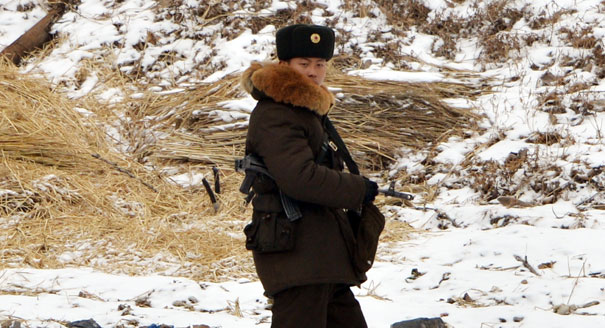
Imagine you are the leader of a country with nuclear weapons. You know that three of your country’s neighbors also possess nuclear deterrence. Then one day you find out that another neighbor has nuclear ambitions. This country has been your protégé for six decades. But it is a peculiar relationship because you are ashamed of bragging about it at home or abroad. The protégé is a hereditary personal dictatorship.
The question is: Would you give your blessing to the protégé’s nuclear ambitions or would you try your best—on your own or in cooperation with the international community—to prevent your apprentice from acquiring nuclear weapons? The choice should be a no-brainer. Any sensible leader would not want another nuclear power on its border, especially one ruled by a dictatorship. Yet, China seems to have chosen the opposite path of turning a blind eye to the nuclear ambitions of its protégé, North Korea.
North Korea has conducted three nuclear tests—the first in 2006, a second in 2009, and the last in February of this year. China’s Ministry of Foreign Affairs stated that it was “strongly dissatisfied” with and “firmly opposed” to the latest test. The test site was reportedly less than 70 kilometers away from the Chinese border, alarming millions of residents in northeast China. The Chinese Ministry of Environmental Protection released several statements after the nuclear test to reassure residents that no radioactive particles had been detected in aerosol samples collected in the northeast region.
North Korea has decided to repay China’s support by endangering millions of Chinese citizens’ lives with potential nuclear fallout, or even a nuclear apocalypse. This signifies the utter failure of China’s North Korea policy.
The most important reason for China’s commitment to supporting the North Korean regime appears to be Pyongyang’s geopolitical value. North Korea could serve as a buffer zone between China and U.S. troops stationed in South Korea. This kind of strategic thinking led China to enter the Korean War in 1950, sending millions of troops across the Sino-Korean border to drive U.S.-led UN forces from northern territory.
However, many far-reaching changes since the Korean War have rendered the U.S. military presence on the Korean Peninsula much less menacing, which has significantly reduced North Korea’s strategic value to China. For instance, in 1964 China detonated its own atomic bomb, and in 1979 U.S.-Chinese relations were normalized and ties between the two countries have been rapidly growing. Additional changes that tipped the balance were the democratization of South Korea, the end of the Cold War, and the rise of China as an economic and military power. In light of Beijing’s much-improved security environment in northeast Asia, the reasons for China’s continued pandering to North Korea are not clear.
Another reason that China may be supporting North Korea is to prevent regime collapse. The potential influx of North Korean refugees into northeast China could develop into a humanitarian crisis of unprecedented scale. That could destabilize a region that is home to one of China’s most important agricultural and industrial bases.
While China’s concerns about North Korean refugees are legitimate to a degree, they do not justify Beijing’s unconditional support for Pyongyang.
China may not be the primary destination for North Korean refugees. South Korea has the benefit of sharing the same language as North Korea, and compared to China’s political system, South Korea provides the additional appeal of an open democracy.
In addition, the other major regional powers (the United States, South Korea, and Japan) cannot afford a destabilized northeast Asia, which is home to the world’s second- and third-largest economies. Together, China and the other major regional powers have more than enough resources to manage a crisis of such a scale.
China’s continued support of the North Korean regime may also stem from historical memory of the Korean War. The war cost more than half a million Chinese lives. Some Chinese believe that abandoning North Korea may mean all those lives were sacrificed in vain.
While China’s security environment in 1950 may have justified intervention in the war, times are changing, and it is neither necessary nor desirable to back the current North Korean regime. To allow this legacy to dictate China’s current North Korea policy is to swim against the tide of history.
Further complicating this policy is the fact that North Korea may be a useful strategic buffer for China, but Beijing needs to factor in whether Pyongyang is willing to play the role of pawn in another country’s chess match. China’s decision to normalize relations with South Korea and its full embrace of the capitalist road with nominally socialist characteristics may have deeply upset and alienated the North Korean leadership. It is difficult to believe that North Korea would happily offer itself on the altar of Chinese interests. More importantly, after living under the shadow of the Chinese empire for hundreds of years, the nationalist North Koreans have many reasons to be resentful and suspicious of the patronizing Chinese.
If China continues to view North Korea as a buffer state, then Pyongyang is in the position to ransom Beijing for political and economic support. To frame the current relationship more vividly, North Korea is the tail wagging the Chinese dog. China has little unilateral leverage over North Korea, which may be why Beijing is eager to restart the Six-Party Talks on Pyongyang’s nuclear program. But the Chinese have only themselves to blame.
It is time for China to let go of North Korea. Close association with such a regime does not provide any benefit to China’s national interests and international reputation. Moreover, Beijing should actively work with the international community to denuclearize the Korean Peninsula. Having an unpredictable, ungrateful, and totalitarian regime armed with nuclear weapons is the last thing China wants on its border.
Xie Tao is an associate professor at Beijing Foreign Studies University.
This article was published as part of the Window into China series