Excerpts
Introduction
“Despite the passing of years since [the attack on Mumbai in] 2008, Indian national security elites still struggle with how to effectively respond to the threats posed by terrorism emanating from Pakistan.”
—p. 4
“‘We don’t have empirical evidence that force will motivate them to change,’ a recently retired high-ranking Air Force officer acknowledged, ‘but the theory is to keep raising the costs, and over time they will change.’”
—p. 11
“No theories in the existing international literature or in other states’ practices offer guidance as to how India could most effectively proceed. Studies of strategies and tactics to deter and defeat terrorism have not addressed situations in which the major antagonists possess nuclear weapons. Theories and case studies of nuclear deterrence and escalation management in a nuclearized environment have not involved cases where terrorists with ambiguous relationships to one of the state antagonists are the instigators of aggression and the ‘unitary rational actor’ model may not apply.”
—p. 15
Chapter 1: The Decision-Making Setting
“Remarkably, Indian authorities have not articulated any comprehensive strategy, nor rigorously analysed and debated the resources and methods they could feasibly acquire and deploy in order to motivate Pakistani leaders to curtail the terrorist threat.”
—p. 28
“‘It’s a Rubik’s cube—dealing with Pakistan’, a former Indian national security advisor offered in a November 2014 interview. ‘You keep fiddling with the squares, and as you move one set, others are affected or become problems. You don’t have a solution.’”
—p. 38
“‘They can’t stop everybody. But we need to know they are trying—whether it’s through private communications or whatever—that they are taking measures against LeT and others.’”
—p. 42
Chapter 2: Proactive Strategy
“While Cold Start’s deterrent effects on Pakistan were ambiguous at best, it did provide a handy justification for Pakistani military leaders to call for more intensive production of nuclear weapons with a new emphasis on battlefield systems that could counter India’s putative proactive capabilities and doctrine.”
—p. 78
“Indian scholars offer relatively few ideas about exactly how and why limited conventional operations on Pakistani territory would motivate Pakistani authorities to change their policy and demobilize anti-India groups rather than escalate the conflict.”
—p. 83
“Well-informed Indian civilian experts doubt the feasibility of the proposed strategy. As one put it in a 2014 interview, ‘There is no theory of how Cold Start or any other military action would compel the Pakistanis to dismantle the terrorist infrastructure. You have to negotiate with the Pakistanis to close the camps.’”
—p. 87
“Positing a doctrine that threatens to take Pakistani territory plays directly into the Army’s preferred narrative and helps justify its predominance within Pakistan.”
—p. 92
Chapter 3: Air Power
“Limited punitive air strikes also would put India into a league with the US and Israel as ‘hard’, militarily-capable democracies determined to combat terrorism. . . . The US and Israeli experiences show that punitive air strikes often have not solved the problems they were meant to address.”
—p. 105
“Both Indian and Pakistani defence officials and experts consider attacks on non-state targets in Kashmir as inherently less provocative. . . . Yet, few Indians or Pakistanis believe that attacking terrorist targets in Kashmir would cause Pakistani officials to change their policies.”
—p. 106, 108
“The value of going after specific leaders depends on the retaliator’s theory of how the target’s death would affect the future.”
—p. 112
“India would have to mobilize elements of its Army and other services to deter and/or blunt reprisals by Pakistani forces. This mobilization would add time between the initial terrorist attack on India and even limited, punitive Indian air strikes on Pakistan. India’s mobilization also would warn Pakistan, attenuating the element of surprise.”
—p. 117
“‘India is not Israel,’ a former high-ranking Pakistani general said, ‘and we are not the Palestinians. It’s not so one-sided. If India conducts air strikes on Pakistan, there will be serious escalation.’”
—p. 118
Chapter 4: Covert Operations
“Covert operations may be attractive if the alternative choices are to do nothing or to conduct major conventional military operations on the ground, in the air, and/or at sea.”
—p. 150
“‘You need political credit at home to be seen doing something,’ he said. ‘But to be effective, what you do should not be visible…. So the two imperatives work in opposite directions: the need for visible use of force, versus the effectiveness of covert force. If you want them to change what they are doing, you have to act secretly so they can save face when they change policy.’”
—p. 163
“The records of states that have relied heavily on covert actions—the US, Israel, Pakistan among them—offer clear warnings that even tactical successes often do not yield strategic gains.”
—p. 168-9
Chapter 5: Nuclear Capabilities
“Interest in altering India’s nuclear policy comes generally from a perception that, in the pointed words of retired Indian Air Marshall Brijesh Jayal, the nuclear doctrine is ‘good in theory, but not credible in practice.’”
—p. 189
“Pakistan’s acquisition of short-range nuclear weapons that it asserts can be used on the battlefield has compounded India’s dilemmas. These Pakistani capabilities further frustrate India’s efforts to put conventional rungs on the escalation ladder below the nuclear threshold.”
—p. 198
“India’s current nuclear doctrine and posture are fundamentally sufficient as long as Indian leaders believe they will not authorize the Indian Army to make major thrusts into Pakistani territory, or the Air Force to conduct major missile or bombing missions against the Pakistani heartland in response to a terrorist attack.”
—p. 216
“Though there may be reasons that India would adjust its nuclear policy as its capabilities evolve and the deterrence environment changes, the answer to India’s strategic challenge from Pakistan are unlikely to be found at this level.”
—p. 218
Chapter 6: Non-Violent Compellence
“If India could muster support in the US for cutting security assistance, and support in the EU, Japan, and Australia for curtailing economic assistance, this could raise the costs of the Pakistani security establishment’s unwillingness to demobilize anti-India groups.”
—p. 241
“India has strengths to draw upon. The growing size of the Indian market for foreign goods and services—especially as reforms are implemented—provides leverage. India’s soft power resources continue to grow: India’s campaign to promote regional infrastructure connectivity, the appeal of Bollywood, the state’s capacity to manage free and fair elections on a tremendous scale. These are just some assets that build India’s credibility as a positive actor. Social media techniques amplify their potency and reach.”
—p. 254
“Non-violent compellence is less risky and can be more cost-effective than conventional military operations and the more robust forms of covert operations. But this does not mean that the effects will be potent enough to change the Pakistani security establishment’s behaviour. Still, one advantage of non-violent action compared with violence is that its effects can be tested at little risk and cost.”
—p. 257
“It is to India’s advantage to exploit Pakistan’s self-made vulnerabilities and avoid playing to its relative strengths—military capabilities, including nuclear.”
—p. 258
Conclusion
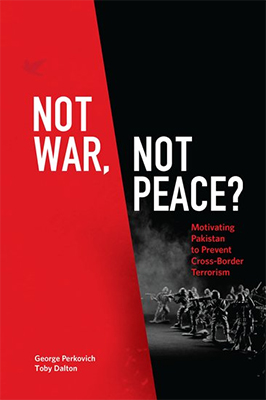
“‘Not war, not peace’ is the most likely condition in which Indians and Pakistanis will operate for the foreseeable future. In this condition, when Indians reform institutions, develop strategy, and acquire capabilities, they will have the opportunity to consider more than coercive options.”
—p. 275
“The analysis presented in this book shows that there are no clear solutions that India can unilaterally pursue to end the threat of violence from Pakistan.”
—p. 279
“Only a combination of Indian coercive and non-violent policies and capabilities, paired with a willingness to bargain, can motivate Pakistan to remove the threat of violence.”
—p. 280