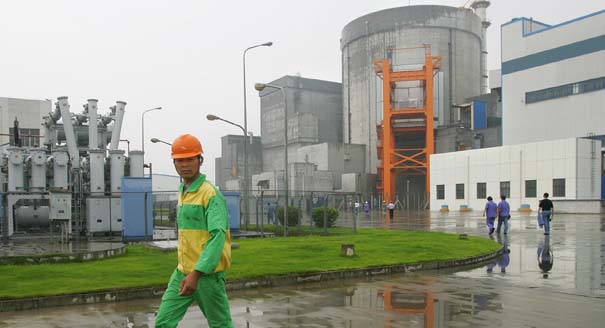
: China has impressively succeeded by quickly replicating existing nuclear power technologies deployed and demonstrated by others for half a century and over many thousands of cumulative operating years worldwide. Beginning in the 2020s China
aims to develop and deploy more advanced technologies that will require China to take international leadership, assume greater risk, control costs, innovate, and make difficult transitions from R&D to commercial application.
It would be a mistake to assume that the next two decades for China’s nuclear power program will represent a straight-line continuation of the last two decades. To be sure, even if power demand growth falls to half the level of China’s boom years, in two to three decades China’s demand for electricity will double. Executives at nuclear SOEs therefore express confidence that China will keep adding light-water reactors at a steady clip. But if the “new normal” deepens, if the coal sector pushes back, and if power sector reforms continue, without continued and additional state intervention nuclear energy may be priced out of the market especially if its costs increase.
How Much Nuclear Energy?
In 2005, premier Wen Jiabao, reacting to expectations in the global industry that a “nuclear renaissance” was on the horizon, and to real-time electricity shortages caused by logistical problems in China’s coal sector, dramatically accelerated nuclear power plant construction. By the end of the 2000s, quasi-official estimates were commonplace that by 2050 China’s population of nuclear power plants would reach 400 or even more. This was not idle speculation. China burns more coal to make electricity than any country by far. Environmentalists told the government that that many reactors would be needed to cut China’s coal consumption by half.
Today, if there is something like an informal and unofficial consensus among Chinese experts about how many nuclear power plants China will have three decades from now, rough estimates are likely to be far lower, between 100 and 300. Can China have 200 power reactors on the grid by 2050? Measured by investment capacity, the answer is probably yes, but only if the government is firmly resolved to do it, if SOEs including construction firms and equipment makers remain focused, and if China turns out enough skilled people to do the work responsibly and reliably. Chinese industry says it can make enough equipment for between 8 to 10 reactors per year, and its foreign partner firms estimate that China’s industrial capacity is probably still higher.
China’s Nuclear Generating Capacity in 2050
So there may be a way, but there must also be a will. And that’s where the “new normal” factors in and where deep questions arise.
If China overcomes “new normal” challenges, by 2050 it might have over 200 power reactors spread out over the country; Beijing may have negotiated opaque compromises with local authorities, ratepayers and taxpayers to arrange for side payments and subsidies needed to pay for R&D, nuclear power price supports, and setting up installations to close the nuclear fuel cycle. China may be routinely exporting nuclear power plants and replacing its oldest light-water reactors with fast reactors and other advanced designs.
Alternatively, if “new normal” conditions bedevil nuclear decision makers, by 2050 China may be preparing instead to gradually retire a fleet of 100 power reactors and replace much of their capacity with other technologies. Industry may have failed to control nuclear costs, and firms may resist pressure from the state to invest in technologies bearing greater risk. Middle-class Chinese might not support expansion of nuclear power after about 2030 when China’s air is clean. Protectionism may inhibit nuclear power plant exports.
What in fact transpires in the near to medium term may be something in between. In 2005 China added missions for a dramatically enlarged nuclear power program that will ensure it will continue at least into the 2020s: de-toxifying the air breathed in China’s megacities, creating intellectual property including for exports, and generating a great quantity of carbon-free electricity. On balance there is a reasonable likelihood that China by 2050 will have 150 power reactors on line, maybe more. It will depend upon what technologies are available to China’s power system and to a great extent on how China copes with the “new normal.”
China’s nuclear industry might not thrive into mid-century unless the state continues to provide it incentives and benefits that are now coming under pressure from market forces and their advocates in Chinese government agencies. Unlike in the West where decisions about nuclear investments are mostly left to commerce and industry, China’s government makes these decisions, and they are driven by strategic rationales. Strategists in Beijing may ultimately prevail and protect China’s nuclear investments, but they won’t likely have a blank check.
These remarks were given as a keynote presentation to the conference “Nuclear Energy at a Crossroads: China’s Expansion in Global Perspective,” held at the Katz Graduate School of Business at the University of Pittsburgh on March 16, 2018.