

Commentary
What should happen when sanctions designed to weaken the Belarusian regime end up enriching and strengthening the Kremlin?
Denis Kishinevsky
{
  "authors": [
    "Mikhail Korostikov"
  ],
  "type": "commentary",
  "blog": "Carnegie Politika",
  "centerAffiliationAll": "",
  "centers": [
    "Carnegie Endowment for International Peace",
    "Carnegie Russia Eurasia Center"
  ],
  "collections": [
    "Politika: The Best of 2025"
  ],
  "englishNewsletterAll": "",
  "nonEnglishNewsletterAll": "",
  "primaryCenter": "Carnegie Russia Eurasia Center",
  "programAffiliation": "",
  "programs": [],
  "projects": [],
  "regions": [
    "United States",
    "Ukraine",
    "Russia",
    "North Korea"
  ],
  "topics": [
    "Foreign Policy",
    "Security",
    "Global Governance"
  ]
}
The conflict between Ukraine and Russia is far more intractable than Trump seems to realize, and history suggests the U.S. leader will quickly lose interest.
The euphoria that accompanied the start of negotiations between the United States and Russia to end the fighting in Ukraine was misleading. What we know of U.S. President Donald Trump’s approach to foreign policy suggests that talks are extremely unlikely to yield anything.
Trump likes to present himself as someone who can solve complex international issues with consummate ease—but the truth is that he has had far more foreign policy failures than successes. He may not be shy about getting involved in deep-rooted conflicts, but he is unwilling to get on top of the details, and has a tendency to lose interest if immediate results are not forthcoming.
The current U.S. strategy when it comes to ending the war in Ukraine seems to have a lot in common with how Trump approached the problem of North Korea’s nuclear weapons in 2017–2018. Back then, many expertspointed out that even tough sanctions were unlikely to work because nuclear weapons were an existential issue for Pyongyang (Russian President Vladimir Putin talks about the need for control over Ukraine in a similar way). Nevertheless, Trump attempted to resolve the issue.
Trump’s first move was to issue threats against North Korea (just like his recent promise to drastically ramp up sanctions on Russia if it refused to negotiate). At first, Pyongyang ignored Trump, and continued testing nuclear weapons. However, at the start of 2018, North Korea changed course and announced it was ready to talk.
As a sweetener, Trump offered a series of major concessions to his North Korean counterpart, Kim Jong Un. Trump agreed to first one, then a second bilateral summit between the two heads of state, and called off what he said were “provocative” military exercises between the United States and South Korea in 2018 (compare this to how Trump recently said the full-scale invasion of Ukraine was the fault of his predecessor, Joe Biden).
In response to Washington’s overtures, Pyongyang became effusive about Trump, bestowing on him the sort of public praise he was not receiving at home at the time. But that ended up being the only concrete result of all Trump’s efforts over several years. North Korea did not give up its nuclear weapons; its relations with the United States continued to worsen; and it did not halt missile tests.
In many ways, Trump’s tactics with Kim Jong Un were typical of his diplomatic style. He clearly hoped the North Korean dictator would be frightened by U.S. threats, and then become malleable in the face of U.S. magnanimity.
It’s true these tactics sometimes worked for Trump in 2017 and 2018—but only with countries heavily dependent on the United States. For example, Trump convinced Canada, Mexico, and South Korea to revisit trade agreements and make additional concessions. But it was strange to think that approach could work with North Korea, which operates in complete economic isolation from the United States.
Trump’s many other foreign policy failures during his first term often developed along similar lines to what happened with North Korea. Despite the many threats and promises Trump made to China, for example, he was unable to obtain a satisfactory trade deal. Trump also failed to agree with Putin when it came to the issues of Syria and disarmament, with Iran about its nuclear program, with mostArab states about normalizing ties with Israel, and with the Taliban about retaining a secular government in Afghanistan after the withdrawal of U.S. troops.
In fact, Trump’s only major foreign policy success in his first term was the Abraham Accords, which saw Bahrain, the United Arab Emirates, Morocco, and Sudan recognize the state of Israel and normalize trade ties with it. While the agreement was asuccess, Trump failed to get Saudi Arabia—originally meant to be the biggest player on the Arab side—to sign up. Furthermore, Washington rewarded the signatories generously (the UAE received U.S. F-35 fighter jets, for example). In effect, Washington simply played the role of an organizer.
For the moment, negotiations over the war in Ukraine seem to be heading the same way as U.S. diplomatic engagement with North Korea in 2017 and 2018. First, Trump announced that he would end the war in Ukraine quickly—and permanently. Then he threatened both Moscow and Kyiv if they didn’t take part in talks. Then, as with North Korea, Trump said that he understood the position of his opponent (Russia), and accused Ukraine of inflexibility.
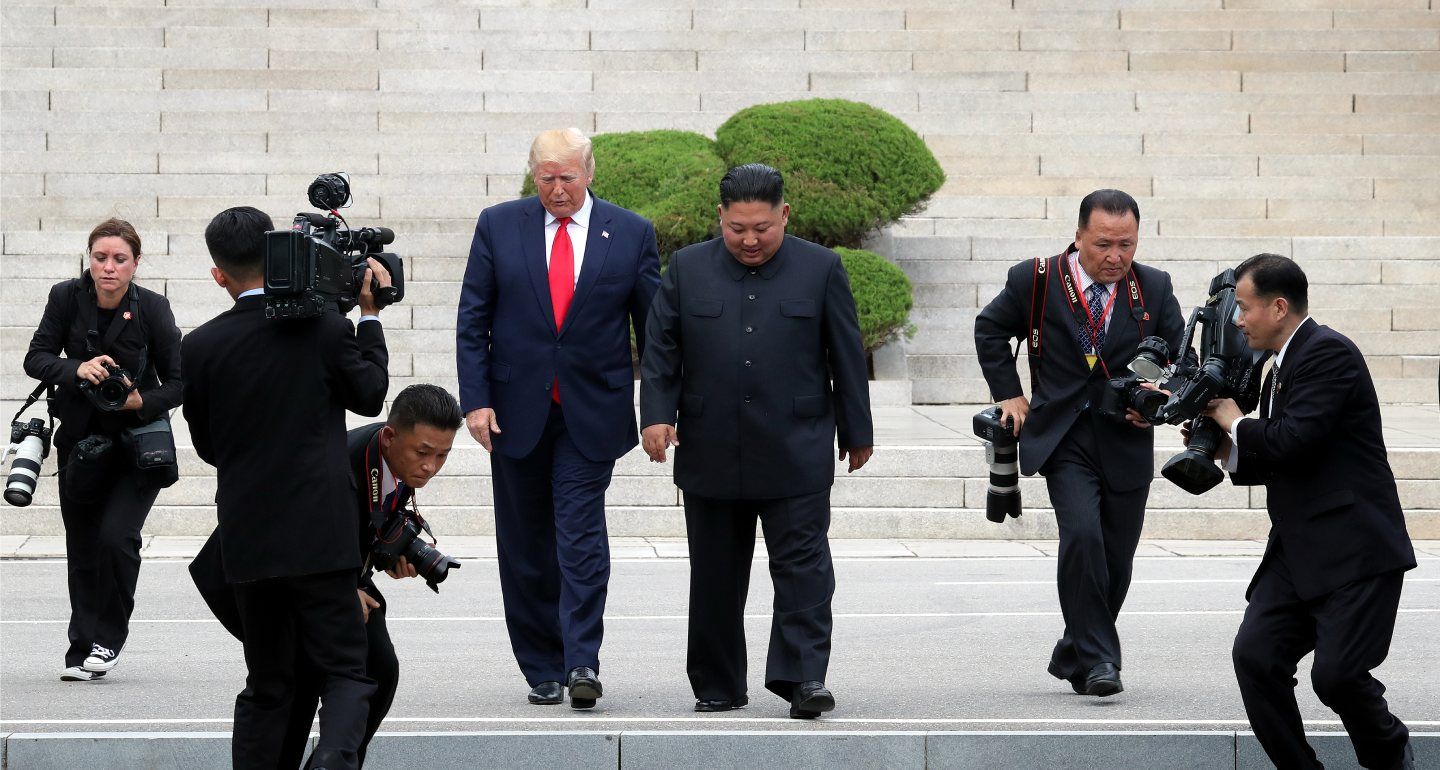
It’s not difficult to predict that the next step will be to organize a lavish summit in an expensive hotel, with journalists thronging the perimeter, plenty of photos, and mutual assurances of respect.
After that, there will be an announcement about a successful start to negotiations, and the talks will begin to address the details. And that will be the end of any deal, because of a lack of common ground between the two sides. In a best-case scenario, there will be another summit six months later when Putin will be relaxed and his U.S. counterpart somewhat perplexed—but still optimistic. Both leaders will say that the process is a slow one, but that the prospects of a deal are good. Soon after, Trump will begin to lose interest, and the problem of the war in Ukraine will be farmed out to the Europeans.
Admittedly, Trump met with Kim Jong Un a third time (in the demilitarized zone between North Korea and South Korea), but that was merely symbolic. When no deal was forthcoming, Trump soon turned his attention to other problems. North Korea resumed its missile launches, and Washington and Seoul restarted their joint military exercises. And when the COVID-19 pandemic hit in 2020, most people forgot about this unsuccessful diplomatic episode.
If Trump’s push to end the war in Ukraine ends in failure, however, the conflict will not drop off the diplomatic agenda. Unlike North Korea, the situation in Ukraine changes every day, which will force both Europe and the United States to respond. Ultimately, the inevitable failure of Trump’s rushed peacemaking efforts means Ukraine and Europe will have to come up with a new strategy.
Carnegie does not take institutional positions on public policy issues; the views represented herein are those of the author(s) and do not necessarily reflect the views of Carnegie, its staff, or its trustees.
What should happen when sanctions designed to weaken the Belarusian regime end up enriching and strengthening the Kremlin?

Denis Kishinevsky

The supposed threats from China and Russia pose far less of a danger to both Greenland and the Arctic than the prospect of an unscrupulous takeover of the island.

Andrei Dagaev

Western negotiators often believe territory is just a bargaining chip when it comes to peace in Ukraine, but Putin is obsessed with empire-building.

Andrey Pertsev
Unexpectedly, Trump’s America appears to have replaced Putin’s Russia’s as the world’s biggest disruptor.

Alexander Baunov

Baku may allow radical nationalists to publicly discuss “reunification” with Azeri Iranians, but the president and key officials prefer not to comment publicly on the protests in Iran.

Bashir Kitachaev