

{
  "authors": [
    "Petro Poroshenko",
    "Jessica Tuchman Mathews",
    "James F. Collins"
  ],
  "type": "event",
  "centerAffiliationAll": "dc",
  "centers": [
    "Carnegie Endowment for International Peace",
    "Carnegie Russia Eurasia Center"
  ],
  "collections": [],
  "englishNewsletterAll": "ctw",
  "nonEnglishNewsletterAll": "",
  "primaryCenter": "Carnegie Endowment for International Peace",
  "programAffiliation": "russia",
  "programs": [
    "Russia and Eurasia"
  ],
  "projects": [],
  "regions": [
    "North America",
    "United States",
    "Caucasus",
    "Russia",
    "Eastern Europe",
    "Ukraine",
    "Western Europe"
  ],
  "topics": [
    "Political Reform",
    "Economy",
    "Security",
    "Foreign Policy"
  ]
}
Foreign Minister Poroshenko: Challenges and Priorities of Ukraine's Domestic and Foreign Policy
Wed, December 9th, 2009
Washington, D.C.
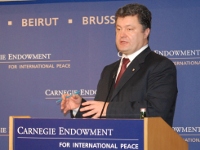
Ukrainian Foreign Affairs Minister Petro Poroshenko spoke at Carnegie about the domestic and foreign policy challenges facing Ukraine, ahead of the first presidential elections since the Orange Revolution of 2004.
Poroshenko began his remarks by giving some background about the nature of the presidential elections in Ukraine:
- Eighteen candidates will run for presidency in January 2010. The elections are scheduled to take place on January 17, 2010, and a run-off vote on February 7.
- Poroshenko explained that the close polls demonstrate Ukraine’s strengthened democratic process. More than 1,000 observers have been invited to “guarantee the character” of the election, he added.
- He expressed confidence that the elections will demonstrate free and fair election campaign procedures, by guaranteeing freedom of speech, freedom of the media, and equal access to all presidential candidates.
Ukraine faces many challenges, some of which stem from its geographic position and geopolitical environment. Poroshenko described this geographic and geopolitical position as opportune for achieving Ukraine’s goal “to become an equal and prosperous participant of an undivided and peaceful Europe.” Achieving that goal, he explained, will require new, wide-ranging interaction on a regional and global scale. Its elements will include:
- A new and open approach to building the architecture of European and global security that would incorporate diverse views from all the nations involved.
- Renewing dialogue with the IMF to implement necessary economic reforms, after Ukraine’s elections.
- Ukraine’s strengthened relations with China in such spheres as security, economics, trade, science, and technology is a step toward that greater engagement.
- Support for Belarus and Moldova, intended to foster domestic economic and democratic reforms in those countries and to engage in joint border-security and development projects.
Foreign Minister Poroshenko said that U.S. support for Ukraine's territorial integrity and sovereignty continues to be of critical importance to his government: “We salute the U.S. administration’s efforts in resetting U.S.-Russia relations. At the same time, we highly value the signal of the Obama administration that the United States will not recognize anyone’s area of influence, and that finding common ground between Washington and Moscow will not affect the present Ukraine-U.S. strategic partnership.”
Carnegie India does not take institutional positions on public policy issues; the views represented herein are those of the author(s) and do not necessarily reflect the views of Carnegie, its staff, or its trustees.
Event Speakers
Petro Poroshenko
Distinguished Fellow

Mathews is a distinguished fellow at the Carnegie Endowment for International Peace. She served as Carnegie’s president for 18 years.
Nonresident Senior Fellow, Russia and Eurasia Program; Diplomat in Residence
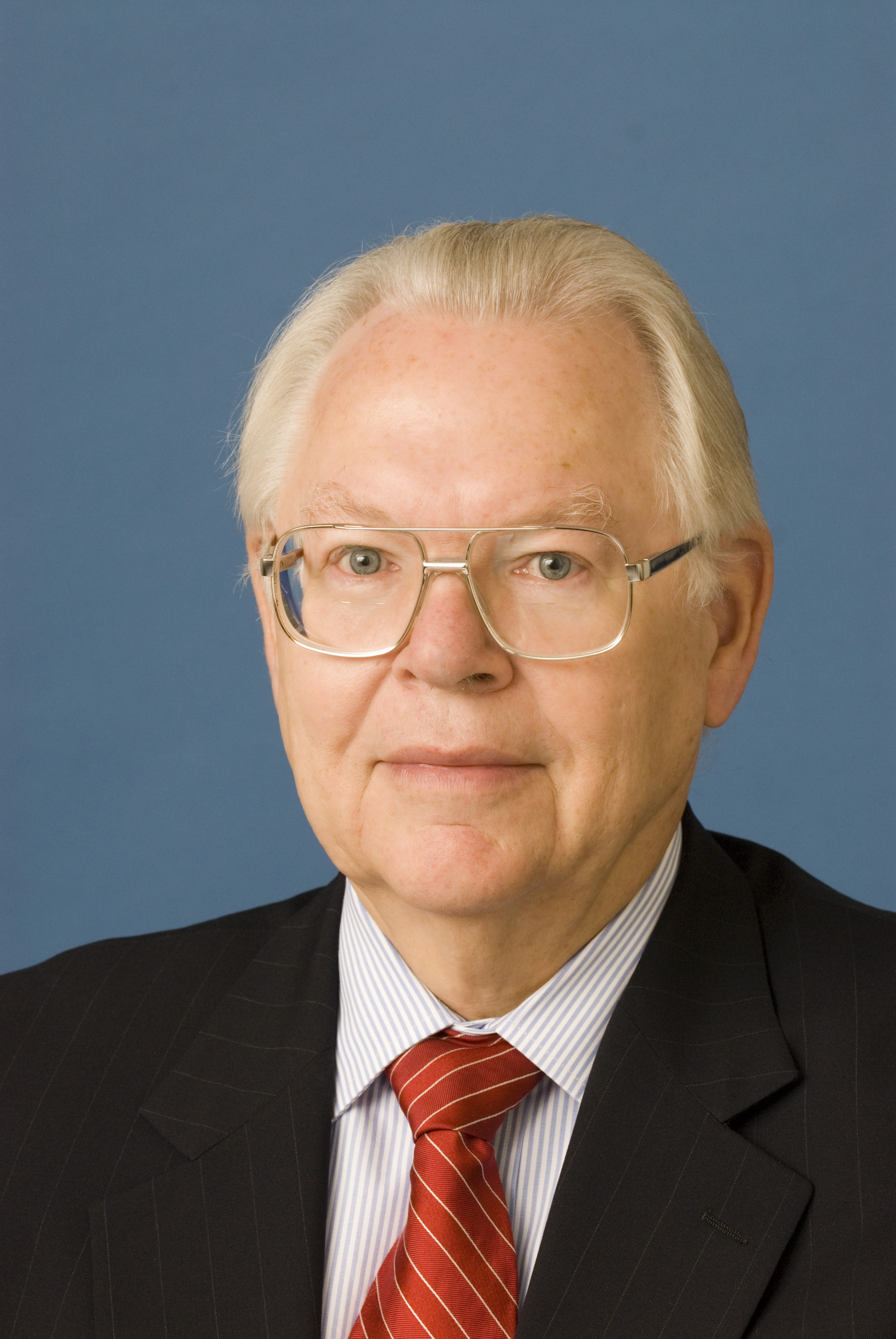
Ambassador Collins was the U.S. ambassador to the Russian Federation from 1997 to 2001 and is an expert on the former Soviet Union, its successor states, and the Middle East.