

{
  "authors": [
    "C.H. Tung",
    "Jessica Tuchman Mathews"
  ],
  "type": "event",
  "centerAffiliationAll": "dc",
  "centers": [
    "Carnegie Endowment for International Peace"
  ],
  "collections": [],
  "englishNewsletterAll": "asia",
  "nonEnglishNewsletterAll": "",
  "primaryCenter": "Carnegie Endowment for International Peace",
  "programAffiliation": "AP",
  "programs": [
    "Asia"
  ],
  "projects": [],
  "regions": [
    "East Asia",
    "China",
    "Taiwan"
  ],
  "topics": [
    "Political Reform"
  ]
}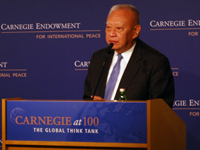
China: Political Development and Future—A Conversation with C.H. Tung
Thu, September 29th, 2011
Washington, D.C.
As the 18th National Party Congress approaches, 2012 promises to be a very interesting year for China. Speculation abounds that Xi Jinping and Li Keqiang will replace Hu Jintao and Wen Jiabao as president and premier, respectively, but few are able to accurately describe how this change might impact China's domestic and international policies.
Substantial Progress since Reform and Opening
China’s Economic Path: The Right Mix Between a Market and Planned Economy
- Domestic Adjustments: Beijing seeks to create an environment conducive to increased domestic spending and in particular, an increase in the service sector through investment in advanced tech industries, Tung said.
- Restructuring and Urbanization: China is developing and restructuring its economy towards a more modern industrial base. Because 55 percent of the population is still agricultural, urbanization efforts are ongoing.
China’s Political Path: Developing China’s Unique Form of Democracy
- Institutionalization: The development of Chinese democracy is being institutionalized in the National People’s Congress (NPC) and the Chinese People's Political Consultative Conference (CPPCC), said Tung. These organizations serve the function of making people’s voices heard, serving as voices to the government, as a check and balance, and the CPPCC is important for helping develop consensus. Decisions are made after an extensive institutionalized process, he noted.
- Democracy: Tung noted he is often asked about when China will adopt western style democracy. He suggested that Chinese democracy will evolve in its own way according to its own needs. He pointed out that many important needs exist, such as rooting out corruption and training local officials.
China’s International Path: Peaceful Development, Good Relations with All Nations
- Strategic Choice: Tung explained that China’s pursuit of peaceful development internationally was a strategic choice made for the following reasons:
- It is in China’s interest to have a stable and peaceful international environment, especially as its interests and the interests of the world have become intertwined.
- Globalization has led to win-win results in trade, commerce and investment so that prosperity can be better shared throughout the world.
- It is part of China’s culture and values to seek harmony by seeking common ground and avoiding war.
- It is in China’s interest to have a stable and peaceful international environment, especially as its interests and the interests of the world have become intertwined.
- Military Investment: China’s military investment is perceived as high, he argued, because of China’s need to defend its long land and sea borders and to protect trade. Additionally, he argued that China’s military development is defensive in nature, aids in modernization, and it is only a small portion of the nation’s GDP.
- Challenging the U.S. Military? China does not have the capability, reason, or cultural intention to challenge the United States militarily, Tung asserted. A vigorous United States aids in global and Chinese prosperity.
Praise for the Chongqing Model
- Successful: The Western city of Chongqing has been very successful in attracting industry, which prevents social problems that result from potential labor moving to other cities, where they lack residency status, he explained.
- Potential Model: It is a “very impressive beginning” Tung asserted, noting that if it proves successful, it could be a model for other cities.
South China Sea Claims
- Clarified Claims: China’s claim on territory in the South China Sea is not a claim on the whole sea, Tung noted, but to the islands and the 12 nautical miles around those islands.
- Code of Conduct: The 2002 Declaration on a Code of Conduct signed between China and ASEAN is a good way to resolve the issue, Tung noted. Since then, others in ASEAN have continued drilling, but China has not, preferring to wait to find a peaceful solution, Tung asserted.
Policy Changes under the Coming Leadership
Arguments against the RMB Bill in the U.S. Senate
- Congressional Bill: Tung argued against a pending congressional bill dealing with reniminbi (RMB) revaluation, saying that Congress should not rock the boat in U.S.-China relations. Since 2005 the RMB has devalued by 30 percent, headded.
- Raise Wages: Raising wages is the other, equivalent way to tackle this issue, Tung argued. Wages in China must increase by 20 percent per year.
- U.S. Jobs: RMB revaluation is not the solution to the problem of job creation in the United States, he argued. In June of 2008 U.S. unemployment was 5.8 percent; in June 2009 it was about 10 percent. Tung asserted that it was “unthinkable” that China could cause this. From 2001 to 2010, U.S. exports to China grew from $19 billion to $91 billion, about a 30 percent increase per year. Tung argued that every 1 percent increase created about 8000 jobs in the U.S.
Carnegie India does not take institutional positions on public policy issues; the views represented herein are those of the author(s) and do not necessarily reflect the views of Carnegie, its staff, or its trustees.
Event Speakers
C.H. Tung
C.H. Tung is the vice chairman of the Twelfth National Committee of the Chinese People's Political Consultative Conference of the People's Republic of China. He is the founding chairman of the China-United States Exchange Foundation and Our Hong Kong Foundation. Prior to these appointments, Tung served as the first chief executive of the Hong Kong Special Administrative Region of the People's Republic of China from July 1997 to March 2005.
Distinguished Fellow

Mathews is a distinguished fellow at the Carnegie Endowment for International Peace. She served as Carnegie’s president for 18 years.