

Paper
Thomas Carothers
{
  "authors": [
    "Thomas Carothers"
  ],
  "type": "legacyinthemedia",
  "centerAffiliationAll": "dc",
  "centers": [
    "Carnegie Endowment for International Peace"
  ],
  "collections": [],
  "englishNewsletterAll": "democracy",
  "nonEnglishNewsletterAll": "",
  "primaryCenter": "Carnegie Endowment for International Peace",
  "programAffiliation": "DCG",
  "programs": [
    "Democracy, Conflict, and Governance"
  ],
  "projects": [],
  "regions": [],
  "topics": [
    "Political Reform",
    "Democracy",
    "Foreign Policy"
  ]
}
REQUIRED IMAGE
Source: Carnegie
The Washington Post, January 23, 2000
With the presidential campaign fully underway, debate over foreign policy is heating up. The opening salvos from the Republican side make clear that the time-honored pattern in presidential campaigns will hold in 2000: Confronted with the fact that most elements of American foreign policy rest on a bipartisan consensus, those on the attack will exaggerate minor differences to try to create the impression they have a dramatic corrective to offer.
In their search for issues in international affairs, some Republican policy experts have mistakenly seized upon efforts to promote democracy abroad. As part of their sweeping indictment of the Clinton administration for allegedly frittering away American power on trivialities, such as security in the Balkans or massive human suffering in Africa, they flag democracy-building as one more example of wasteful do-goodism.
For example, in their defense of John McCain's foreign policy pronouncements, Robert Ellsworth and Dimitri Simes recently denounced U.S. efforts to foster democracy abroad as "dangerous" ventures arising from illegitimate "elite ideologies" [op-ed, Dec. 29]. In her broadside against Clinton policy in the current Foreign Affairs, Bush adviser Condoleeza Rice excludes democracy promotion from her list of key U.S. priorities.
The growing attacks on the Clinton record in this area rest on a jumble of misconceptions that obscure rather than clarify the terrain. To start with, the notion that the administration has been bent on a global democratic crusade is risible. President Clinton and his advisers have indeed invoked grand Wilsonian rhetoric at every turn. Their actual pursuit of democracy promotion, however, has been scarcely more assertive than that of the Bush administration before them.
Where democratization obviously reinforces U.S. economic and security interests, as in Latin America and Eastern Europe, the Clinton team has actively supported democratic transitions and helped ward off coups. But where Clinton officials believe that pushing for democratic change might upset autocrats friendly to U. S. economic and security interests, as in China, Saudi Arabia, Egypt, Kazakhstan, Azerbaijan, Armenia and elsewhere, they are quick to play down democracy.
The Republican critics appear to be confusing humanitarian intervention with promotion of democracy. The various military interventions of the 1990s that realist critics now bemoan as "global social work" were rooted in diverse motives, from saving lives to stopping the flow of refugees to U.S. shores and ensuring peace in Europe. Though Clinton officials habitually tacked on a democracy rationale to these actions, democracy-building was not a driving motive. Only the most starry-eyed of Wilsonian idealists, which the Republican critics presumably are not, could believe that the Clinton administration intervened in Haiti or Kosovo primarily out of concern about the lack of democracy therein.
Equally puzzling is the idea presented in some critiques that democracy promotion is only a Clintonian or Democratic vocation. It was Ronald Reagan, after all, who brought the concept out of the U.S. foreign policy wilderness after it had receded from U.S. policy in the late 1960s. For Reagan, fortifying democracy in other countries was intrinsic to a policy of American strength and purpose, not a decorative add-on.
A striking development of the past 10 years is that almost every major democracy, from Sweden to Spain and Germany to Canada, is engaged in activities explicitly aimed at building democracy around the world, from strengthening the rule of law in Latin America to fostering civil society in Africa. The common tendency of established democracies to share and spread the political system that today defines political success in the world is a powerful unifying trend in international affairs, not some oddball American inclination.
This fact helps point up the error of another part of the realist critique: the idea that America's democracy promotion efforts are prompting the incipient global backlash against the United States. A backlash may be brewing but it is brought on by America's tendency to treat international norms and treaties as though they should apply to everyone but itself, by American arrogance about the U.S. economic boom and by the cultural pressures created by the globalization of American goods and services.
Democracy promotion is not a divisive issue in U.S. foreign policy and should not be treated as such by either side. Debate about it is definitely needed, but it should focus on the real questions: how to reduce the inconsistencies between policy rhetoric and reality, how to make existing democracy promotion efforts more effective and what level of resources should be devoted to the task.
The writer is vice president for studies at the Carnegie Endowment for International Peace.

Harvey V. Fineberg Chair for Democracy Studies; Director, Democracy, Conflict, and Governance Program
Thomas Carothers, director of the Carnegie Endowment for International Peace’s Democracy, Conflict, and Governance Program, is a leading expert on comparative democratization and international support for democracy.
Recent Work
Thomas Carothers

Richard Youngs, Thomas Carothers
Carnegie India does not take institutional positions on public policy issues; the views represented herein are those of the author(s) and do not necessarily reflect the views of Carnegie, its staff, or its trustees.

After the chill in ties between 2020 and 2024 that brought India–China relations to their lowest point in several decades, the two countries have engaged each other afresh. This paper argues that there are predominantly four imperatives guiding India’s approach to China, and they exist in an order of priority.

Saheb Singh Chadha

This piece argues that India’s central challenge is not managing a single flashpoint but resolving the underlying tension between expansion and institutional coherency of the BRICS grouping.

Vrinda Sahai

A partnership between India, a country of subcontinental size, and Africa, a continent of fifty-four countries, may seem asymmetric until one notes that both are home to nearly the same number of people—1.4 billion. This essay spells out the existing challenges to the partnership, its optimal potential, and the possible pathways to realize it over the next quarter-century.

Rajiv Bhatia

The India–EU Free Trade Agreement (FTA) is shaping up to be one of the most consequential trade negotiations, both economically and strategically. But, what’s in the agreement, what’s missing, and what will determine its success in the years ahead
Vrinda Sahai, Nicolas Köhler-Suzuki
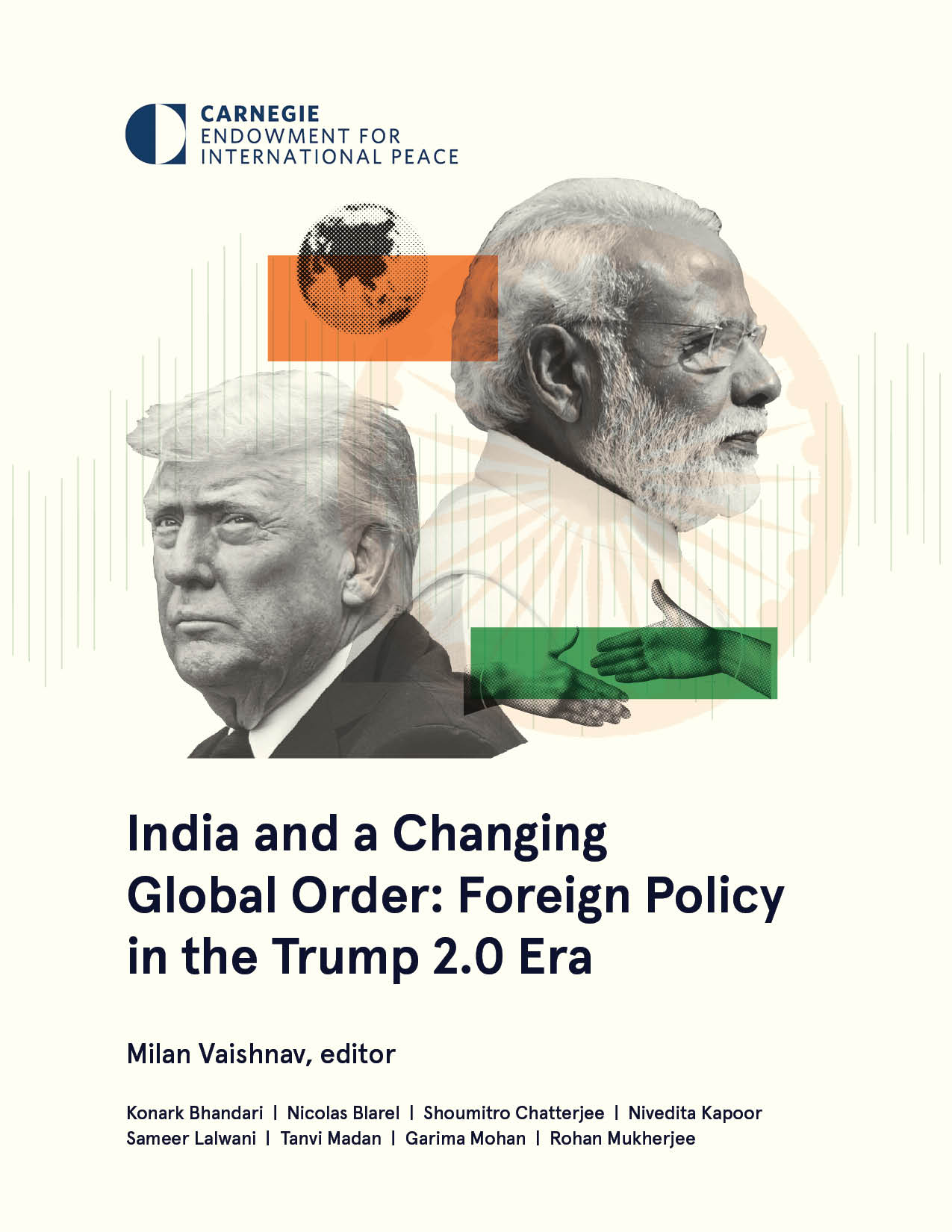
Trump 2.0 has unsettled India’s external environment—but has not overturned its foreign policy strategy, which continues to rely on diversification, hedging, and calibrated partnerships across a fractured order.



Milan Vaishnav, ed., Sameer Lalwani, Tanvi Madan, …