

In The Media
Michele Dunne, Robert Kagan
{
  "authors": [
    "Robert Kagan"
  ],
  "type": "legacyinthemedia",
  "centerAffiliationAll": "",
  "centers": [
    "Carnegie Endowment for International Peace"
  ],
  "collections": [],
  "englishNewsletterAll": "",
  "nonEnglishNewsletterAll": "",
  "primaryCenter": "Carnegie Endowment for International Peace",
  "programAffiliation": "",
  "programs": [],
  "projects": [],
  "regions": [
    "China"
  ],
  "topics": [
    "Foreign Policy"
  ]
}
REQUIRED IMAGE
Source: Carnegie
Reprinted with permission from the Weekly Standard, March 4, 2002
THE FULL SWEEP of the new Bush Doctrine was on display this past week, as President Bush traveled through North Asia delivering a consistent and powerful message: American security and global security require a determined assault not just on terrorists but on the three-headed hydra of tyranny, terror, and weapons of mass destruction. The imperative of regime change was the core message of Bush's State of the Union address. This week Bush made plain that the implications of his doctrine go beyond North Korea, Iran, and Iraq, the "axis of evil." Just as the Reagan Doctrine-- primarily aimed at overthrowing Communist regimes--ended up toppling right-wing dictatorships in the Philippines and South Korea, so, too, the Bush Doctrine could help undo dictatorships not only in Iraq, Iran, and North Korea, but also in, for example, China and Saudi Arabia.
In South Korea, the president did not back down an inch from his characterization of the Pyongyang government as "evil." Unmoved by the international rehabilitation of the newly smiling Kim Jong Il, Bush spoke with Reaganesque simplicity: "I will not change my opinion on Kim Jong Il until he frees his people." Earlier in Japan, Bush went out of his way to declare his solidarity with and commitment to the democratic people of Taiwan, a stance he then forcefully reiterated in Beijing. Rather than kowtow in the fashion of Clinton, who used his visit to China as an opportunity to distance America from Taiwanese democracy, Bush told the Chinese government plainly that he intended to abide by the Taiwan Relations Act. Last spring, Bush promised to "do what it takes" to defend Taiwan. Beijing's leaders ought to be convinced now that he means it.
The most important part of Bush's Asia trip, however--the part that may best be remembered by future generations of both Americans and Chinese--came in his speech to students at Tsinghua University, which was televised live in China. Under the pretext of explaining to the Chinese people how the American system of government really works, Bush articulated a devastating critique of the Beijing dictatorship and called on the Chinese people to demand change. In the United States, he said, "No one is above the law . . . everyone stands equal." In the United States, "All political power . . . is limited and temporary, and only given by a free vote of the people." In the United States, Bush said, "You can support the policies of our government, or you are free to openly disagree with them." Every Chinese citizen who heard Bush's words understood the invidious comparison he was drawing between American freedom and Chinese tyranny. Everyone heard his message: that the tyranny under which they suffer must be changed or brought down. And to the old argument so often proffered by Chinese tyrants and their American apologists--that China is not "ready" for democracy--well, Bush had an answer for that, too. "Those who fear freedom sometimes argue it could lead to chaos, but it does not, because freedom means more than every man for himself."
It is hard to recall a more forceful statement of American democratic principles on Chinese soil, or a more pointed rebuke to the Beijing dictatorship. To find a historical precedent, one must go back to Ronald Reagan's 1988 speech at Moscow State University. And, of course, Bush's call for freedom and regime change in China marks a striking shift away from the "realist," commercialist orthodoxy that has dominated the Republican foreign policy establishment for more than a decade. You wouldn't have heard this kind of talk from the first Bush administration, and, in truth, you might not have heard it from this administration, either, before September 11.
But September 11 really did change everything. President Bush grasped that our response to the attacks must go beyond simply destroying some terrorist groups, important as that is. He also understood the underlying truth that there's no substitute for American leadership--a leadership that is willing not just to use our military strength, but also to defend and advance liberal democratic principles. George W. Bush is now a man with a mission. As it happens, it is America's historic mission.
© Copyright 2001, News Corporation, Weekly Standard, All Rights Reserved.

Former Senior Associate
Kagan, author of the recent book, The Return of History and the End of Dreams (Knopf 2008), writes a monthly column on world affairs for the Washington Post and is a contributing editor at both the Weekly Standard and the New Republic.
Recent Work

Michele Dunne, Robert Kagan
Robert Kagan, Michele Dunne
Carnegie India does not take institutional positions on public policy issues; the views represented herein are those of the author(s) and do not necessarily reflect the views of Carnegie, its staff, or its trustees.

After the chill in ties between 2020 and 2024 that brought India–China relations to their lowest point in several decades, the two countries have engaged each other afresh. This paper argues that there are predominantly four imperatives guiding India’s approach to China, and they exist in an order of priority.

Saheb Singh Chadha

This piece argues that India’s central challenge is not managing a single flashpoint but resolving the underlying tension between expansion and institutional coherency of the BRICS grouping.

Vrinda Sahai

A partnership between India, a country of subcontinental size, and Africa, a continent of fifty-four countries, may seem asymmetric until one notes that both are home to nearly the same number of people—1.4 billion. This essay spells out the existing challenges to the partnership, its optimal potential, and the possible pathways to realize it over the next quarter-century.

Rajiv Bhatia

The India–EU Free Trade Agreement (FTA) is shaping up to be one of the most consequential trade negotiations, both economically and strategically. But, what’s in the agreement, what’s missing, and what will determine its success in the years ahead
Vrinda Sahai, Nicolas Köhler-Suzuki
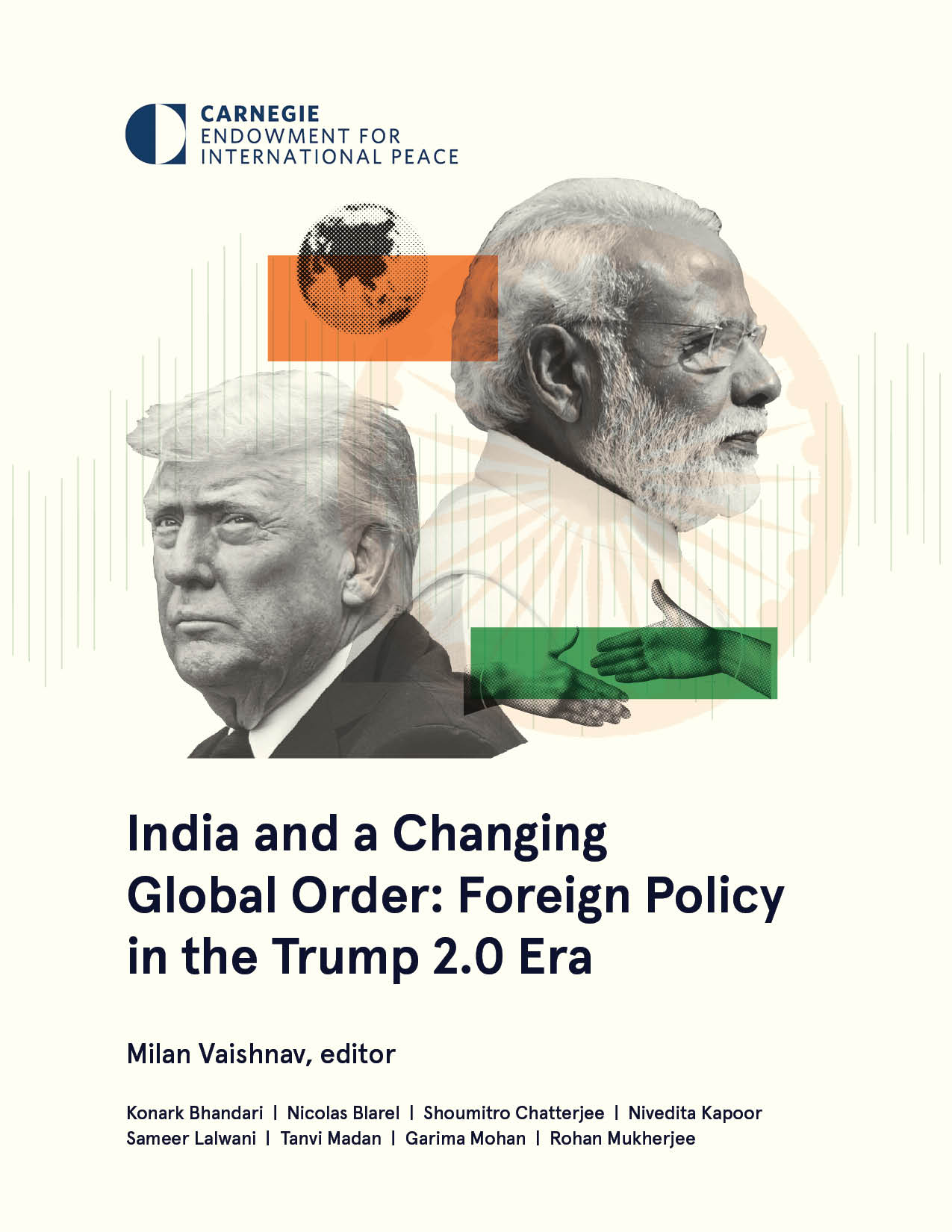
Trump 2.0 has unsettled India’s external environment—but has not overturned its foreign policy strategy, which continues to rely on diversification, hedging, and calibrated partnerships across a fractured order.



Milan Vaishnav, ed., Sameer Lalwani, Tanvi Madan, …