Why Egypt Has To Be The U.S. Priority In The Middle East
If Egypt can make the transition to democracy, it will lead the way to a new era for the Arab world. If Cairo falls back to dictatorship of one variety or another, it is unlikely the rest of the region will move on without it.
Why Egypt Has To Be The U.S. Priority In The MiddlWith the horrific carnage in Libya, the flames of revolution burning in Yemen and Bahrain, and protests for political change in Jordan and Morocco, there's a danger that the United States and Europe may lose sight of what still has to be our highest priority in the region: helping the people of Egypt complete their transition to democracy and a new chance at prosperity.
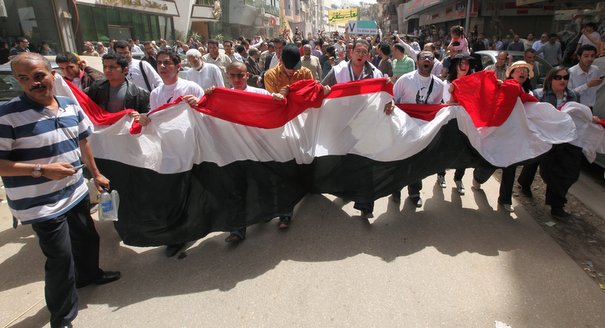
Why is Egypt so important? Because it is the heart of the Arab world. It was the birthplace of pan-Arabism under Gamal Nasser, the linchpin of Middle East peace under Anwar Sadat. With more than 80 million people - as many as Iraq, Saudi Arabia and Syria combined - it has a large and vigorous civil society, feisty, independent media, a broad array of political forces, and a well-respected judiciary. If Egypt can make the transition to democracy, it will lead the way to a new era for the Arab world. If Cairo falls back to dictatorship of one variety or another, it is unlikely the rest of the region will move on without it. The Arab Spring will live or die in Egypt.
The Obama administration is right to be wary of wielding a too-heavy hand. Egyptians are proud and capable and don't want a made-in-America democracy. We particularly need to avoid trying to dictate what kinds of groups can take part in Egypt's democratic process.
But there are important kinds of help that we can provide - above all, economic assistance. As in Eastern Europe, the first wave of enthusiasm for democracy will give way to questions about how well this form of government can deliver the goods.
What Egyptians most want from us is smart, targeted and timely assistance. Actions that could be taken immediately include:
Debt forgiveness: Egypt owes billions of dollars to the United States and Europe. This debt should be forgiven or at least substantially reduced.
Free trade: The Bush administration came close to beginning free-trade negotiations with Egypt in 2005 but backed away because of Hosni Mubarak's repression of political rivals. Once there is an elected Egyptian government that respects citizens' rights, the United States should offer such negotiations as an incentive for that government to adopt a free-market economic philosophy. In the meantime, Washington can offer a preferential trade agreement, which Congress could pass immediately.
Rethink the U.S. assistance package: The administration has requested for the next fiscal year the same aid as before Mubarak's fall. Although it makes sense to give at least as much to a democratizing Egypt as we did to an authoritarian one, this is not the time for policy on auto-pilot. The administration should discuss with Egypt's political leaders shifting the balance toward more economic and less military aid. The military ought to be happy to show the Egyptian people it is willing to give them a bigger share of American aid.
Private investment: Sens. John McCain and Joseph Lieberman recently returned from Egypt with a clear message: The Egyptians need and want foreign companies to come and invest in their country. The senators have proposed sending a delegation of high-tech executives to Egypt and Tunisia. The administration ought to help make this happen.
Appoint a special Middle East transition czar: To oversee all these efforts, the administration is going to need a high-powered individual at the White House, someone with the domestic and international clout to pull together the efforts of the Pentagon, State Department, Treasury and Commerce, as well as the private sector and foreign aid. The U.S. government is not currently equipped to manage this process.
The United States also needs to show consistent support, publicly and privately, for protesters' ongoing pro-democracy demands. They are asking to slow down the breakneck pace Egypt's military leadership has set for elections and want to reform internal security services to ensure that torture and intimidation cease. Egypt can and should hold presidential elections this fall - there is a danger in waiting too long to let the Egyptian people choose their own leaders. But parliamentary elections should wait until a more open and balanced political playing field has been created. Throughout the process, the United States and Europe need to provide appropriate technical and financial assistance.
Whether the Arab Spring succeeds or fails is ultimately up to the peoples of the region. But that is no excuse for the United States and other democratic nations not to help in every way we can. The Egyptian people harbor justified resentment that the United States backed the repressive and often-brutal Mubarak regime for so long; they question our commitment to helping them enjoy the same freedoms that we do. The United States should make sure that we aid the transition now underway so that there is no room for doubt. History will not be kind if we blow this opportunity.
Michele Dunne was a nonresident scholar in Carnegie’s Middle East Program, where her research focuses on political and economic change in Arab countries, particularly Egypt, as well as U.S. policy in the Middle East.
Kagan, author of the recent book, The Return of History and the End of Dreams (Knopf 2008), writes a monthly column on world affairs for the Washington Post and is a contributing editor at both the Weekly Standard and the New Republic.
Carnegie India does not take institutional positions on public policy issues; the views represented herein are those of the author(s) and do not necessarily reflect the views of Carnegie, its staff, or its trustees.
After the chill in ties between 2020 and 2024 that brought India–China relations to their lowest point in several decades, the two countries have engaged each other afresh. This paper argues that there are predominantly four imperatives guiding India’s approach to China, and they exist in an order of priority.
This piece argues that India’s central challenge is not managing a single flashpoint but resolving the underlying tension between expansion and institutional coherency of the BRICS grouping.
A partnership between India, a country of subcontinental size, and Africa, a continent of fifty-four countries, may seem asymmetric until one notes that both are home to nearly the same number of people—1.4 billion. This essay spells out the existing challenges to the partnership, its optimal potential, and the possible pathways to realize it over the next quarter-century.
The India–EU Free Trade Agreement (FTA) is shaping up to be one of the most consequential trade negotiations, both economically and strategically. But, what’s in the agreement, what’s missing, and what will determine its success in the years ahead
Trump 2.0 has unsettled India’sexternal environment—buthas notoverturned its foreign policystrategy,which continuesto relyon diversification, hedging,and calibrated partnerships across a fractured order.
+6
Milan Vaishnav, ed., Sameer Lalwani, Tanvi Madan, …