

In The Media
Michele Dunne, Robert Kagan
{
  "authors": [
    "Robert Kagan"
  ],
  "type": "legacyinthemedia",
  "centerAffiliationAll": "",
  "centers": [
    "Carnegie Endowment for International Peace"
  ],
  "collections": [],
  "englishNewsletterAll": "",
  "nonEnglishNewsletterAll": "",
  "primaryCenter": "Carnegie Endowment for International Peace",
  "programAffiliation": "",
  "programs": [],
  "projects": [],
  "regions": [
    "Iraq"
  ],
  "topics": [
    "Foreign Policy"
  ]
}
REQUIRED IMAGE
Source: Carnegie
Divided on the War? Not Really
Reprinted from The Washington Post, Friday, December 19, 2003
Faithful consumers of the American media can be forgiven for believing that
the Iraq war has created searing divisions in the American body politic of
a kind not seen since the nation was torn apart in the later years of the
Vietnam War. But is the reality division or consensus? In fact, Americans
have been remarkably supportive of the Iraq war, both on the original decision
to invade and on the need to keep troops in Iraq for years to come if necessary.
This support was on the rise, moreover, even before Saddam Hussein was pulled
out of his hole this past week.
You could see the public mood reflected in the statements of Sen. Hillary Clinton (N.Y.) a couple of weeks ago. One of the most popular Democrats in the country, and also one of the shrewdest, Clinton dismissed the antiwar argument: "I think that Saddam Hussein was certainly a potential threat" who "was seeking weapons of mass destruction, whether or not he actually had them." Her husband, another popular Democrat, said the same last July.
Clinton's pro-war statements shocked some, but she was only expressing the mainstream view. In a CNN/USA Today/Gallup poll taken over the weekend of Dec. 5-7 -- before Hussein's capture -- 59 percent of respondents said they believed it was "worth going to war" in Iraq; 39 percent said it was not. That poll reflected a steady trend that pre-dated Hussein's capture. Support for the war, which had briefly fallen from more than 60 percent in the summer to 50 percent in early September, had been climbing back up ever since. Hussein's capture bumped the numbers a bit -- 62 percent now believe the war was worth it; 33 percent think it wasn't -- but they might have risen anyway. The CBS/New York Times poll shows the same results: Before Hussein's capture, 64 percent believed the United States did "the right thing" going to war in Iraq, while 28 percent believed the war was a mistake. The percentages remain roughly the same after Hussein's capture.
This is a pretty solid pro-war consensus in historical terms, especially given the casualties U.S. troops have suffered in Iraq since the official end of the war, not to mention the endless stream of Iraq-related scandals involving alleged lies and the lying liars who tell them. By comparison, in June 1999, about a week after the war in Kosovo ended in a casualty-free victory for the United States and its NATO allies, a Washington Post poll showed that 52 percent of Americans believed the United States had done the "right thing" by going to war while 40 percent still believed it was a "mistake." According to CNN's polls this year, only once has support for the Iraq war fallen as low as 50 percent, despite the steady stream of relatively bad news. This suggests that even if the fight in Iraq remains a tough slog in the coming months, public support may not drop that much.
The consistent pro-war numbers are even more surprising given the failure, so far, to uncover any chemical or biological weapons stocks in Iraq. According to an NBC News/Wall Street Journal survey, 57 percent of Americans believed the war "will have been worthwhile" even if weapons of mass destruction are "never" discovered -- and that was before Hussein's capture. Now the number is 60 percent. Imagine where the poll numbers would go if even a shred of new evidence about Hussein's weapons of mass destruction, or about connections with al Qaeda, appeared in the next few months.
Perhaps more amazing is the strong public support for keeping U.S. troops in Iraq as long as necessary. In the latest NBC poll, 55 percent of respondents believe U.S. troops should "stay as long as necessary to complete the process" in Iraq -- "even if it takes as long as five years"! Another 23 percent are willing to give it another year and a half. Only 20 percent want to withdraw "as soon as possible." Those numbers, too, are virtually unchanged from a month ago.
You have to wonder, moreover, about the roughly one-third of the country that says it opposes the war. How much of that opposition is antiwar, and how much is anti-Bush? In 1999 a significant portion of the opposition to Clinton's war in Kosovo was simply Clinton-hating Republicans expressing their hatred. The same phenomenon is surely at work now. If a Democratic president had gone to war in Iraq, even without a U.N. resolution -- as Bill Clinton did on a much smaller scale in 1998, and as a President Al Gore and his hawkish Vice President Joe Lieberman might well have done had the vote in Florida gone differently -- some percentage of today's antiwar Democrats would have been supportive. (And some pro-war Republicans would have been opposed.)
So when some Democrats argue that Howard Dean can't win the general election, they would seem to have a point. As predicted, Dean has now surrounded himself with respected centrist advisers from the Democratic establishment. The big foreign policy speech they wrote for him masterfully tried to cast him as a moderate, which on some issues other than Iraq, he may well be. But Dean undid all his advisers' efforts when he insisted that "the capture of Saddam has not made America safer." A landslide's worth of Americans really don't agree.
The writer, a senior associate at the Carnegie Endowment for International Peace, writes a monthly column for The Post.

Former Senior Associate
Kagan, author of the recent book, The Return of History and the End of Dreams (Knopf 2008), writes a monthly column on world affairs for the Washington Post and is a contributing editor at both the Weekly Standard and the New Republic.
Recent Work

Michele Dunne, Robert Kagan
Robert Kagan, Michele Dunne
Carnegie India does not take institutional positions on public policy issues; the views represented herein are those of the author(s) and do not necessarily reflect the views of Carnegie, its staff, or its trustees.

After the chill in ties between 2020 and 2024 that brought India–China relations to their lowest point in several decades, the two countries have engaged each other afresh. This paper argues that there are predominantly four imperatives guiding India’s approach to China, and they exist in an order of priority.

Saheb Singh Chadha

This piece argues that India’s central challenge is not managing a single flashpoint but resolving the underlying tension between expansion and institutional coherency of the BRICS grouping.

Vrinda Sahai

A partnership between India, a country of subcontinental size, and Africa, a continent of fifty-four countries, may seem asymmetric until one notes that both are home to nearly the same number of people—1.4 billion. This essay spells out the existing challenges to the partnership, its optimal potential, and the possible pathways to realize it over the next quarter-century.

Rajiv Bhatia

The India–EU Free Trade Agreement (FTA) is shaping up to be one of the most consequential trade negotiations, both economically and strategically. But, what’s in the agreement, what’s missing, and what will determine its success in the years ahead
Vrinda Sahai, Nicolas Köhler-Suzuki
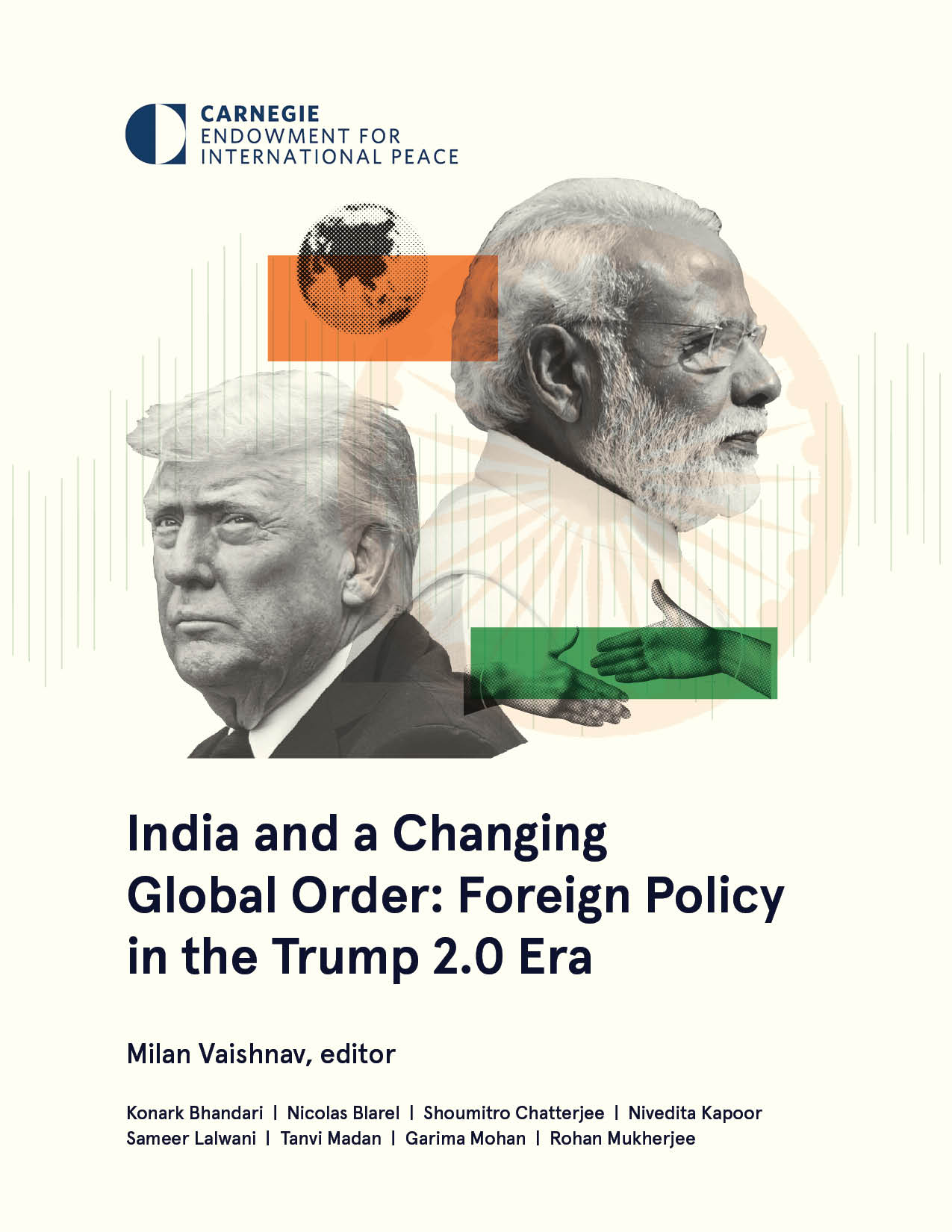
Trump 2.0 has unsettled India’s external environment—but has not overturned its foreign policy strategy, which continues to rely on diversification, hedging, and calibrated partnerships across a fractured order.



Milan Vaishnav, ed., Sameer Lalwani, Tanvi Madan, …