

Article
Amr Hamzawy
{
  "authors": [
    "Amr Hamzawy"
  ],
  "type": "legacyinthemedia",
  "centerAffiliationAll": "dc",
  "centers": [
    "Carnegie Endowment for International Peace"
  ],
  "collections": [],
  "englishNewsletterAll": "democracy",
  "nonEnglishNewsletterAll": "",
  "primaryCenter": "Carnegie Endowment for International Peace",
  "programAffiliation": "DCG",
  "programs": [
    "Democracy, Conflict, and Governance",
    "Middle East"
  ],
  "projects": [],
  "regions": [
    "Middle East",
    "Egypt"
  ],
  "topics": [
    "Political Reform",
    "Democracy",
    "Foreign Policy"
  ]
}
REQUIRED IMAGE
Source: The Daily Star
As expected, Hosni Mubarak won Egypt's presidential election on September 7. However, with a voter turnout as low as 20 percent according to independent estimates and massive irregularities reported at the polls, the regime's claim that Mubarak was confirmed democratically and by a majority of Egyptians does not have much substance.
Egypt's election day represented a step forward on the road to the opening up of a persistently authoritarian regime. It revitalized the political scene and partially minimized citizens' apathy toward politics. But to describe having nine opposition contenders against Mubarak as a historical breakthrough ignores the fact that the election was not competitive and that the election rules were clearly undemocratic.
From the start the amendment of Article 76 of the Constitution, which opened the door for candidates of opposition parties, excluded independents and therefore alienated popular political movements, such as the Muslim Brotherhood. Mubarak's regime refused to accept international monitors and effectively limited the capacity of Egyptian non-governmental organizations to oversee the election. There were widespread reports that the ruling National Democratic Party (NDP) resorted, especially in rural areas, to using state resources to mobilize support for the president. His only two serious opponents, Nouman Gomaa of the liberal Wafd and Ayman Nour of Al-Ghad, expressed doubts about the validity of the election results. Nour went so far as to stamp the election as illegitimate, echoing the position of different new protest alliances such as the Kifaya (Enough) Movement. Mubarak's allies in the West are already voicing concerns about election irregularities.
Egypt was divided on the road toward its first multi-candidate presidential election and is polarized after it. The election gave Mubarak a fifth term, but did not change his regime's autocratic character. In the absence of truly democratic practices and the broad consent of citizens, the president's legitimacy is destined to erode. The opposition, secular and religious, seems determined to contest his authority.
Yet, there is one way for the regime to solve its upcoming legitimacy crisis. During his election campaign Mubarak pledged to introduce substantial constitutional and political reforms which touched on most of the major demands in opposition platforms. He committed himself to replacing the quarter-century-old state of emergency with a more specific anti-terrorism law, amending the Constitution to limit the powers of the presidency, putting more oversight capacity in the hands of the judiciary and legislature, delegating more authority to his Cabinet, and initiating a new round of national dialogue. Should Mubarak instruct his government and the NDP to initiate these reforms and articulate specific timelines for their implementation, his credibility would benefit greatly.
The opposition will most likely welcome any steps in this direction. Opposition parties and movements have legitimate doubts as to whether Mubarak's promises will materialize and how democratically spirited these measures are going to be. After all, government reforms of the last two years fall short of opening up political life and previous rounds of national dialogue failed due to the NDP's unwillingness to compromise. But, the suspicious opposition is also well aware of its own weakness in today's Egypt and the need for the regime's consent to initiate political reform.
Mubarak's first measures in the fifth term will be subject to intense scrutiny, both domestically and internationally. The test for his commitment to political reform is approaching with the upcoming parliamentary elections this November. Should he manage to engage the opposition in healthy discussion of reform policies, there could be some reason for hope.
As friends of Mubarak and of Egypt, the United States and Europe should encourage all efforts leading to national dialogue. Their sole focus on regime reformers or on liberal politicians has proved insufficient in recent years. Western governments should use their leverage over the regime to press it to reach out to the opposition and articulate a consensus-based reform agenda. This is the only viable way to promote political reform in Egypt, a country of 77 million citizens desperate for real change.
Amr Hamzawy is senior associate in the Democracy and Rule of Law project at the Carnegie Endowment for International Peace. He wrote this commentary for THE DAILY STAR.

Director, Middle East Program
Amr Hamzawy is a senior fellow and the director of the Carnegie Middle East Program. His research and writings focus on Egypt’s and other middle powers’ involvement in regional security in the Middle East, particularly through collective diplomacy and multilateral conflict resolution
Recent Work
Amr Hamzawy


Amr Hamzawy, Andrew Leber, Eric Lob, …
Carnegie India does not take institutional positions on public policy issues; the views represented herein are those of the author(s) and do not necessarily reflect the views of Carnegie, its staff, or its trustees.

A partnership between India, a country of subcontinental size, and Africa, a continent of fifty-four countries, may seem asymmetric until one notes that both are home to nearly the same number of people—1.4 billion. This essay spells out the existing challenges to the partnership, its optimal potential, and the possible pathways to realize it over the next quarter-century.

Rajiv Bhatia

The India–EU Free Trade Agreement (FTA) is shaping up to be one of the most consequential trade negotiations, both economically and strategically. But, what’s in the agreement, what’s missing, and what will determine its success in the years ahead

Vrinda Sahai, Nicolas Köhler-Suzuki
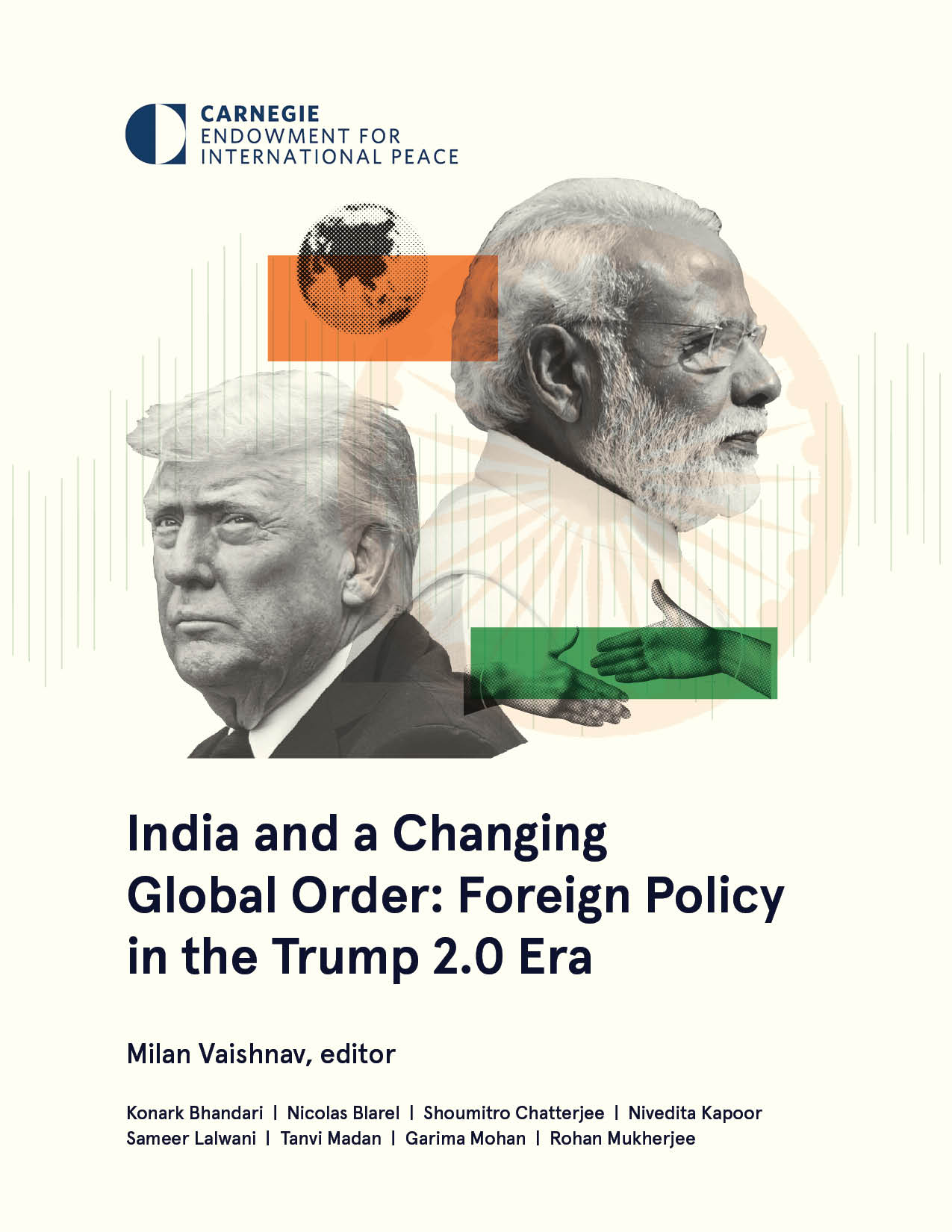
Trump 2.0 has unsettled India’s external environment—but has not overturned its foreign policy strategy, which continues to rely on diversification, hedging, and calibrated partnerships across a fractured order.



Milan Vaishnav, ed., Sameer Lalwani, Tanvi Madan, …

This piece examines India’s response to U.S. sanctions and tariffs, specifically assessing the immediate market consequences, such as alterations in import costs, and the broader strategic implications for India’s energy security and foreign policy orientation.
Vrinda Sahai
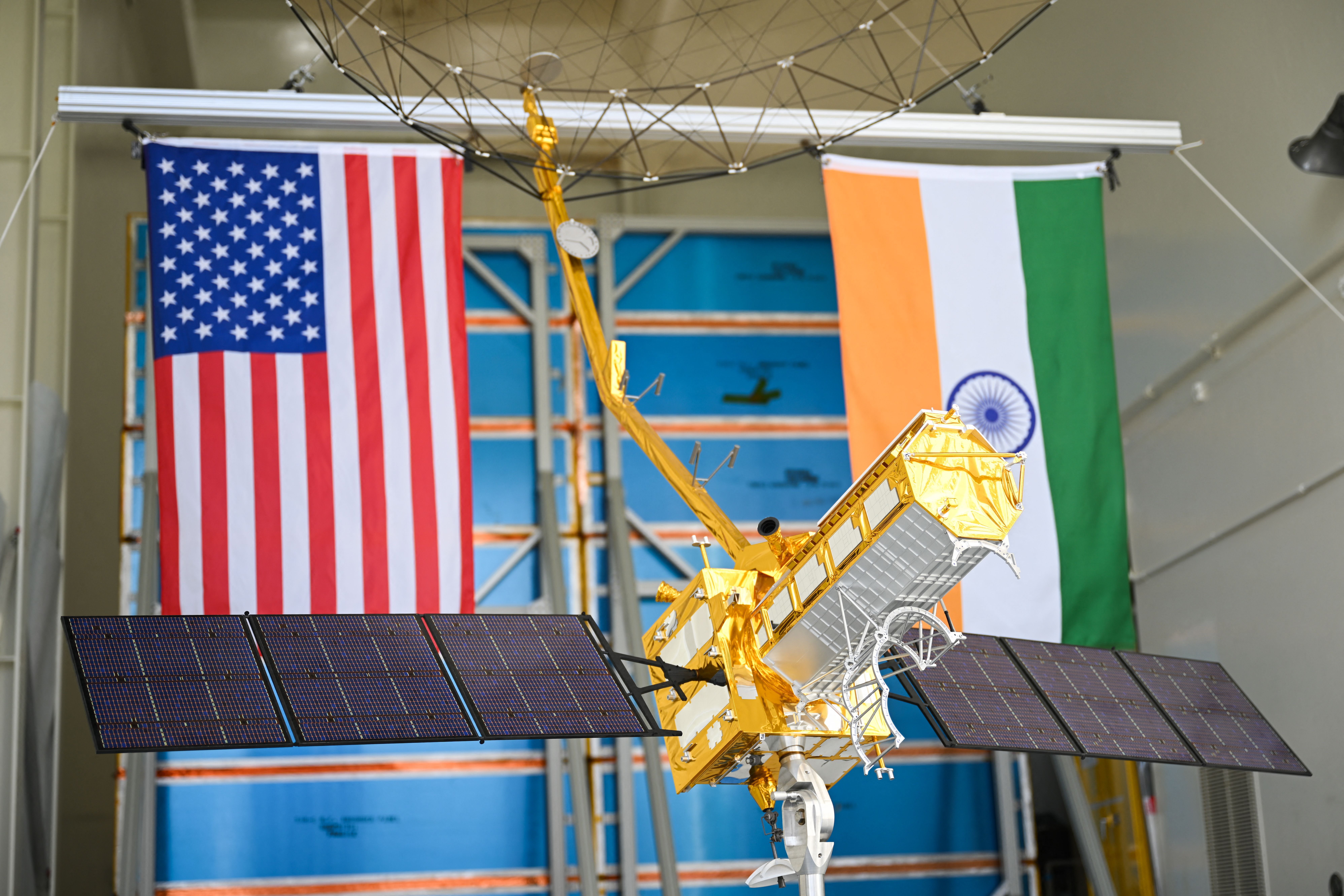
On July 30, 2025, the United States announced 25 percent tariffs on Indian goods. While diplomatic tensions simmered on the trade front, a cosmic calm prevailed at the Sriharikota launch range. Officials from NASA and ISRO were preparing to launch an engineering marvel into space—the NASA-ISRO Synthetic Aperture Radar (NISAR), marking a significant milestone in the India-U.S. bilateral partnership.

Tejas Bharadwaj