

Article
Amr Hamzawy, Kathryn Selfe
{
  "authors": [
    "Amr Hamzawy"
  ],
  "type": "legacyinthemedia",
  "centerAffiliationAll": "dc",
  "centers": [
    "Carnegie Endowment for International Peace"
  ],
  "collections": [],
  "englishNewsletterAll": "democracy",
  "nonEnglishNewsletterAll": "",
  "primaryCenter": "Carnegie Endowment for International Peace",
  "programAffiliation": "DCG",
  "programs": [
    "Democracy, Conflict, and Governance",
    "Middle East"
  ],
  "projects": [],
  "regions": [
    "Lebanon"
  ],
  "topics": [
    "Political Reform",
    "Democracy",
    "Security",
    "Military",
    "Foreign Policy"
  ]
}
Source: Getty
Secretary Ric's heralding of the birth of the new Middle East amounts to is a belittling of true hopes for change now that the reform project is devoid of credibility, for it fails to intimate a better future in Arab minds tired of the inhumanity of the Israeli military machine and the gross ugliness of its American collaborators.
Source: Al-Ahram Weekly

US Secretary of State Condoleezza Rice's address about the "new Middle East" being in the throes of a difficult birth in Lebanon provides further evidence of the vastly problematic approach involved in the Bush administration's relation to the Arab world. Washington has acquired the habit of declaring its regional vision at inopportune moments that tend to prove shocking to Arab peoples and governments alike, be they liberal or Islamic. No doubt the invasion of Iraq and occupation of Baghdad were contemporaneous with the drafting of the Middle East partnership initiative and the "Greater Middle East Initiative" endorsing democratic reform and freedom in Arab societies. Regardless of differences concerning any given reading of the true goals and intentions behind these two initiatives, at the time, no Arab politician, activist or intellectual, could help but reject the initiatives, irrespective of ideology, for they were but new episodes in the saga of imposing American hegemony on the Middle East and breaking Arab will.
Today, in the context of a savage Israeli attack on Lebanon taking place with the sanction and protection of Washington, Rice makes bold to herald the birth of the new Middle East, expressing wonder at the Arab consensus on condemning the offering of innocent blood to the idols of American and Israeli interests in the region -- particularly with regard to friendly governments and liberal elites who have been US allies. In the recent past, the Bush administration dealt Arab democratic transformation a blow by reducing the scope of its objective to fighting those regimes that had opposed it and committing a seemingly endless series of mistakes in post-Saddam Iraq. What Rice's latest address amounts to is a belittling of true hopes for change now that the reform project is devoid of credibility, for it fails to intimate a better future in Arab minds tired of the inhumanity of the Israeli military machine and the gross ugliness of its American collaborators.
On the other hand, the ideological convictions of the current resident of the White House, and many symbols of his administration, prevent an effective understanding of the complexity and interconnectedness of Middle East conflicts, pushing interpretations in a perilously reductive, unilateral direction. When he repeatedly stresses that what is happening now in Lebanon, down to the Qana massacre, is part of the global war between freedom and terrorism and hence the essential conflict of good and evil -- one that will end with the triumph of good -- President Bush is convinced of every word he says, in the sense that he forges the orientation of his administration in the framework of such simplistic imagery laden with conclusive religious symbolism.
Bush's principal concern is with the American drive to stand by the camp of "good" and defend Israel, which raises the American (ie righteous) banner in the face of the danger posed by Hizbullah terrorists. Neither the historical roots of the Israeli-Lebanese conflict nor the facts of reality -- Hizbullah's weighty role in Lebanon's internal affairs, and the destructive nature of Israeli aggression and the ways in which it undermines Siniora's government, which is close to Washington -- have managed to penetrate the ideological wall with which Bush surrounds himself. One after the other, the facts of reality fall and disappear beneath his fundamentalist conviction in the victory of the forces of good and the emergence of a new Middle East. Nor do those voices within the administration that might have reservations about such a reductive ideology, voicing them in the wider circles of American foreign policy, have any effective access to his small decision-making circles.
Reflecting its obsession with American power and overeager pursuit of national interests, the Bush administration is further characterised by impetuousness in dealing with international and regional developments as strategic opportunities for reinforcing American hegemony without the least regard for international legitimacy or material and human cost. Thus Washington engaged with 9/11 by waging a world war on terror aiming to bring down the Taliban and paralyse Al-Qaeda. Yet they went beyond that aim in altering the political geography of central Asia and neighbouring Iran, as well as putting pressure on regimes opposed to America in the Arab and Islamic world. The same method was applied to Iraq, with a military intervention that brought down Saddam and tried and failed to create a new Iraq that would re-map the Middle East.
Today, with the Israeli war on Lebanon, the Bush administration perceives opportunity to reformulate the rules of the game within Lebanon on the one hand -- a complete or partial exclusion of Hizbullah, enabling more pro-American or less anti-American elements to lay siege to Hizbullah and limit its influence -- and altering regional power relations on the other in such a way as to reduce a strategic assets of Syria (ie Hizbullah) and containing the rising influence of the Islamic republic, the greatest beneficiary of Bush's misadventure in Iraq. It is along these lines that the "new Middle East" should be understood. Washington's identification with Tel Aviv is likewise to be understood in the context of its own interests; its drive to accomplish the "mission" before a ceasefire is declared.
What Rice's eagerness to herald a new Middle East indicates is a crisis of Bush's policies. Having implicated the US in three major projects that together attempted to change the face of the Arab world, the Bush administration has so far failed to achieve any one of them. Despite its initial achievements, the war on terror cost the US a good portion of its ethical credibility due to it consistently ignoring international law and conventions and its continuing failure, even so, to eliminate a phenomenon which, if you restrict dealing with it to the arena of security and ignore its social aspects, will inevitably regenerate itself in ways even worse than before. Likewise Iraq, which following the fall of Saddam turned out to be neither a quiet colonial picnic nor a beacon of democracy spreading light across the Mashreq.
As for the project of endorsing democracy and freedom in the Arab world, it was born an orphan, due to the administration's hesitation in prioritising its strategic importance as compared with other American interests, be they hegemony, oil or Israeli security, and because it lacked any realistic mechanisms enabling its implementation in the light of Washington's friendly relations with most of the regimes in power. Soon enough, indeed, the American drive to endorse democracy turned into fear of the rising political weight of Islamic movements, which also uncovered the weakness of the liberal elites in most Arab elections -- something that imposed a state of stasis on Bush's policy in this arena. In other words, a little over a year before the end of Bush's second term, the United States seems exhausted and drained of ideas, its credibility undermined enough to endanger its Middle East interests.
Rice stepping over Lebanon is thus to be understood in the context of a desperate search for a lifebuoy to give the Bush administration respite from the endless whirlwinds of failure and refresh the conviction of ideologues concerning US abilities to form a holistic vision for the world in which the war on terror can sit happily with both freedom and the drive to get rid of oppositional forces. Arabs would be mistaken to think Rice's address was directed at them; all the more that it is a turning point in current developments. It is but a regurgitation of the same old ideas, undertaken for the exclusive benefit of the Bush administration.

Director, Middle East Program
Amr Hamzawy is a senior fellow and the director of the Carnegie Middle East Program. His research and writings focus on Egypt’s and other middle powers’ involvement in regional security in the Middle East, particularly through collective diplomacy and multilateral conflict resolution
Recent Work
Amr Hamzawy, Kathryn Selfe
Amr Hamzawy
Carnegie India does not take institutional positions on public policy issues; the views represented herein are those of the author(s) and do not necessarily reflect the views of Carnegie, its staff, or its trustees.

After the chill in ties between 2020 and 2024 that brought India–China relations to their lowest point in several decades, the two countries have engaged each other afresh. This paper argues that there are predominantly four imperatives guiding India’s approach to China, and they exist in an order of priority.

Saheb Singh Chadha

This piece argues that India’s central challenge is not managing a single flashpoint but resolving the underlying tension between expansion and institutional coherency of the BRICS grouping.

Vrinda Sahai

A partnership between India, a country of subcontinental size, and Africa, a continent of fifty-four countries, may seem asymmetric until one notes that both are home to nearly the same number of people—1.4 billion. This essay spells out the existing challenges to the partnership, its optimal potential, and the possible pathways to realize it over the next quarter-century.

Rajiv Bhatia

The India–EU Free Trade Agreement (FTA) is shaping up to be one of the most consequential trade negotiations, both economically and strategically. But, what’s in the agreement, what’s missing, and what will determine its success in the years ahead
Vrinda Sahai, Nicolas Köhler-Suzuki
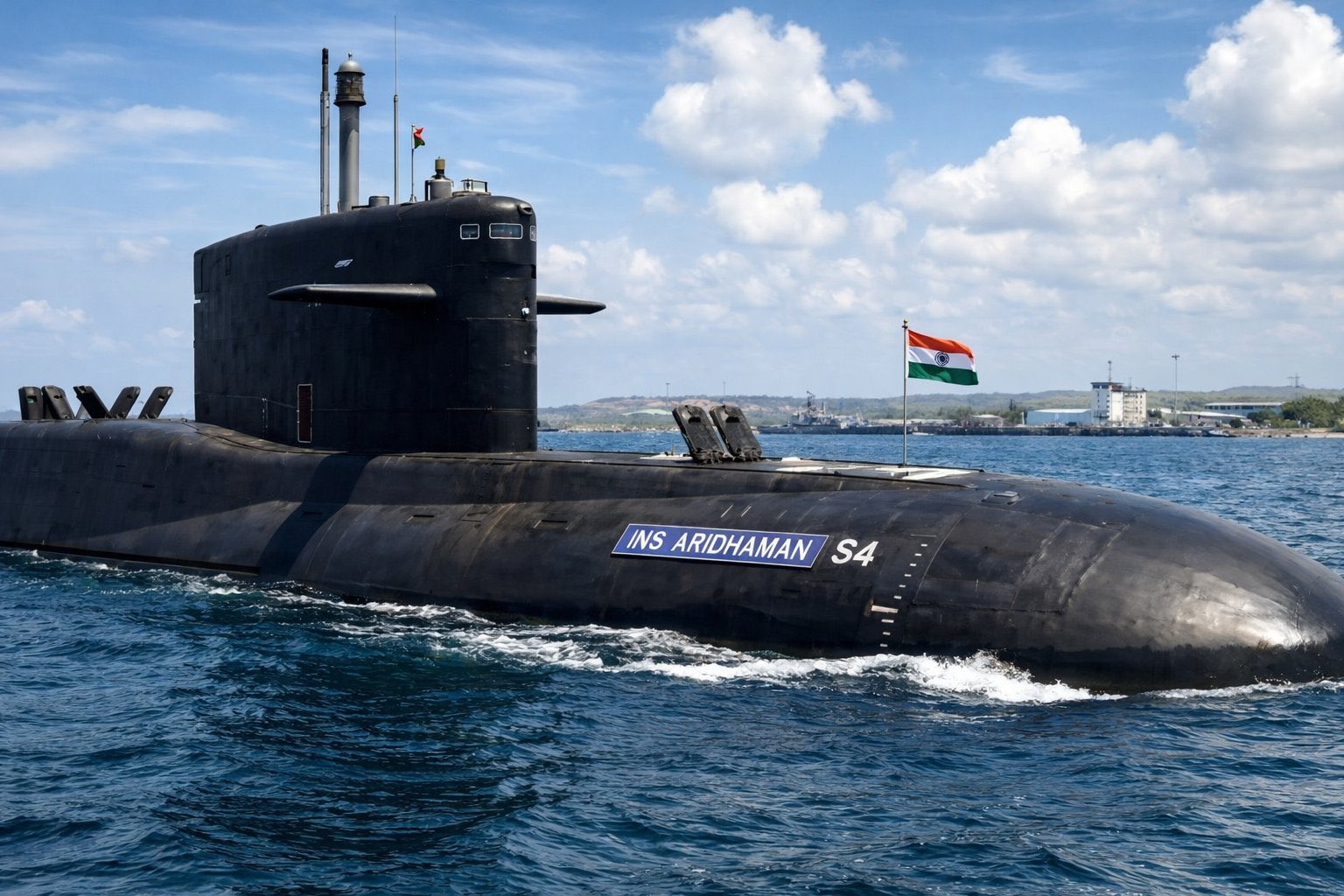
The induction of INS Aridhaman, which features several technological enhancements, now gives India the third nuclear ballistic missile submarine to ensure continuous at-sea deterrent.

Dinakar Peri