

Q&A
- +2
Judy Dempsey, Alexander Gabuev, Rose Gottemoeller, …
{
  "authors": [
    "Rose Gottemoeller"
  ],
  "type": "legacyinthemedia",
  "centerAffiliationAll": "dc",
  "centers": [
    "Carnegie Endowment for International Peace"
  ],
  "collections": [
    "Korean Peninsula"
  ],
  "englishNewsletterAll": "ctw",
  "nonEnglishNewsletterAll": "",
  "primaryCenter": "Carnegie Endowment for International Peace",
  "programAffiliation": "russia",
  "programs": [
    "Russia and Eurasia",
    "Nuclear Policy"
  ],
  "projects": [],
  "regions": [
    "Middle East",
    "Iran",
    "South Korea",
    "Caucasus",
    "Russia"
  ],
  "topics": [
    "Foreign Policy",
    "Nuclear Policy"
  ]
}
REQUIRED IMAGE
Source: International Herald Tribune
MOSCOW Iran has answered its opponents at the negotiating table, and a clever answer it is. In June, the five permanent members of the UN Security Council plus Germany proposed a package of incentives to Iran, but they also warned of sanctions if Tehran did not agree to suspend uranium enrichment. The Iranians have come back sounding eminently reasonable, requesting an immediate return to "serious talks" - but they also have said nothing about suspending enrichment.
So the "five-plus-one" team now faces a serious challenge: Can the coalition hold together to implement sanctions against Iran when it fails to suspend enrichment on Aug. 31? Russia and the United States have had very different views of the effectiveness of sanctions, and Iran seems intent on splitting these two strong countries apart.
The issue becomes more urgent with the reality that sooner or later, the United States, Russia and their partners are bound to sit down again with North Korea, the other country threatening damage to the nonproliferation regime.
On the face of it, Russia and the United States have a history that will help them. They have been leaders in preventing nuclear proliferation since they joined forces to negotiate the Nuclear Nonproliferation Treaty in the 1960s. As the two largest nuclear weapon states, they have had a special responsibility to lead by example - reducing their own arsenals - as well as preventing the further spread of nuclear weapons.
In the past decade, Moscow and Washington have often fallen down on the first task by failing to negotiate new reductions in nuclear weapons. They have, however, succeeded in reducing nuclear potential. Alone and in concert, they have closed down or shrunk key weapons-production facilities and disposed of tons of weapons-useable nuclear material.
The United States and Russia are accustomed to working together to solve tough proliferation problems. Cooperation in this area is vulnerable, though, when attention in both capitals swings to the latest dire crises, as it has today to the Iran nuclear program. Joint programs that are vital to reducing nuclear weapons potential begin to sink into the swamps of politics and bureaucracy. Two programs are in this fix today - one to dispose of weapons plutonium, the other to prevent more plutonium from being produced.
In the 1990s, the United States and Russia agreed to cooperate on these tasks, vital to slashing their potential to produce new nuclear weapons. Today, Washington and Moscow are working together to shut down Russia's plutonium-production reactors. The United States is bearing a significant share of the cost of the project and is closely involved in design and construction.
And both Russia and the United States are ramping up efforts to dispose of weapons plutonium.
Sadly, this new momentum may be stalling. The U.S. Congress has taken notice of past problems with the programs, and has decided to cut their funding for 2007. The Senate cut $206 million from the program to replace the plutonium reactors, saying that Russia with its oil wealth should now be able to contribute more for the program. The House of Representatives has cut funding from the program to destroy plutonium, arguing that the two countries can't even agree on the technical details of how to go about it, much less figure out how to pay for it all.
Both arguments have some truth to them, but they could not come at a worse time. If the United States and Russia lose their close cooperation on weapons plutonium, they will severely undermine the basis for their joint fight against nuclear proliferation.
President George W. Bush and President Vladmir Putin of Russia will have to refocus their attention on these problems. The experts should be able to agree on the technical options for dealing with plutonium, and what each will cost. With Putin's urging, the Russians could see their way clear to making a bigger contribution to these joint programs.
If the plutonium programs are killed in Congress, then Moscow and Washington will have lost a big battle in the fight against nuclear proliferation. And when the negotiating game gets tough, they may even find that they no longer have the joint will to counter the nuclear ambitions of Iran and North Korea.
Rose Gottemoeller is the director of the Carnegie Moscow Center. She was assistant U.S. secretary of energy responsible for nonproliferation programs during the Clinton administration.
Originally published in the International Herald Tribune.

Nonresident Senior Fellow, Nuclear Policy Program
Rose Gottemoeller is a nonresident senior fellow in Carnegie’s Nuclear Policy Program. She also serves as lecturer at Stanford University’s Freeman Spogli Institute for International Studies and is a research fellow at the Hoover Institution. Ambassador Gottemoeller served as the deputy secretary general of NATO from 2016 to 2019.
Recent Work


Judy Dempsey, Alexander Gabuev, Rose Gottemoeller, …
Carnegie India does not take institutional positions on public policy issues; the views represented herein are those of the author(s) and do not necessarily reflect the views of Carnegie, its staff, or its trustees.

After the chill in ties between 2020 and 2024 that brought India–China relations to their lowest point in several decades, the two countries have engaged each other afresh. This paper argues that there are predominantly four imperatives guiding India’s approach to China, and they exist in an order of priority.

Saheb Singh Chadha

This piece argues that India’s central challenge is not managing a single flashpoint but resolving the underlying tension between expansion and institutional coherency of the BRICS grouping.

Vrinda Sahai

A partnership between India, a country of subcontinental size, and Africa, a continent of fifty-four countries, may seem asymmetric until one notes that both are home to nearly the same number of people—1.4 billion. This essay spells out the existing challenges to the partnership, its optimal potential, and the possible pathways to realize it over the next quarter-century.

Rajiv Bhatia

The India–EU Free Trade Agreement (FTA) is shaping up to be one of the most consequential trade negotiations, both economically and strategically. But, what’s in the agreement, what’s missing, and what will determine its success in the years ahead
Vrinda Sahai, Nicolas Köhler-Suzuki
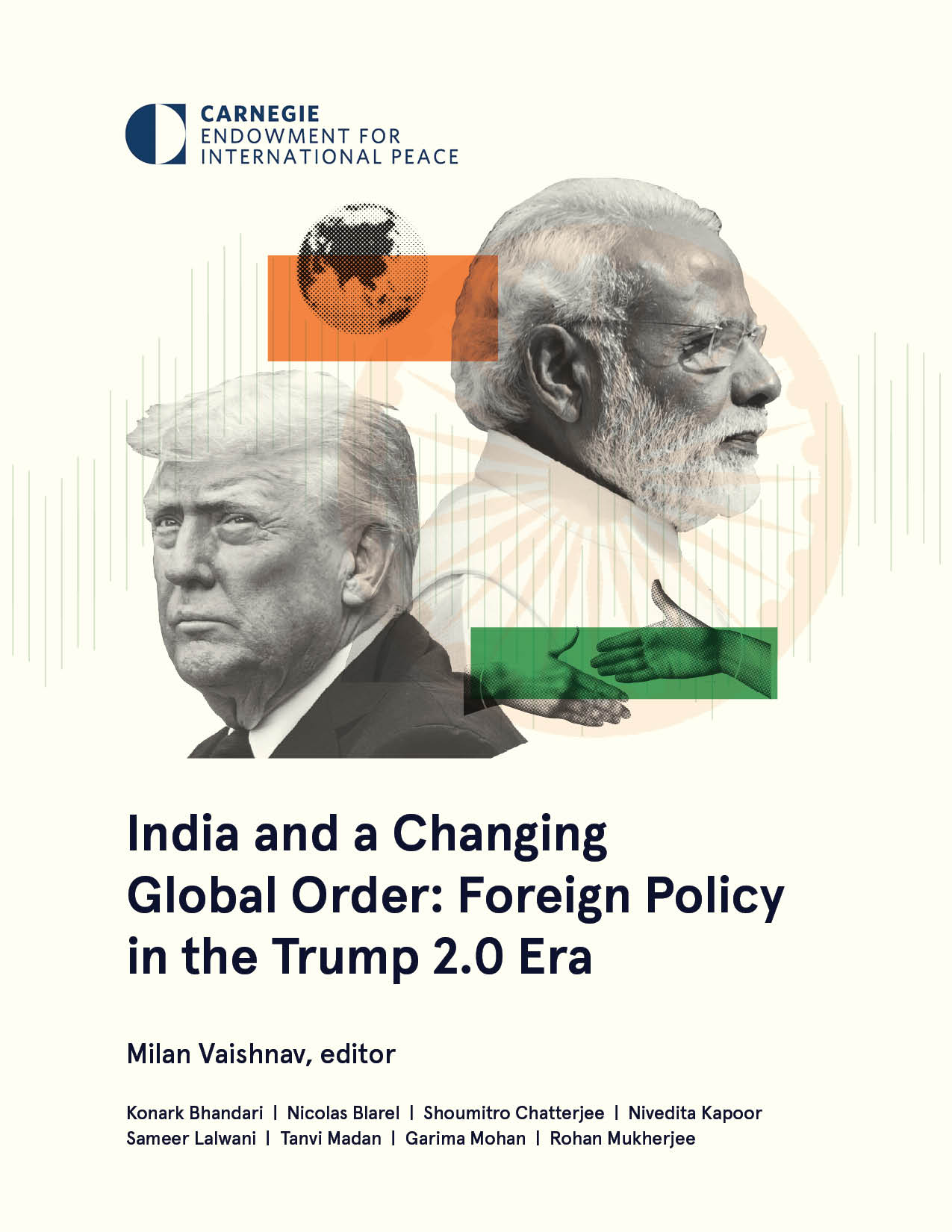
Trump 2.0 has unsettled India’s external environment—but has not overturned its foreign policy strategy, which continues to rely on diversification, hedging, and calibrated partnerships across a fractured order.



Milan Vaishnav, ed., Sameer Lalwani, Tanvi Madan, …