

Commentary
Maria Lipman
{
  "authors": [
    "Maria Lipman"
  ],
  "type": "legacyinthemedia",
  "centerAffiliationAll": "",
  "centers": [
    "Carnegie Endowment for International Peace",
    "Carnegie Russia Eurasia Center"
  ],
  "collections": [],
  "englishNewsletterAll": "",
  "nonEnglishNewsletterAll": "",
  "primaryCenter": "Carnegie Russia Eurasia Center",
  "programAffiliation": "",
  "programs": [],
  "projects": [],
  "regions": [
    "Caucasus",
    "Russia"
  ],
  "topics": [
    "Foreign Policy"
  ]
}
Source: Getty
Kosovo has evolved as an issue of consensus among the Russian leadership as well as the public. The Russian people – from nationalist hawks to liberal Westernizers – all agree: Kosovo independence is not a good idea.
Source: Washington Post’s PostGlobal

Kosovo has evolved as an issue of consensus among the Russian leadership as well as the public. The Russian people – from nationalist hawks to liberal Westernizers – all agree that Kosovo independence is not a good idea.
Affinity with Serbia and the Serbs does not play an important role. Slavic or Orthodox brotherhood may be an issue for those on the nationalist front, but otherwise it’s of little interest here.
For moderate Russians, Kosovo’s independence in itself may be OK —it is its recognition by Western countries that matters. Independent political commentators, as well those among the intellectual circles, believe that the West is creating a dangerous precedent by effectively enforcing a division of a country (Serbia) without its consent; that the West disregards the consequences of such an enforcement - not just in Abkhazia or South Ossetia, the two secessionist territories of Georgia, but elsewhere in the world.
In her Washington Post column last week, Anne Applebaum warned the “denizens of the Kremlin” against irresponsible policy toward Abkhazia and South Ossetia; she wrote about the risks of effectively encouraging the secessionist aspirations of these territories. Indeed, a recognition of Abkhazia and South Ossetia will hardly benefit Russia. It may have a strong negative effect, such as a destabilization at the Russian southern borders.
But the Russian leadership appears to be well aware of this and to take a rational approach to this issue. In fact, everyone from Putin himself to hawkish right-wing officials to liberal analysts has stated quite unambiguously that Russia would not move to recognize the claims of Abkhazia or South Ossetia for independent statehood.
Russia's own strategy vis-a-vis Abkhazia and South Ossetia has been to freeze those conflicts, and so far this approach has worked reasonably well. At least, for quite some time there have not been large-scale hostilities in either of these regions.
The case of Kosovo illustrates, first and foremost, the irreconcilable differences between Russia and the West and the failure of the existing international institutions to help them find a compromise. Each side is guided by its own priorities. The West has actively interfered with the Kosovo crisis, it has supported Kosovo’s quest for independent statehood and invested a great deal of human and financial resources in this region. It has overseen the administration and development of Kosovo over the past years. So from a western standpoint, it looks natural that Kosovo independence should be promoted and enforced.
Meanwhile, Russia was vehemently against the bombing of Yugoslavia to begin with. It could not effectively oppose the bombing, and the West simply ignored Russia’s protest. At the time the attempt by a group of Russian servicemen to bar the way to NATO troops was not just a pathetic failure, it was a symbolic expression of Russia’s weakness. It is thus hard to expect that now that Russia has reasserted itself on the world scene, it should come on board with the West as it proceeds with its Kosovo policy. A desire to make up for the past humiliation appears to be a much more natural response.
It is almost a universal belief in Russia that the West consistently takes advantage of Russia’s weakness, and the West’s Kosovo policy was a most graphic example of this strategy. This perception of the Western motives causes bitterness and anger among the Russian people. Some may say that such a perception is not justified. Not infrequently, however, words by western policy-makers, experts or pundits reinforce this Russian bitterness.
Take, for instance, what Richard Holbrooke, a prominent US foreign-policy figure, told The New Yorker magazine in the fall of 2007: “The Bush Administration had an open glide path to Kosovo independence during its first term…. (when) the United States was globally dominant, and, most important, the Russians were still flat on their back.”
This article was originally posted in the Washington Post’s PostGlobal, February 25, 2008.

Former Scholar in Residence, Society and Regions Program, Editor in Chief, Pro et Contra, Moscow Center
Lipman was the editor in chief of the Pro et Contra journal, published by the Carnegie Moscow Center. She was also the expert of the Carnegie Moscow Center’s Society and Regions Program.
Recent Work
Maria Lipman
Maria Lipman
Carnegie India does not take institutional positions on public policy issues; the views represented herein are those of the author(s) and do not necessarily reflect the views of Carnegie, its staff, or its trustees.

After the chill in ties between 2020 and 2024 that brought India–China relations to their lowest point in several decades, the two countries have engaged each other afresh. This paper argues that there are predominantly four imperatives guiding India’s approach to China, and they exist in an order of priority.

Saheb Singh Chadha

This piece argues that India’s central challenge is not managing a single flashpoint but resolving the underlying tension between expansion and institutional coherency of the BRICS grouping.

Vrinda Sahai

A partnership between India, a country of subcontinental size, and Africa, a continent of fifty-four countries, may seem asymmetric until one notes that both are home to nearly the same number of people—1.4 billion. This essay spells out the existing challenges to the partnership, its optimal potential, and the possible pathways to realize it over the next quarter-century.

Rajiv Bhatia

The India–EU Free Trade Agreement (FTA) is shaping up to be one of the most consequential trade negotiations, both economically and strategically. But, what’s in the agreement, what’s missing, and what will determine its success in the years ahead
Vrinda Sahai, Nicolas Köhler-Suzuki
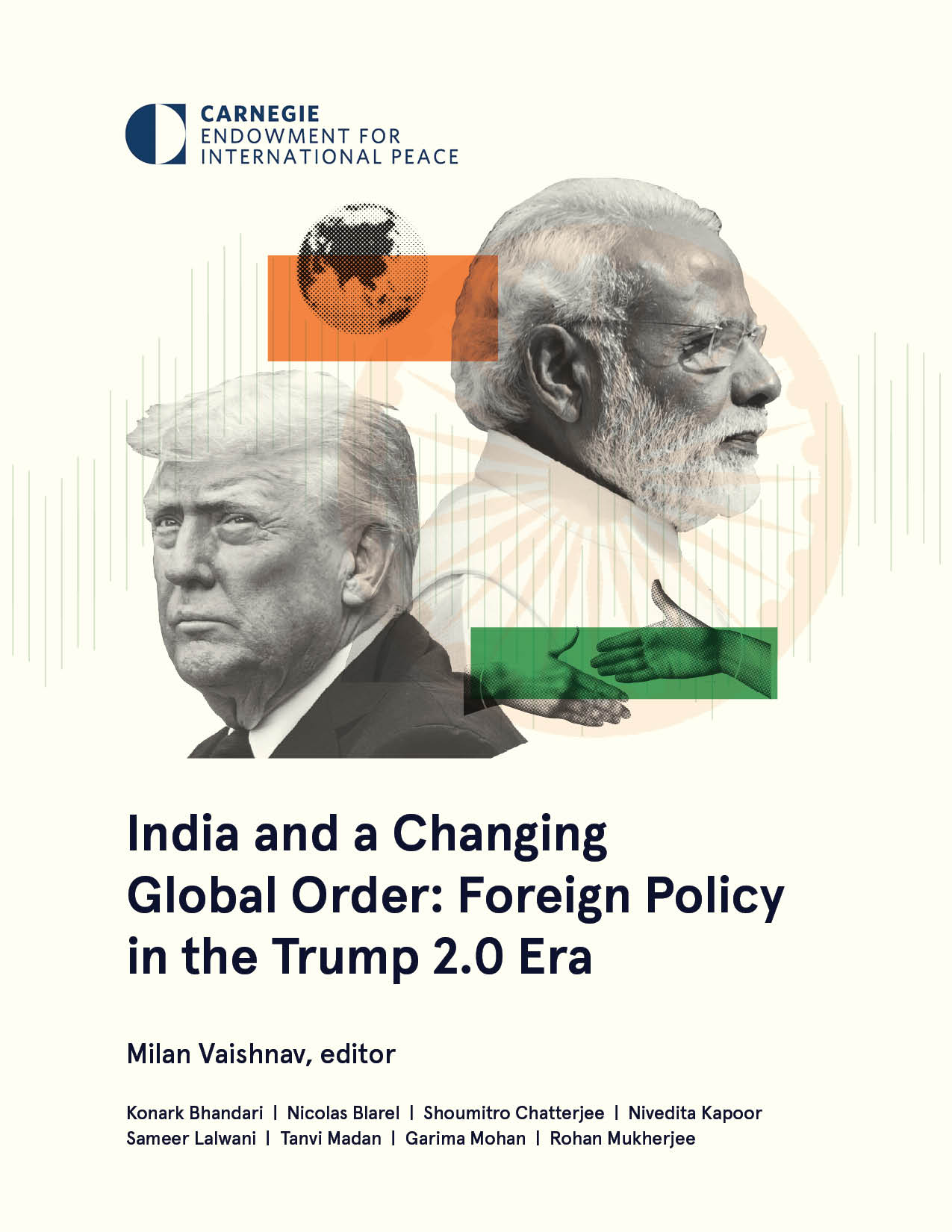
Trump 2.0 has unsettled India’s external environment—but has not overturned its foreign policy strategy, which continues to rely on diversification, hedging, and calibrated partnerships across a fractured order.



Milan Vaishnav, ed., Sameer Lalwani, Tanvi Madan, …