

Article
Thomas Carothers
{
  "authors": [
    "Thomas Carothers"
  ],
  "type": "testimony",
  "centerAffiliationAll": "dc",
  "centers": [
    "Carnegie Endowment for International Peace"
  ],
  "collections": [
    "Democracy and Governance"
  ],
  "englishNewsletterAll": "democracy",
  "nonEnglishNewsletterAll": "",
  "primaryCenter": "Carnegie Endowment for International Peace",
  "programAffiliation": "DCG",
  "programs": [
    "Democracy, Conflict, and Governance"
  ],
  "projects": [],
  "regions": [],
  "topics": [
    "Political Reform",
    "Democracy",
    "Foreign Policy"
  ]
}
Source: Getty
Democracy assistance, once a bipartisan initiative, has come under threat in recent years, but the Obama administration has a unique opportunity to effectively promote democracy around the world.
Source: Cornell University
Democracy assistance, once a bipartisan initiative, has come under threat in recent years. After a decade of unprecedented democratic growth in the 1990s, democracy appears to have stagnated in the beginning of the 21st century. Additionally, the Bush administration damaged the reputation of U.S. democracy promotion by associating it with American military interventions and the pursuit of selfish interests. Yet, Thomas Carothers explained at Cornell University’s Einaudi Center for International Studies, it would be a mistake to see the Bush administration’s foreign policy as an expression of excessive democracy promotion. President Bush spoke eloquently on democracy, but the administration in fact pursued a realist policy in the war on terror, maintaining close relationships with authoritarian governments and proving willing to violate human rights.
Despite the inherent difficulties, Carothers asserted, President Obama cannot and should not avoid democracy promotion. The idea of democracy is too intertwined with America’s self-image and too important in the world to be ignored. The Obama administration understandably wants to distance itself from Bush era policies, but the problem was how the Bush administration promoted democracy, not democracy promotion itself. In fact, President Obama has a unique opportunity to effectively promote democracy around the world, Carothers added. Obama’s inspiring personal story and the global excitement surrounding his election, as well as his inclination towards cooperation and moderation, provide him with tools for rallying global support around democracy. The administration has already made encouraging steps in promising to close Guantanamo Bay prison, but Carothers concluded that it will need to go farther and articulate a positive vision for democracy promotion.

Harvey V. Fineberg Chair for Democracy Studies; Senior Fellow, Democracy, Conflict, and Governance Program
Thomas Carothers, a senior fellow in the Carnegie Endowment for International Peace’s Democracy, Conflict, and Governance Program, is a leading expert on comparative democratization and international support for democracy.
Recent Work
Thomas Carothers
Thomas Carothers
Carnegie India does not take institutional positions on public policy issues; the views represented herein are those of the author(s) and do not necessarily reflect the views of Carnegie, its staff, or its trustees.

After the chill in ties between 2020 and 2024 that brought India–China relations to their lowest point in several decades, the two countries have engaged each other afresh. This paper argues that there are predominantly four imperatives guiding India’s approach to China, and they exist in an order of priority.

Saheb Singh Chadha

This piece argues that India’s central challenge is not managing a single flashpoint but resolving the underlying tension between expansion and institutional coherency of the BRICS grouping.

Vrinda Sahai

A partnership between India, a country of subcontinental size, and Africa, a continent of fifty-four countries, may seem asymmetric until one notes that both are home to nearly the same number of people—1.4 billion. This essay spells out the existing challenges to the partnership, its optimal potential, and the possible pathways to realize it over the next quarter-century.

Rajiv Bhatia

The India–EU Free Trade Agreement (FTA) is shaping up to be one of the most consequential trade negotiations, both economically and strategically. But, what’s in the agreement, what’s missing, and what will determine its success in the years ahead
Vrinda Sahai, Nicolas Köhler-Suzuki
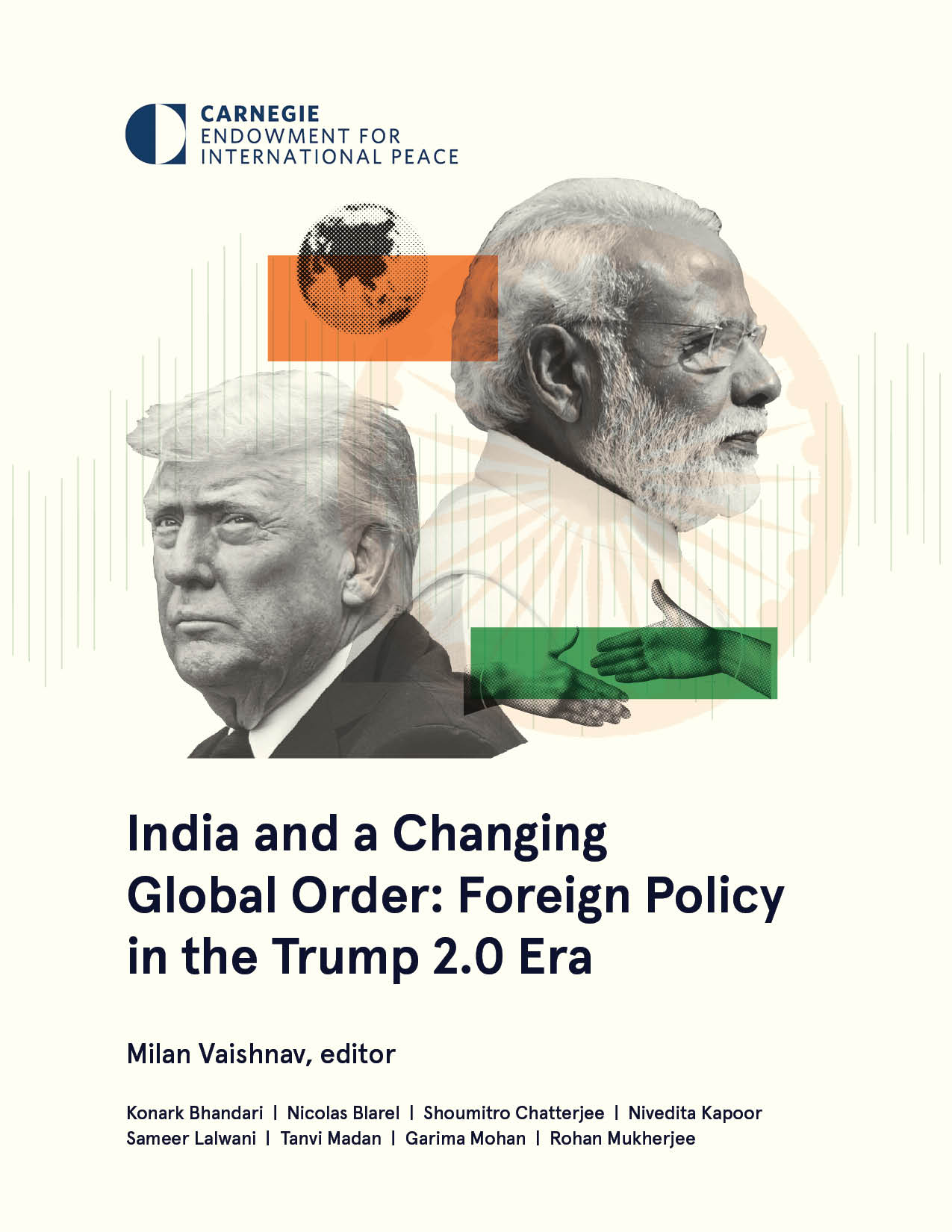
Trump 2.0 has unsettled India’s external environment—but has not overturned its foreign policy strategy, which continues to rely on diversification, hedging, and calibrated partnerships across a fractured order.



Milan Vaishnav, ed., Sameer Lalwani, Tanvi Madan, …