

Feature
A one-stop source for following crucial trends in the most significant antigovernment protests worldwide since 2017. Last updated on September 9, 2026.
{
  "authors": [
    "Thomas Carothers",
    "McKenzie Carrier"
  ],
  "type": "commentary",
  "blog": "Emissary",
  "centerAffiliationAll": "dc",
  "centers": [
    "Carnegie Endowment for International Peace"
  ],
  "collections": [
    "Global Democracy"
  ],
  "englishNewsletterAll": "democracy",
  "nonEnglishNewsletterAll": "",
  "primaryCenter": "Carnegie Endowment for International Peace",
  "programAffiliation": "DCG",
  "programs": [
    "Democracy, Conflict, and Governance"
  ],
  "regions": [
    "Iran"
  ],
  "topics": [
    "Democracy",
    "Domestic Politics"
  ]
}
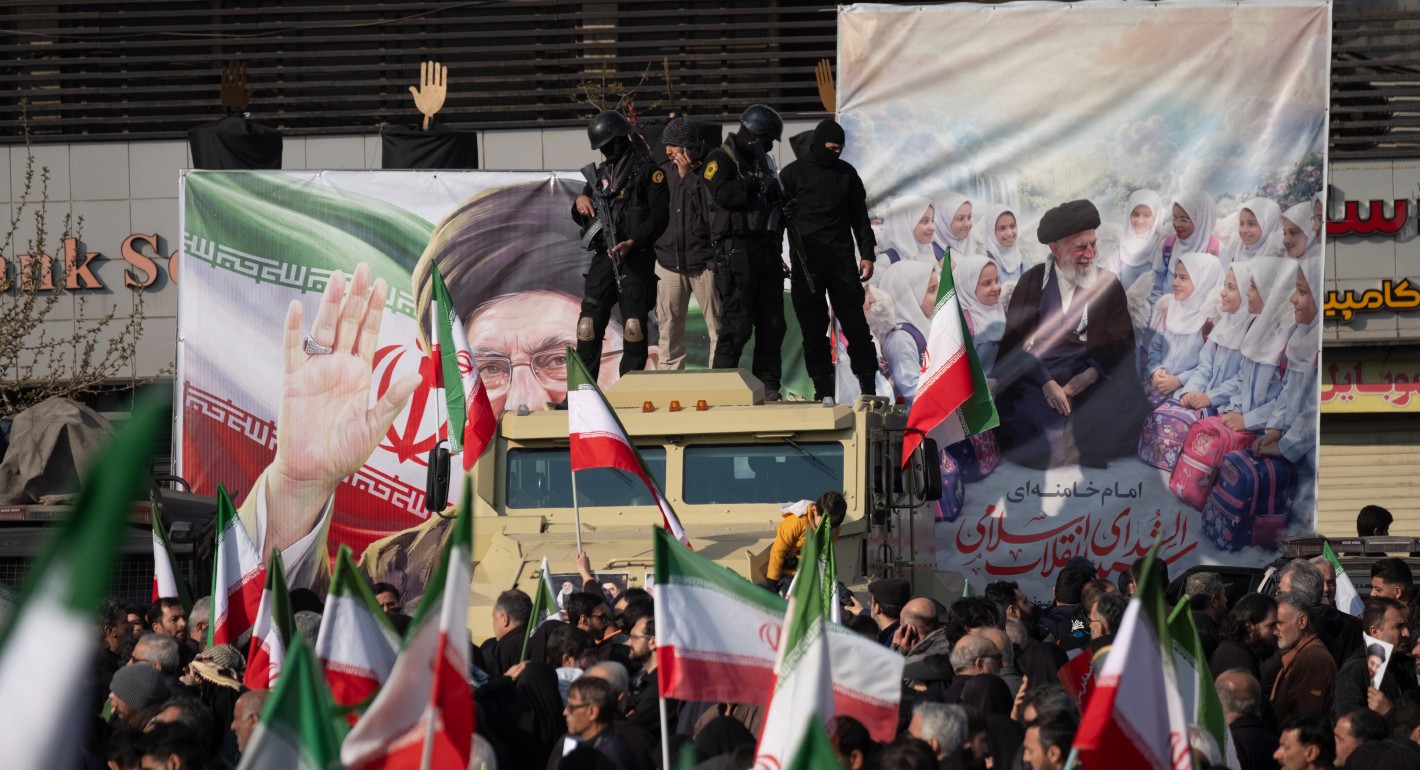
Iran’s Special Police Forces monitor a rally for Supreme Leader Mojtaba Khamenei in Tehran on March 9, 2026. (Photo by Morteza Nikoubazl/NurPhoto via Getty Images)
The recent record of citizen uprisings in autocracies spells caution for the hope that a new wave of Iranian protests may break the regime’s hold on power.
The statements from President Donald Trump’s administration about its objectives in Iran have varied widely since it first launched military strikes against the country on February 28. But within this changing story, the hope of regime change is clearly on the table. In his initial recorded video statement announcing the intervention, Trump called on Iranians to rise up and overthrow the government once the United States finished its military action. He reiterated the point a day later when he told the Iranian public to seize the moment to take back their country.
Multiple experts have attempted to assess the likelihood of success of a new citizen uprising against the Iranian government. Some, like Suzanne Maloney, take a pessimistic line, arguing that “the opposition is divided, unarmed, and unable to easily communicate. Iran’s ballistic missiles and nuclear program may be decimated, but it still has the guns to kill protesters or coup plotters.” Others are more optimistic, such as Michael Stephens and John Kennedy, who believe that there “is the possibility of a popular uprising actually succeeding” if Iranians “take to the streets and face the remnants of a tyrannical regime willing to fight to remain in power.”
Focusing on specific elements of the Iranian context, as these various analyses do, is vital to any such assessment. But a broader comparative look is also useful. Large-scale anti-government protests seeking to overturn undemocratic regimes have erupted in numerous places over the past ten years, from Algeria and Bangladesh to Nicaragua and Myanmar. What has been their record of success, and what light does it shed on what might happen in Iran?
Many cases of stubborn authoritarian resilience in the face of mass protests have occurred in the past ten years. They include Nicaragua in 2018; Belarus and Thailand in 2020; Myanmar in 2021; Georgia, Mozambique, and Venezuela in 2024; and Tanzania in 2025—and of course Iran itself, both in 2022 and again in December 2025–January 2026. In some of these cases, a clear trigger sparked the protests: stolen elections in Belarus, Mozambique, Tanzania, and Venezuela; a paused EU accession bid followed by a fraudulent election in Georgia; and a coup in Myanmar. In others, such as Iran, Nicaragua, and Thailand, multiple smaller grievances ignited citizens’ anger over turgid, repressive governance. In some, the protests were long-lasting, like in Georgia, Thailand, and Myanmar, where protests continued for over one to two years. In others, like Belarus, Nicaragua, and Tanzania, they were fully suppressed within a few weeks or months.
The repressive measures taken by these governments against the protesters have broadly resembled one another, following a relentless authoritarian playbook that includes targeted surveillance that is increasingly powered by digital technologies, mass arrests, detention or imprisonment, and financial retribution, alongside fabricated, often hysterically overwrought narratives of foreign conspiracies. Violence by police and other security forces was a major part of the story in most cases, although the extremity of the violence varied widely. Iran and Myanmar have experienced extraordinarily high levels of violence, with protesters killed numbering well over 5,000 in both cases, and possibly as high as 30,000 in Iran. Mozambique, Nicaragua, and Tanzania saw hundreds killed; Venezuela, dozens. In Belarus, Georgia, Thailand, the government met protests with force—with security services employing tear gas, water cannons, rubber bullets, and beatings against protesters—but not with large-scale murder.

A one-stop source for following crucial trends in the most significant antigovernment protests worldwide since 2017. Last updated on September 9, 2026.
The shape of the protest movements in these cases has also varied. In Iran and Thailand, the protests were relatively spontaneous, leaderless demonstrations, erupting and mushrooming very suddenly with little clear organizational pattern or structure. In most of the others, while protests broke out spontaneously, civic and political organizations undergirded the movements to varying degrees, providing some structure and leadership. Young people were a major part of all the protests. In some, like Belarus and Myanmar, women played a substantial role.
There have also been at least seven cases where mass protests have forced some change in undemocratic contexts: Armenia in 2018; Algeria, Bolivia, and Sudan in 2019; Sri Lanka in 2022; Bangladesh in 2024; and Madagascar in 2025. In most of these cases, however, the governing systems were not fully autocratic. Instead, they were electoral autocracies with some space for political organizing, functioning (albeit usually besieged) political oppositions, and regular, at least somewhat meaningful elections. In these cases, the protests achieved the ouster of a president, sometimes followed by a significant alternation of power in favor of new or renewed opposition forces, but they were not about completely uprooting a fully closed political system. In Algeria and Sudan, the systems were fully autocratic. However, the change achieved was limited to the toppling of the person at the top; the ruling military establishments remained in control.
Bangladesh is the only case of a substantially autocratic context (though still “partly free” according to Freedom House) where protests succeeded in overturning the whole system of power. Prime Minister Sheikh Hasina put the full authoritarian playbook to work against the wave of demonstrators who rose up in July 2024, including the killing of an estimated 1,400 people. Yet in the course of only thirty-five days, the protests caused her to flee the country and triggered a full political reset. Crucial to the success of the protests were two factors: their enormous size, gathering crowds with hundreds of thousands of participants, and the rapid fragmentation of the ruling system, with elements of the military, the judiciary, and the official bureaucracy distancing themselves from the government.
Overall, the comparative record of mass protests against undemocratic governments is daunting. In significantly authoritarian contexts—such as Iran—large-scale outbreaks of citizen mobilization have succeeded only once in the past ten years in breaking the hold of the existing regime. Even relatively well-organized, resolute protests underpinned by coherent civic networks have been successfully repressed. In all the other cases where protests did achieve some significant change, the political systems were only partly autocratic, the change was only that of a leader but not the system, or both.
Moreover, in Iran, the fact that the regime massacred an extraordinarily large number of people in the December 2025–January 2026 demonstrations means that thousands of those Iranians most inclined to protest have been killed or imprisoned, potentially robbing a new protest wave of many of its most determined players.
Yet every national context is different, and while the comparative record is relatively clear, it is not a straitjacket. Iran is unusual in having experienced multiple successive waves of enormous anti-government protests over the past twenty years, making clear the extremely deep and wide citizen anger toward the ruling system. And the relentless military strikes by the United States and Israel against the Iranian military and security establishment have undoubtedly corroded its capacity (although not necessarily its will) to beat back any new protest wave. At the same time, as Marwan Muasher observes, the U.S. decimation of Saddam Hussein’s military in the 1991 Gulf War and U.S. calls for Iraqis to “fill the streets and alleys and bring down Saddam Hussein and his aides” did not lead to a successful citizen uprising against the Iraqi dictator.
This unusually complex mix of distinctive features of the Iranian context and the weight of the comparative record underlines the need for caution with regard to all efforts to predict the outcome of any renewed citizen uprising in the months ahead.
The latest from Carnegie scholars on the world’s most pressing challenges, delivered to your inbox.

Harvey V. Fineberg Chair for Democracy Studies; Senior Fellow, Democracy, Conflict, and Governance Program
Thomas Carothers, a senior fellow in the Carnegie Endowment for International Peace’s Democracy, Conflict, and Governance Program, is a leading expert on comparative democratization and international support for democracy.

Former Research Assistant, Democracy, Conflict, and Governance Program
McKenzie Carrier was a research assistant in the Democracy, Conflict and Governance Program.
Carnegie does not take institutional positions on public policy issues; the views represented herein are those of the author(s) and do not necessarily reflect the views of Carnegie, its staff, or its trustees.
It signals a new era of tech diffusion and warfare.

Steve Feldstein
The conflict has sent economic and political shock waves through a country with no representation at the negotiating table—and Kenya is not alone.
Georgia Schaefer-Brown, Jane Munga
The targeting of Damietta Port appears to be more than a mere security message.

Amr Hamzawy
Despite the agreement’s uncertainty, it’s still a significant development in regional and nuclear policy.


Andrew Leber, Jane Darby Menton
By burying disagreements in imprecision, the new deal risks same fate as its predecessors.

James M. Acton