

Commentary
How is AI reshaping space security, creating governance challenges, and where does international diplomacy stand today?
Tejas Bharadwaj, Almudena Azcárate Ortega
{
  "authors": [
    "James M. Acton",
    "George Perkovich"
  ],
  "type": "legacyinthemedia",
  "centerAffiliationAll": "dc",
  "centers": [
    "Carnegie Endowment for International Peace"
  ],
  "collections": [
    "U.S. Nuclear Policy"
  ],
  "englishNewsletterAll": "ctw",
  "nonEnglishNewsletterAll": "",
  "primaryCenter": "Carnegie Endowment for International Peace",
  "programAffiliation": "NPP",
  "programs": [
    "Nuclear Policy"
  ],
  "projects": [],
  "regions": [
    "North America",
    "United States"
  ],
  "topics": [
    "Nuclear Policy"
  ]
}
Source: Getty
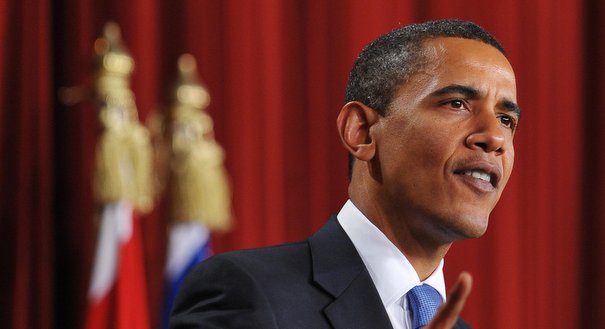
A new nuclear resolution proposed by the Obama administration and passed by the UN shows that disarmament measures are back on the agenda.
Source: The Guardian

The resolution is modest, but it boasts language even George Bush would have endorsed. Indeed, Chris Ford, who served in the Bush administration as the US special representative for non-proliferation, observed that his administration had contributed some of the best ideas in the draft. The resolution goes further than the non-proliferation treaty (NPT). It makes clear, for example, that if a state breaks the rules, it cannot avoid consequences by withdrawing from the treaty. This is a vital signal to send out.
The Bush administration could never have gotten the security council to agree to this draft. Many of the 12 non-nuclear weapon states on the council – including Mexico, Libya and Vietnam – accept it only because it embraces the goal of a world free of nuclear weapons and because they believe Obama's commitment to take practical steps toward that end.
For years, non-nuclear weapon states have complained that nuclear states have failed to respect the bargain enshrined in the NPT. In return for renouncing their right to acquire nuclear weapons, non-nuclear states received promises that the existing nuclear powers would work in good faith toward the elimination of those weapons.
The end of the cold war brought high hopes for progress in nuclear disarmament, but results have been modest and sporadic, at best. In response many non-nuclear weapon states have refused to enact further, much-needed non-proliferation measures.
On 7 April, Obama renewed "America's commitment to seek the peace and security of a world free from nuclear weapons". Even before that various British ministers, including Gordon Brown, frequently emphasised that goal.
Obama and Brown recognise that it will be an unprecedented challenge to create the security conditions that would enable the last nuclear weapons to be dismantled, especially since the United States is committed to ensuring the security of its allies as well as itself. But they also recognise that without setting the goal of a nuclear-weapon-free world, preventing nuclear proliferation will be impossible.
Obama and Brown hope to break the logjam. Their critics call them naïve, claiming that non-nuclear weapon states use the lack of progress on disarmament as a convenient excuse for not enacting non-proliferation measures that they dislike for other reasons. The new UN resolution helps to demonstrate that these critics are too pessimistic.
All states, whether they possess nuclear weapons or not, now need to build upon this promising start.
In the short term, the disarmament priority is for the US and Russia to conclude and ratify a follow-on to the 1991 strategic arms reduction treaty, which expires in December. After that, they should begin work on a more ambitious treaty, which would make much deeper cuts to nuclear weapon numbers. Meanwhile, non-nuclear weapon states should be much more willing to pressure Iran if its offer to negotiate turns out to be hollow. Iran has attended nuclear talks since 2005, but has not actually negotiated on concrete steps to build confidence that all of its nuclear activities are, as it claims, for peaceful purposes.
In the best of all possible worlds, the US and China would also ratify the comprehensive test ban treaty, though Obama will have a hard time persuading his domestic critics of its value to the country. Hopefully, Thursday's security council resolution will help convince undecided senators that the quid pro quo of non-proliferation for disarmament can be made to work.
But for now, disarmament measures long-promised and in recent years neglected, are back on the agenda – and it is starting to pay non-proliferation dividends.

Jessica T. Mathews Chair, Co-director, Nuclear Policy Program
Acton holds the Jessica T. Mathews Chair and is co-director of the Nuclear Policy Program at the Carnegie Endowment for International Peace.

Japan Chair for a World Without Nuclear Weapons, Senior Fellow
George Perkovich is the Japan Chair for a World Without Nuclear Weapons and a senior fellow in the Carnegie Endowment for International Peace’s Nuclear Policy Program. He works primarily on nuclear deterrence, nonproliferation, and disarmament issues.
Carnegie India does not take institutional positions on public policy issues; the views represented herein are those of the author(s) and do not necessarily reflect the views of Carnegie, its staff, or its trustees.

How is AI reshaping space security, creating governance challenges, and where does international diplomacy stand today?


Tejas Bharadwaj, Almudena Azcárate Ortega

The U.S.–India semiconductor cooperation story is well-stocked with top-level strategic intent. What remains unresolved, however, are some underlying challenges that will determine whether the cooperation actually functions. Three such friction points stand out.

Shruti Mittal

India and the United States are close to concluding a Reciprocal Defense Procurement Agreement (RDPA) that will allow firms from the two countries to sell to each other’s defense establishments more easily. While this may not remedy the specific grievances both sides may have regarding larger bilateral issues, an RDPA could restore some momentum, following the trade deal announcement.

Konark Bhandari

On the last day of the India AI Impact Summit, India signed Pax Silica, a U.S.-led declaration seemingly focused on semiconductors. While India’s accession to the same was not entirely unforeseen, becoming a signatory nation this quickly was not on the cards either.
Konark Bhandari

This piece examines India’s response to U.S. sanctions and tariffs, specifically assessing the immediate market consequences, such as alterations in import costs, and the broader strategic implications for India’s energy security and foreign policy orientation.

Vrinda Sahai