

Commentary
How is AI reshaping space security, creating governance challenges, and where does international diplomacy stand today?
Tejas Bharadwaj, Almudena Azcárate Ortega
{
  "authors": [
    "Robert Kagan",
    "Dan Blumenthal"
  ],
  "type": "legacyinthemedia",
  "centerAffiliationAll": "",
  "centers": [
    "Carnegie Endowment for International Peace"
  ],
  "collections": [],
  "englishNewsletterAll": "",
  "nonEnglishNewsletterAll": "",
  "primaryCenter": "Carnegie Endowment for International Peace",
  "programAffiliation": "",
  "programs": [],
  "projects": [],
  "regions": [
    "North America",
    "United States",
    "East Asia",
    "China"
  ],
  "topics": [
    "Foreign Policy"
  ]
}
Source: Getty
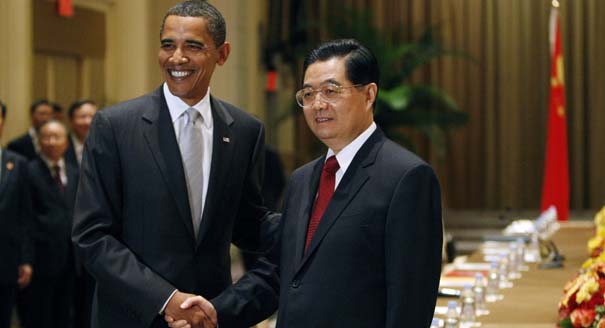
Obama’s new approach to China, dubbed “strategic reassurance,” strays from the U.S. strategy of the past decades, which sought to bring China into the "family of nations" through engagement, while balancing Chinese power in the region
Source: The Washington Post

The administration has announced a similar accommodating approach to China. Dubbed "strategic reassurance," the policy aims to convince the Chinese that the United States has no intention of containing their rising power. Details remain to be seen, but as with the Russia "reset," it is bound to make American allies nervous.
Administration officials seem to believe that the era of great-power competition is over. The pursuit of power, President Obama declared during a July speech about China, "must no longer be seen as a zero-sum game."
Unfortunately, that is not the reality in Asia. Contrary to optimistic predictions just a decade ago, China is behaving exactly as one would expect a great power to behave. As it has grown richer, China has used its wealth to build a stronger and more capable military. As its military power has grown, so have its ambitions.
This is especially true of its naval ambitions. Not so long ago, our China experts believed it was absurd for China to aspire to a "blue-water" navy capable of operating far from its shores.
Yet the new head of the U.S. Pacific Command, Adm. Robert Willard, noted last month that "in the past decade or so, China has exceeded most of our intelligence estimates of their military capability. . . . They've grown at an unprecedented rate." Defense Secretary Robert Gates recently warned that China's military modernization program could undermine U.S. military power in the Pacific.
It is hardly surprising that China wants to supplant U.S. power in the region. To the Chinese, the reign of "the middle kingdom" is the natural state of affairs and the past 200 years of Western dominance an aberration. Nor is it surprising that China wants to reshape international security arrangements that the United States established after World War II, when China was too weak to have a say.
What is surprising is the Obama administration's apparent willingness to accommodate these ambitions. This worries U.S. allies from New Delhi to Seoul.
Those nations are under no illusion about great-power competition. India is engaged in strategic competition with China, especially in the Indian Ocean, which both see as their sphere of influence. Japan's government wants to improve relations with Beijing, but many in Japan fear an increasingly hegemonic China. The nations of Southeast Asia do business with China but look to the United States for strategic support against their giant neighbor.
For decades, U.S. strategy toward China has had two complementary elements. The first was to bring China into the "family of nations" through engagement. The second was to make sure China did not become too dominant, through balancing. The Clinton administration pushed for China's accession to the World Trade Organization and normalized trade but also strengthened the U.S. military alliance with Japan. The Bush administration fostered close economic ties and improved strategic cooperation with China. But the United States also forged a strategic partnership with India and enhanced its relations with Japan, Singapore and Vietnam. The strategy has been to give China a greater stake in peace, while maintaining a balance of power in the region favorable to democratic allies and American interests.
"Strategic reassurance" seems to chart a different course. Senior officials liken the policy to the British accommodation of a rising United States at the end of the 19th century, which entailed ceding the Western Hemisphere to American hegemony. Lingering behind this concept is an assumption of America's inevitable decline.
Yet nothing would do more to hasten decline than to follow this path. The British accommodation of America's rise was based on close ideological kinship. British leaders recognized the United States as a strategic ally in a dangerous world -- as proved true throughout the 20th century. No serious person would imagine a similar grand alliance and "special relationship" between an autocratic China and a democratic United States. For the Chinese -- true realists -- the competition with the United States in East Asia is very much a zero-sum game.
For that reason, "strategic reassurance" is likely to fail. The Obama administration cannot back out of the region any time soon; Obama's trip this week, in fact, seems designed to demonstrate American staying power. Nor is China likely to end or slow its efforts to militarily and economically dominate the region. So it will quickly become obvious that no one on either side feels reassured.
Unfortunately, the only result will be to make American allies nervous. For an administration that has announced "we are back" after years of alleged Bush administration neglect in Asia, this is not an auspicious beginning.

Former Senior Associate
Kagan, author of the recent book, The Return of History and the End of Dreams (Knopf 2008), writes a monthly column on world affairs for the Washington Post and is a contributing editor at both the Weekly Standard and the New Republic.
Dan Blumenthal
American Enterprise Institute
Carnegie India does not take institutional positions on public policy issues; the views represented herein are those of the author(s) and do not necessarily reflect the views of Carnegie, its staff, or its trustees.

How is AI reshaping space security, creating governance challenges, and where does international diplomacy stand today?


Tejas Bharadwaj, Almudena Azcárate Ortega

After the chill in ties between 2020 and 2024 that brought India–China relations to their lowest point in several decades, the two countries have engaged each other afresh. This paper argues that there are predominantly four imperatives guiding India’s approach to China, and they exist in an order of priority.

Saheb Singh Chadha

This piece argues that India’s central challenge is not managing a single flashpoint but resolving the underlying tension between expansion and institutional coherency of the BRICS grouping.

Vrinda Sahai

A partnership between India, a country of subcontinental size, and Africa, a continent of fifty-four countries, may seem asymmetric until one notes that both are home to nearly the same number of people—1.4 billion. This essay spells out the existing challenges to the partnership, its optimal potential, and the possible pathways to realize it over the next quarter-century.

Rajiv Bhatia

The U.S.–India semiconductor cooperation story is well-stocked with top-level strategic intent. What remains unresolved, however, are some underlying challenges that will determine whether the cooperation actually functions. Three such friction points stand out.

Shruti Mittal