The Iranian Regime Is Now More Vulnerable Than Ever Before
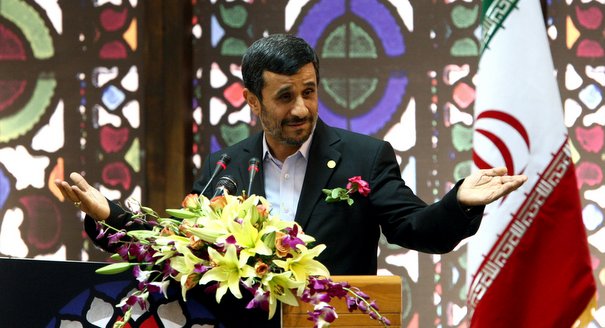
As the domestic political situation in Iran remains tense, the Obama administration is engaged in a careful balancing act, being tepid in its support for the Iranian opposition while engaging the regime in an effort to prevent a nuclear armed Iran.
The Iranian Regime Is Now More Vulnerable Than EveQantara's Birgit Kaspar talked to Karim Sadjadpour about the situation in Iran and perspectives in the nuclear crisis with the West.
Birgit Kaspar: The political situation in Iran is tense. On the occasion of the 30th anniversary of the takeover of the United States Embassy in Iran on November 4th tens of thousands of protesters were on the streets of Tehran despite severe warnings from Iranian security forces. The demonstrations took place not only in Tehran but also in various other cities around the country. Mr. Sadjadpour, for how long do you think will the opposition be able to keep up the pressure against President Mahmoud Ahmadinejad's government?
Karim Sadjadpour: There remains an enormous sense of outrage and injustice at a popular level after the disputed presidential elections in June and I think that every time we have seen the opposition show their numbers they have exceeded people's expectations. But I think people realize this is a long-term process, results will not be achieved overnight.
Kaspar: What do you think is going to happen over the next few months?
Sadjadpour: I think we will see a further deterioration of the economic situation in Iran, due to poor management, external pressure, and the contraction of oil prices. Rather than reach out to his domestic opponents and try to build bridges I think Ahmedinejad is going to continue to alienate them. The gulf between the opposition and the regime is likely to increase. University students will continue their agitations'. In general I don't think 'people are going to forgive or forget what happened last June any time soon.
Kaspar: During the demonstrations on November 4th we heard for the first time people chanting "Obama, Obama – either you're with them or you're with us" along with the slogan "Down with the dictator". Do you think the Obama administration responded in an apt manner to the developments in Iran?
Sadjadpour: I think the Obama administration could stand to be more outspoken about Iran's inability to adhere to international standards of human rights and justice. I have no illusions that raising the issue of human rights will cause the regime to have second thoughts about employing repression and brutality; but if we neglect talking about human rights, the United States sends the signal to the Iranian people that America is a cynical superpower willing to "do a deal" at their expense. This could unwittingly pour cold water on the momentum of the movement. Our philosophy should be to "do no harm".
Kaspar: Does the opposition feel betrayed by the West?
Sadjadpour: I think part of the opposition is certainly concerned that the US has focused far too much on the nuclear issue and far too little about their plight. Iranian political culture is very conspiratorial, and I think the Obama administration has to reconcile how they engage the regime without betraying the will of the people. '
Kaspar: The Obama Administration shows first signs of patience running low. First Tehran seemed to have agreed to send its Low Enriched Uranium to Russia and France in order to get it back in a higher enriched form for use in a medical reactor. Then the Iranians backpedalled. For how long will Obama keep committed to the diplomatic talks?
Sadjadpour: The Obama administration has every desire to try and resolve this issue diplomatically, and they've gone much further than the Bush administration in seeking a compromise. Whereas the Bush administration's red lines were to prevent Iran from enriching uranium, I think the Obama Administration's red lines are simply to prevent Iran from weaponizing its nuclear program.
I'm not sure if anyone in Washington still believes that zero enrichment is a feasible outcome. But there is tremendous internal pressure on the administration to take a tougher approach toward Iran. If there is no diplomatic progress in the coming few months the administration will be forced to pursue harsher measures.
Kaspar: If no compromise can be found on the basis of the International Atomic Agency's proposal increased sanctions will be on the agenda. How do you rate the chances that such sanctions will lead Ahmadinejad to change course?
Sadjadpour: In the past sanctions have not brought about more conciliatory Iranian policies. Remember, this is a regime that has been willing to endure severe economic hardship in order to further its political and ideological aims. But they're now more vulnerable than ever before.
The Obama administration believes that the breadth of sanctions is more important than the depth, meaning a more robust international coalition – including Russia and ideally China – will concentrate Iranian minds much more than simply amplifying existing US and US sanctions. Whether or not Moscow or Beijing will come around is a huge question though.
Kaspar: The Obama administration hasn't taken the military option off the table. Under which circumstances do you think a US military operation would be possible?
Sadjadpour: I think the likelihood of a US attack on Iran is very low. Afghanistan has become a very important domestic political consideration for the Obama administration and the last thing they want is to open up another war front which would inflame the situation in Afghanistan and also Iraq.
The greater concern is that if these negotiations fail, Israel will at some point in the next year feel compelled to take action. And many US officials believe that Israel won't ask permission from Washington first if they truly feel they're facing an existential threat.
Kaspar: The IAEA chief until end of November, Mohammed ElBaradei, told the New York Times "there is total distrust on the part of Iran". Mr Sadjadpour, you have authored a study on the speeches and writings of Ayatollah Ali Khamenei, the supreme leader in Iran. Is the most powerful man in Tehran indeed viscerally opposed to the US?
Sadjadpour: Yes, I believe that. For Khamenei enmity towards the US was a fundamental pillar of the revolution and it remains central to the identity of the Islamic Republic. Ayatollah Ruhollah Khomeini, the father of the Islamic Revolution, once said the relationship between the US and Iran is like that between a wolf and a sheep, and Khamenei recently repeated this mantra.
That said, during times of existential crisis – and the last four months have been a time of existential crisis – survival is paramount. So at those times I think he is willing to talk to the US in order to try to stave off pressure. But I don't think his ultimate objective is to reach an accommodation with Washington. On the contrary, I think he believes that could seriously jeopardize the integrity of the Islamic Republic.
Kaspar: What do you think he is most worried about?
Sadjadpour: Based on his writing and speeches it's clear he's most concerned that the US is trying to foment a velvet or soft revolution in Tehran. He fears that greater interaction between the US and Iran, meaning a greater US or Western presence in Iran, would dilute the 'Islamicness' of the Islamic Republic and undermine their hold on power. In a way I think a rapprochement with the US is more of an existential threat to him, to the hardliners in Teheran, than the status quo of the adversarial relationship.
Karim Sadjadpour is a senior fellow at the Carnegie Endowment for International Peace, where he focuses on Iran and U.S. foreign policy toward the Middle East.
Carnegie India does not take institutional positions on public policy issues; the views represented herein are those of the author(s) and do not necessarily reflect the views of Carnegie, its staff, or its trustees.
After the chill in ties between 2020 and 2024 that brought India–China relations to their lowest point in several decades, the two countries have engaged each other afresh. This paper argues that there are predominantly four imperatives guiding India’s approach to China, and they exist in an order of priority.
This piece argues that India’s central challenge is not managing a single flashpoint but resolving the underlying tension between expansion and institutional coherency of the BRICS grouping.
A partnership between India, a country of subcontinental size, and Africa, a continent of fifty-four countries, may seem asymmetric until one notes that both are home to nearly the same number of people—1.4 billion. This essay spells out the existing challenges to the partnership, its optimal potential, and the possible pathways to realize it over the next quarter-century.
The India–EU Free Trade Agreement (FTA) is shaping up to be one of the most consequential trade negotiations, both economically and strategically. But, what’s in the agreement, what’s missing, and what will determine its success in the years ahead
Trump 2.0 has unsettled India’sexternal environment—buthas notoverturned its foreign policystrategy,which continuesto relyon diversification, hedging,and calibrated partnerships across a fractured order.
+6
Milan Vaishnav, ed., Sameer Lalwani, Tanvi Madan, …