Lebanon’s domestic and regional politics remained relatively calm in 2009, but with Hezbollah’s refusal to disarm and Syria’s continuing determination to ferry arms into Lebanon, the nation lacks full sovereignty and remains vulnerable to sudden shocks.
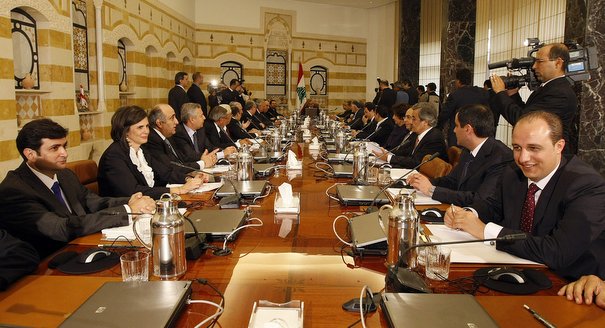
Lebanon in 2009: Revenge of the Status QuoPrime Minister Saad Hariri’s visit to Damascus on December 19-20 closed a four-year long chapter of confrontation between the March 14 movement and Syria and indicated the triumph of the status quo of compromised sovereignty and dysfunctional politics.
Division had paralyzed the country since early 2007 and led to clashes and the occupation of Beirut in May of 2008. The Doha agreement had allowed the election of a president and the holding of parliamentary elections. Even though the March 14 coalition won those elections, the leader of that coalition, Saad Hariri, was not able to form a government in which that majority could be exercised. In addition, he was ‘encouraged’ by Saudi Arabia to reconcile with Damascus even before the results of the investigation into his father’s assassination had concluded.
Hariri’s visit confirms Syria’s return to influence in Lebanon, although without the troops it had before, and within the context of two states with diplomatic relations. It recreates a situation similar to the situation throughout most of the 1990s when the Sunni, Shii, and Druze leadership all had good relations with Damascus. Today, the Christians also have good relations with Syria through their strongest leader and one-time Syrian nemesis, Michel Aoun.
Coming in the wake of Hezbollah’s new manifesto that states that the Resistance plans to keep its arms indefinitely and within the reality that Syria continues to ferry arms to friendly groups in Lebanon across the two countries’ border, the visit indicates that Lebanon’s brief bid for full sovereignty is currently over. Hariri and Saudi Arabia apparently concluded that they cannot confront Hezbollah, Iran and Syria all at once, and have opted to work with Syria rather than against it, in hopes of gaining some backing in ‘managing’ Hezbollah and containing Iran.
Otherwise, 2009 was a year of relative stability and calm for Lebanon in comparison with the turbulent conditions between 2005 and 2008. Changes in US policy as well as shifts in Damascus and Riyadh calmed Lebanon’s external environment and encouraged Lebanese parties to move away from confrontation and toward accommodation.
Most attention was focused during the first part of the year on the parliamentary elections of June 2009. These were the first elections since 1972 on the basis of an election law that all parties agreed to, and without external control. In a hotly contested election in which the influence of confessionalism and money was strong, the March 14 coalition secured 71 seats to March 8’s 57.
The government formation took five months to complete. Hariri wanted a government in which his movement had a clear majority and in which the March 8 opposition did not have a blocking veto. The opposition rejected that, arguing that they had won a popular majority and that Lebanon had to be governed by consensus of its main communities. The March 14 coalition was further shaken by the defection of one of its main pillars, Walid Junblatt, in August.
The delay also reflected a growing dysfunction of the post-Taif Lebanese system. One of the largest communities in Lebanon, namely the Shiite community, is not satisfied with its share of executive power. Whether this will require a renegotiation of the Taif agreement in coming years is not clear. The issue is postponed for now because any new deal will mean a trade-off on Hezbollah’s arms. The government was finally formed on a compromise formula of 15-10-5.
The March 14 coalition had been born in 2005 as a movement calling for the withdrawal of Syrian forces, the regaining of national sovereignty, and the establishment of an international investigation and tribunal to identify and try the killers of Hariri. But by 2009 conditions had changed. The Syrians had already left; the investigation was up and running; and national sovereignty was stuck on the dual contradiction of repeated Israeli violations of Lebanese space and of Hezbollah maintaining its arms outside of the control of the Lebanese state. Both Chirac and Bush that had backed the movement had been replaced with presidents that moved away from confrontation and sought better relations with Syria and negotiation with Iran. With the latest visit, the nature and future of the March 14 movement are in question.
On the economic front, Lebanon did remarkably well in a year which saw a global financial and economic crisis and serious economic setbacks in a number of Arab countries, most notably Dubai. Lebanon’s conservative banking system was insulated from global shocks and actually attracted new deposits; while its real estate sector appeared more stable than the bubbles in other gulf countries and attracted new investors as well.
Looking ahead, the new government has a number of challenges. It needs to hold local elections, implement administrative decentralization, and negotiate a new parliamentary election law. It also needs to negotiate shifting regional and international currents to avoid being caught in any new regional confrontations, particularly between Israel and Iran. Economically it needs to manage its large debt in a difficult global credit market and to make good on its Paris III commitments with regard to reforming the energy, communication and other sectors.
Lebanon might benefit from the calm that domestic and regional politics have arrived at; however, in the absence of sovereignty, its fate remains vulnerable to sudden shocks: a shift in regional alignments, a confrontation between Israel and Iran—which would involve Hezbollah—, or a troubling result of the Hariri tribunal.
Carnegie India does not take institutional positions on public policy issues; the views represented herein are those of the author(s) and do not necessarily reflect the views of Carnegie, its staff, or its trustees.
As India’s economy recovers from the coronavirus pandemic, Indian businesses need efficient financial structures to regain their ground. Key reforms to India’s Insolvency and Bankruptcy Code could fill these gaps.
Access to cross-border data is an integral piece of the law enforcement puzzle. India is well placed to lead the discussions on international data agreements subject to undertaking necessary surveillance reforms.
After the coronavirus pandemic wanes, how will China’s reorientation of the Belt and Road Initiative to address global health concerns influence its relationships with South Asian countries?
Governments around the world are turning to new forms of digital surveillance to monitor the spread of the coronavirus, though they are mostly using existing laws to do so.