

Commentary
How is AI reshaping space security, creating governance challenges, and where does international diplomacy stand today?
Tejas Bharadwaj, Almudena Azcárate Ortega
{
  "authors": [
    "Eduardo Zepeda",
    "Timothy A. Wise",
    "Kevin P. Gallagher"
  ],
  "type": "other",
  "centerAffiliationAll": "",
  "centers": [
    "Carnegie Endowment for International Peace"
  ],
  "collections": [],
  "englishNewsletterAll": "",
  "nonEnglishNewsletterAll": "",
  "primaryCenter": "Carnegie Endowment for International Peace",
  "programAffiliation": "",
  "programs": [],
  "projects": [],
  "regions": [
    "North America",
    "United States",
    "South America"
  ],
  "topics": [
    "Economy",
    "Trade"
  ]
}
Source: Getty
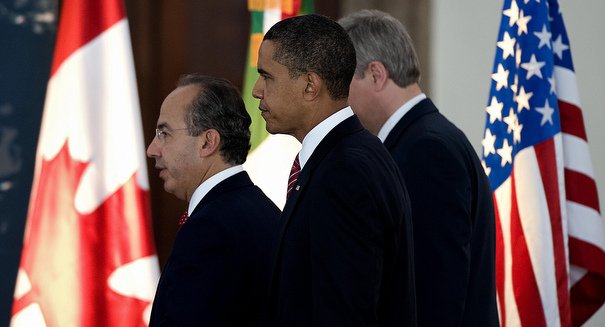
Mexico’s disappointing experience with NAFTA underscores the need to reform trade agreements between the United States and developing countries.
Despite an increase in trade, foreign investment, and productivity since NAFTA took effect in 1994, Mexico has been disappointed by slow economic growth and weak job creation. In addition, recession in the United States is hitting Mexico particularly hard, given its dependence on its northern neighbor.
Mexico’s experience with NAFTA underscores the need to reform trade agreements between the United States and developing countries. There are five things to remember in future trade agreements with the United States, contends a new paper by Eduardo Zepeda of the Carnegie Endowment and Timothy A. Wise and Kevin P. Gallagher of Tufts’ Global Development and Environment Institute:
“There is increasing international recognition that trade policy in the Western Hemisphere should be overhauled,” conclude the authors, based on this comprehensive review of Mexico’s economic performance under NAFTA. “Now is the time for the U.S., Canadian, Mexican, and other developing country governments to take a fresh look at NAFTA’s experience and shape trade and development policies to better meet the needs of their people in a manner that respects the right to development, job creation, and the environment.”
Former Senior Associate, Trade, Equity and Development Program
Zepeda is inter-regional policy coordinator of the Development Policy and Analysis Division, Department of Economic and Social Affairs at the United Nations General Secretariat. He was previously a senior associate in the Trade, Equity, and Development Program at the Carnegie Endowment for International Peace.
Timothy A. Wise
Global Development and Environment Institute
Kevin P. Gallagher
Carnegie India does not take institutional positions on public policy issues; the views represented herein are those of the author(s) and do not necessarily reflect the views of Carnegie, its staff, or its trustees.

How is AI reshaping space security, creating governance challenges, and where does international diplomacy stand today?


Tejas Bharadwaj, Almudena Azcárate Ortega

The U.S.–India semiconductor cooperation story is well-stocked with top-level strategic intent. What remains unresolved, however, are some underlying challenges that will determine whether the cooperation actually functions. Three such friction points stand out.

Shruti Mittal

On March 10, 2026, India’s Union Cabinet approved amendments to Press Note 3, a regulation that mandated government approval on all foreign direct investment (FDI) from countries sharing a land border with India. This amendment raises questions primarily about whether its stated benefits will materialize and if the risks have been adequately weighed. This piece will address the same.

Konark Bhandari

India and the United States are close to concluding a Reciprocal Defense Procurement Agreement (RDPA) that will allow firms from the two countries to sell to each other’s defense establishments more easily. While this may not remedy the specific grievances both sides may have regarding larger bilateral issues, an RDPA could restore some momentum, following the trade deal announcement.
Konark Bhandari

On the last day of the India AI Impact Summit, India signed Pax Silica, a U.S.-led declaration seemingly focused on semiconductors. While India’s accession to the same was not entirely unforeseen, becoming a signatory nation this quickly was not on the cards either.
Konark Bhandari