• Research
  • About
  • Experts
Carnegie India logoCarnegie lettermark logo
AI
{
  "authors": [],
  "type": "pressRelease",
  "centerAffiliationAll": "dc",
  "centers": [
    "Carnegie Endowment for International Peace"
  ],
  "collections": [],
  "englishNewsletterAll": "ctw",
  "nonEnglishNewsletterAll": "",
  "primaryCenter": "Carnegie Endowment for International Peace",
  "programAffiliation": "russia",
  "programs": [
    "Russia and Eurasia"
  ],
  "projects": [],
  "regions": [
    "Caucasus",
    "Russia"
  ],
  "topics": [
    "Foreign Policy"
  ]
}
REQUIRED IMAGE

REQUIRED IMAGE

Press Release

To weather crises, Moscow must begin thinking strategically

To overcome its current challenges, Moscow must begin thinking strategically. Policy makers need to open space for public debate and engage in substantive discussions on critical global issues, and Western governments and institutions need to open the door to independent Russian voices.

Link Copied
Published on Jan 7, 2010

MOSCOW, Jan 7—The Kremlin was able to consolidate its domestic authority and assert itself globally during Russia’s economic boom, but economic, security, and governance crises have shaken Moscow’s confidence. If it is to overcome its current challenges, Moscow must begin thinking strategically. To do this, policy makers need to open space for public debate and engage in substantive discussions on critical global issues—and Western governments and institutions need to open the door to independent Russian voices—contends a new paper by Sam Greene and Dmitri Trenin.

Key Conclusions:

  • As the Kremlin centralized power, leaders cut themselves off from public feedback, leading to a disconnect between realities on the ground and several disastrous policy initiatives.
  • While the Kremlin is slowly beginning to open itself to outside opinions, it must rebuild trust and goodwill among public officials and nongovernmental experts if it is to revive a truly constructive dialogue.
  • Russia has failed to engage on key global issues—including financial regulation, climate change, and the “responsibility to protect”—and risks further marginalization. When it has made proposals, they are so far out of sync with global thinking that they fail to elicit a productive response.

While these challenges must be addressed by the Russian people and their leaders, the West can help:

  • Moscow is aware of its own weakness. There is no benefit for Western leaders to reiterate the point.
  • An institutionalized relationship based on treaties, membership of international organizations, and global cooperation is the best course of action. A bilateral relationship based solely on a personal bond between leaders allows the Kremlin to avoid tackling real issues.
  • President Obama’s approach on his first trip to Russia—depersonalized and pragmatic—struck exactly the right tone.

The authors conclude:

“If the West seeks to exploit Russia’s absence for its own competitive advantage, a future democratic Russia will rightly feel it has been mistreated, and Russia’s nationalists and isolationists will once again win the day. Eventually, Russia’s interests will have to be taken into account, and there is no reason that moment has to wait until the Kremlin learns to express them clearly and constructively.”

###


NOTES

  • Click here to read the paper online
  • Dmitri Trenin is director of the Carnegie Moscow Center. He has been with the Center since its inception. He retired from the Russian Army in 1993. From 1993–1997, Trenin held posts as a senior research fellow at the NATO Defense College in Rome and as a senior research fellow at the Institute of Europe in Moscow.
  • Sam Greene, deputy director for operations, joined the Moscow Center in 2005. Before joining the Center, he was senior media program adviser for the New Eurasia Foundation, a London and Moscow correspondent for FT Business from 2002 to 2004, and a freelance journalist based in Moscow since 1999.
  • The Carnegie Moscow Center was established in 1993 and accommodates foreign and Russian researchers collaborating with Carnegie’s global network of scholars on a broad range of contemporary policy issues relevant to Russia—military, political, and economic.
  • The Carnegie Russia and Eurasia Program has, since the end of the Cold War, led the field on Eurasian security, including strategic nuclear weapons and nonproliferation, development, economic and social issues, governance, and the rule of law.
  • Press Contact: David Kampf, 202/939-2233, dkampf@ceip.org
Foreign PolicyCaucasusRussia

Carnegie India does not take institutional positions on public policy issues; the views represented herein are those of the author(s) and do not necessarily reflect the views of Carnegie, its staff, or its trustees.

More Work from Carnegie India

  • Paper
    Threading the Needle: India’s Path Forward with China

    After the chill in ties between 2020 and 2024 that brought India–China relations to their lowest point in several decades, the two countries have engaged each other afresh. This paper argues that there are predominantly four imperatives guiding India’s approach to China, and they exist in an order of priority.

      Saheb Singh Chadha

  • Article
    Managing Divergence: India’s BRICS Presidency in 2026

    This piece argues that India’s central challenge is not managing a single flashpoint but resolving the underlying tension between expansion and institutional coherency of the BRICS grouping.

      Vrinda Sahai

  • Article
    India–Africa Strategic Partnership: Challenges, Potential, and Possible Pathways

    A partnership between India, a country of subcontinental size, and Africa, a continent of fifty-four countries, may seem asymmetric until one notes that both are home to nearly the same number of people—1.4 billion. This essay spells out the existing challenges to the partnership, its optimal potential, and the possible pathways to realize it over the next quarter-century.

      Rajiv Bhatia

  • Commentary
    Emerging From the “Zombie State” of Trade Agreements: The India-EU FTA

    The India–EU Free Trade Agreement (FTA) is shaping up to be one of the most consequential trade negotiations, both economically and strategically. But, what’s in the agreement, what’s missing, and what will determine its success in the years ahead

      Vrinda Sahai, Nicolas Köhler-Suzuki

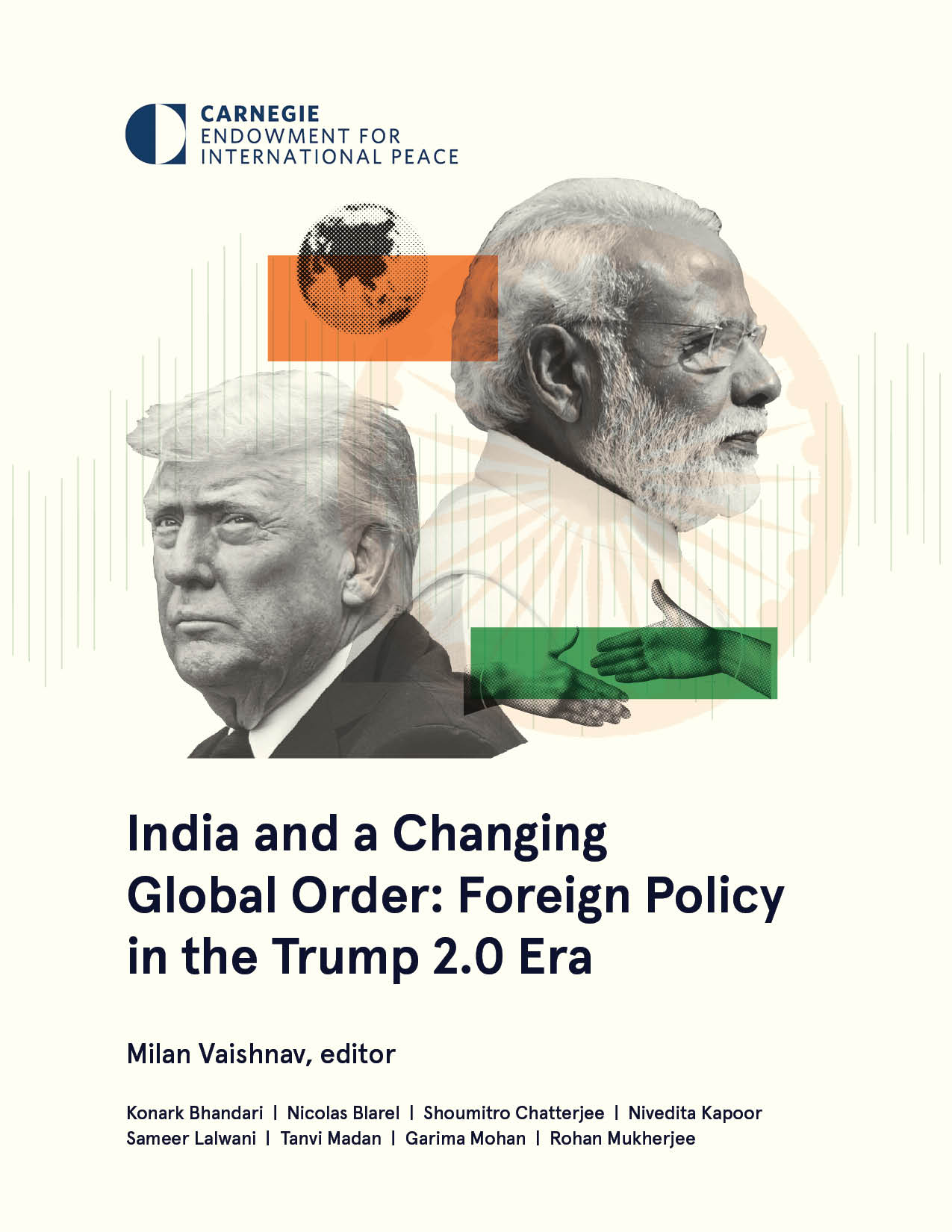
  • India and a Changing Global Order: Foreign Policy in the Trump 2.0 Era
    Research
    India and a Changing Global Order: Foreign Policy in the Trump 2.0 Era

    Trump 2.0 has unsettled India’s external environment—but has not overturned its foreign policy strategy, which continues to rely on diversification, hedging, and calibrated partnerships across a fractured order.

      • Sameer Lalwani
      • +6

      Milan Vaishnav, ed., Sameer Lalwani, Tanvi Madan, …

Get more news and analysis from
Carnegie India
Carnegie India logo, white
Unit C-4, 5, 6, EdenparkShaheed Jeet Singh MargNew Delhi – 110016, IndiaPhone: 011-40078687
  • Research
  • About
  • Experts
  • Projects
  • Events
  • Contact
  • Careers
  • Privacy
  • For Media
Get more news and analysis from
Carnegie India
© 2026 Carnegie Endowment for International Peace. All rights reserved.