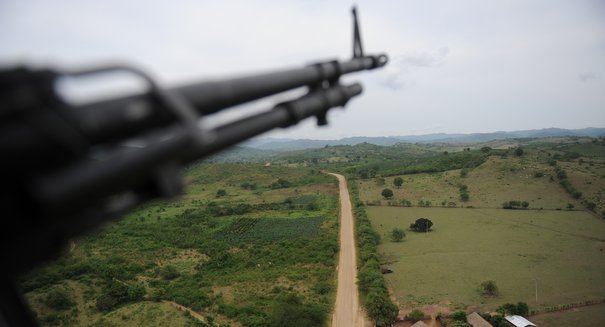
State-sponsored assassination is on the rise worldwide. Aside from questions of moral justification and legality, political assassination also brings to the fore practical policy considerations, not least the law of unintended consequences.
Assassination Season Is OpenState-sponsored assassinations are back in season. Targeted snuff jobs of state enemies are on the rise from Dubai to Dagestan, from Yemen to Waziristan. Even the United States has returned to the practice: American military drones and special operations have been pushing the limits of President Ford’s 1976 executive ban against assassinations.
When one factors in the vast human cost of cruder alternatives, assassination seems like a logical option for dealing with foreign foes. Instead of invading Iraq at the cost of hundreds of thousands of lives, for example, would not a deft poisoning of Saddam Hussein — a “liquid murder” — have been morally justified? Who has ever called the would-be assassins of Hitler and Himmler anything but heroes?
Advances in lethal technology are making assassinations exponentially easier against even the most hardened security systems. Drones, aerolosization devices, synthetic opiates, new biological agents and radiological weapons can be developed without fear of attribution.
But here’s the rub: While it may be morally justified and legal under the laws of war, political assassination carries with it practical policy issues, not least the law of unintended consequences.
Elimination of an enemy’s leadership may seem like a simple solution, but one must ask what will come in its place. And one must bear in mind that what is sauce for the dictatorial goose can equally be sauce for the democratically elected gander. Further, the old notion, paraphrasing Thucydides, that the strong can get away with murder while the weak must bear it, is increasingly unsupportable in today’s high-tech world of lethal agents.
The last era of unrestrained use of assassination by the United States was during the Kennedy administration. So flagrant were the tactics that J.F.K.’s successor, Lyndon Johnson, privately charged that the Kennedy brothers were running a “damned Murder Incorporated.”
J.F.K.’s “executive action” policy was an open season of plots against troublesome foreign leaders such as Rafael Trujillo of the Dominican Republic, Ngo Dinh Diem in Viet Nam, René Schneider in Chile, Patrice Lumumba in Congo and Fidel Castro in Cuba. Committees in both the U.S. Senate and House investigated this policy in 1975-1976 in an attempt to exercise oversight of C.I.A. covert operations.
The inquires of the Church Committee in the Senate led President Ford to issue the 1976 executive order banning “political assassination by U.S.G. employees.” Presidents Carter and Reagan issued similar orders, removing the “political” limitation and extending the prohibition to anybody acting on Washington’s behalf. These orders did nothing to change the traditional laws of war and self-defense, but they sent clear signals about a change of U.S. policy.
It is important to recall the wider context of the Church Committee probes. Then as now, the world’s greatest conspiracy theories swirled around the Kennedy assassination. President Johnson, for one, was convinced that Castro’s hand was behind Lee Harvey Oswald’s trigger finger. In 1968, Johnson told ABC reporter Howard K. Smith that “Kennedy was trying to get to Castro, but Castro got him first.”
At one Church Committee hearing, Senator Chris Dodd remarked on the eerie coincidence that at the very hour of J.F.K.’s assassination, C.I.A. agents were providing a Cuban agent (or double agent) code-named AMLASH with insecticide to poison Castro.
Castro was all too aware of the many U.S.-sponsored attempts on his life (the Church Committee identified eight.) Two weeks before J.F.K. died in Dallas, the Cuban leader warned those he knew were listening that if one more attempt were made on his life there would be dire consequences.
Does the United States want to return to this era of uncertainty? Do democratically elected leaders wish to open this bloody door again, when in fact their own protection is as porous and precarious as ever? Technology has made assassination, as well as escalatory and asymmetrical reprisals, easier than ever for both the geese and the ganders.
There may be little choice in using this tactic against non-state actors such as Al Qaeda, as the Clinton, Bush and Obama administrations have done. However, one should not automatically assume that decapitation works well against all decentralized terrorist or mafia-like structures. To the contrary, the history of assassinating “high value targets” such as international drug lords suggests otherwise — the hydra heads easily regenerate, possibly in more radical form than the ones they replaced.
Actions against national leaders are even more complicated. As security experts consider the option of a surgical decapitation strike against the Iranian leadership to preempt its assumed nuclear ambitions — to avoid a latter-day Cuban Missile Crisis — our leaders should think twice about the unintended consequences of such actions. Leaders in glass security houses should not throw stones.
One need not believe in conspiracy theories about J.F.K. to be seriously concerned about the wisdom of J.F.K.’s assassination policy. The laws of war and self-defense may permit political assassination in certain cases, but prudence dictates thinking carefully before pulling that fateful trigger.
Medish served in the Clinton administration as special assistant to the President and senior director for Russian, Ukrainian, and Eurasian Affairs on the National Security Council from 2000 to 2001.
Carnegie India does not take institutional positions on public policy issues; the views represented herein are those of the author(s) and do not necessarily reflect the views of Carnegie, its staff, or its trustees.
In any defense establishment, change is an ongoing process. However, despite the best of intentions, existing bureaucracies, bound by habit and years of socialization, have their limits in implementing transformative change.
After the chill in ties between 2020 and 2024 that brought India–China relations to their lowest point in several decades, the two countries have engaged each other afresh. This paper argues that there are predominantly four imperatives guiding India’s approach to China, and they exist in an order of priority.
This piece argues that India’s central challenge is not managing a single flashpoint but resolving the underlying tension between expansion and institutional coherency of the BRICS grouping.
A partnership between India, a country of subcontinental size, and Africa, a continent of fifty-four countries, may seem asymmetric until one notes that both are home to nearly the same number of people—1.4 billion. This essay spells out the existing challenges to the partnership, its optimal potential, and the possible pathways to realize it over the next quarter-century.