

In The Media
Michele Dunne, Robert Kagan
{
  "authors": [
    "Robert Kagan"
  ],
  "type": "legacyinthemedia",
  "centerAffiliationAll": "",
  "centers": [
    "Carnegie Endowment for International Peace",
    "Carnegie Europe"
  ],
  "collections": [],
  "englishNewsletterAll": "",
  "nonEnglishNewsletterAll": "",
  "primaryCenter": "Carnegie Endowment for International Peace",
  "programAffiliation": "",
  "programs": [],
  "projects": [
    "U.S.-Russia Bilateral Presidential Commission"
  ],
  "regions": [
    "North America",
    "United States",
    "Middle East",
    "Iran",
    "Caucasus",
    "Russia"
  ],
  "topics": [
    "Foreign Policy"
  ]
}
Source: Getty
Russia’s engagement with the United States on Iran’s nuclear ambitions has not changed significantly since 2007, in spite of the Obama administration’s emphasis on the success of the ‘reset.’
Source: The Washington Post

Yes, it was quite a breakthrough -- by the administration of George W. Bush. In fact, this 2007 triumph came after another, similar breakthrough in 2006, when months of negotiations with Moscow had produced the first watered-down resolution. And both were followed in 2008 by yet another breakthrough, when the Bush administration got Moscow to agree to a third resolution, another marginal tightening of sanctions, after more negotiations and more diluting.
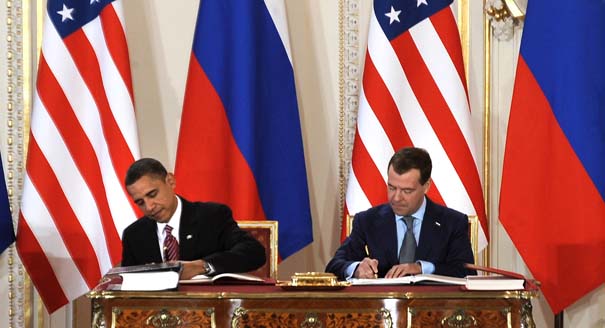
Given that history, few accomplishments have been more oversold than the Obama administration's "success" in getting Russia to agree, for the fourth time in five years, to another vacuous U.N. Security Council resolution. It is being trumpeted as a triumph of the administration's "reset" of the U.S.-Russian relationship, the main point of which was to get the Russians on board regarding Iran. All we've heard in recent months is how the Russians finally want to work with us on Iran and genuinely see the Iranian bomb as a threat -- all because Obama has repaired relations with Russia that were allegedly destroyed by Bush.
Obama officials must assume that no one will bother to check the record (as, so far, none of the journalists covering the story has). The fact is, the Russians have not said or done anything in the past few months that they didn't do or say during the Bush years. In fact, they sometimes used to say and do more. Here's Vladimir Putin in April 2005: "We categorically oppose any attempts by Iran to acquire nuclear weapons. . . . Our Iranian partners must renounce setting up the technology for the entire nuclear fuel cycle and should not obstruct placing their nuclear programs under complete international supervision." Here's one of Putin's top national security advisers, Igor S. Ivanov, in March 2007: "The clock must be stopped; Iran must freeze uranium enrichment." Indeed, the New York Times' Elaine Sciolino reported that month that Moscow threatened to "withhold nuclear fuel for Iran's nearly completed Bushehr power plant unless Iran suspends its uranium enrichment as demanded by the United Nations Security Council" -- which prompted the Times' editorial page to give the Bush administration "credit if it helped Moscow to see where its larger interests lie." Nine months later, of course, Russia delivered the fuel.
It remains to be seen whether this latest breakthrough has greater meaning than the previous three or is just round four of Charlie Brown and the football. The latest draft resolution tightens sanctions in some areas around the margins, but the administration was forced to cave to some Russian and Chinese demands. The Post reported: "The Obama administration failed to win approval for key proposals it had sought, including restrictions on Iran's lucrative oil trade, a comprehensive ban on financial dealings with the Guard Corps and a U.S.-backed proposal to halt new investment in the Iranian energy sector." Far from the comprehensive arms embargo Washington wanted, the draft resolution does not even prohibit Moscow from completing the sale of its S-300 surface-to-air missile defense system to Tehran. A change to the Federal Register on Friday showed that the administration had lifted sanctions against four Russian entities involved in illicit weapons trade with Iran and Syria since 1999, suggesting last-minute deal sweeteners.
What is bizarre is the administration's claim that Russian behavior is somehow the result of Obama's "reset" diplomacy. Russia has responded to the Obama administration in the same ways it did to the Bush administration before the "reset." Moscow has been playing this game for years. It has sold the same rug many times. The only thing that has changed is the price the United States has been willing to pay.
As anyone who ever shopped for a rug knows, the more you pay for it, the more valuable it seems. The Obama administration has paid a lot. In exchange for Russian cooperation, President Obama has killed the Bush administration's planned missile defense installations in Poland and the Czech Republic. Obama has officially declared that Russia's continued illegal military occupation of Georgia is no "obstacle" to U.S.-Russian civilian nuclear cooperation. The recent deal between Russia and Ukraine granting Russia control of a Crimean naval base through 2042 was shrugged off by Obama officials, as have been Putin's suggestions for merging Russian and Ukrainian industries in a blatant bid to undermine Ukrainian sovereignty.
So at least one effect of the administration's "reset" has been to produce a wave of insecurity throughout Eastern and Central Europe and the Baltics, where people are starting to fear they can no longer count on the United States to protect them from an expansive Russia. And for this the administration has gotten what? Yet another hollow U.N. Security Council resolution. Some observers suggest that Iran's leaders are quaking in their boots, confronted by this great unity of the international "community." More likely, they are laughing up their sleeves -- along with the men in Moscow.

Former Senior Associate
Kagan, author of the recent book, The Return of History and the End of Dreams (Knopf 2008), writes a monthly column on world affairs for the Washington Post and is a contributing editor at both the Weekly Standard and the New Republic.
Recent Work

Michele Dunne, Robert Kagan
Robert Kagan, Michele Dunne
Carnegie India does not take institutional positions on public policy issues; the views represented herein are those of the author(s) and do not necessarily reflect the views of Carnegie, its staff, or its trustees.

How is AI reshaping space security, creating governance challenges, and where does international diplomacy stand today?


Tejas Bharadwaj, Almudena Azcárate Ortega

After the chill in ties between 2020 and 2024 that brought India–China relations to their lowest point in several decades, the two countries have engaged each other afresh. This paper argues that there are predominantly four imperatives guiding India’s approach to China, and they exist in an order of priority.

Saheb Singh Chadha

This piece argues that India’s central challenge is not managing a single flashpoint but resolving the underlying tension between expansion and institutional coherency of the BRICS grouping.

Vrinda Sahai

A partnership between India, a country of subcontinental size, and Africa, a continent of fifty-four countries, may seem asymmetric until one notes that both are home to nearly the same number of people—1.4 billion. This essay spells out the existing challenges to the partnership, its optimal potential, and the possible pathways to realize it over the next quarter-century.

Rajiv Bhatia

The U.S.–India semiconductor cooperation story is well-stocked with top-level strategic intent. What remains unresolved, however, are some underlying challenges that will determine whether the cooperation actually functions. Three such friction points stand out.

Shruti Mittal