

Q&A
Suzanne Maloney, Aaron David Miller, Karim Sadjadpour
{
  "authors": [
    "Karim Sadjadpour"
  ],
  "type": "questionAnswer",
  "centerAffiliationAll": "dc",
  "centers": [
    "Carnegie Endowment for International Peace",
    "Carnegie Europe",
    "Malcolm H. Kerr Carnegie Middle East Center",
    "Carnegie Russia Eurasia Center"
  ],
  "collections": [],
  "englishNewsletterAll": "menaTransitions",
  "nonEnglishNewsletterAll": "",
  "primaryCenter": "Carnegie Endowment for International Peace",
  "programAffiliation": "MEP",
  "programs": [
    "Middle East"
  ],
  "projects": [],
  "regions": [
    "Middle East",
    "Iran",
    "Gulf"
  ],
  "topics": [
    "Political Reform",
    "Foreign Policy",
    "Nuclear Policy",
    "Nuclear Energy"
  ]
}
Source: Getty
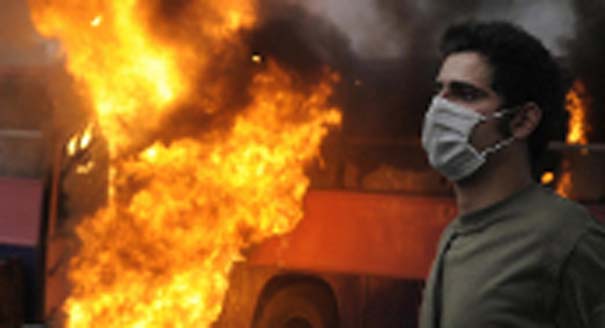
Three days before the anniversary of Iran’s controversial election, the United Nations Security Council imposed its fourth round of sanctions against the country’s nuclear program. These sanctions could end up strengthening the opposition’s argument that the country is in need of new leadership.
Three days before the anniversary of Iran’s controversial election, the United Nations Security Council imposed its fourth round of sanctions against the country’s nuclear program. In a Q&A, Karim Sadjadpour analyzes the changing political situation inside Iran and what the United States and major powers can do to support the opposition and contain Iran’s nuclear ambitions.
While leaders of Iran’s Green Movement will condemn the resolution, Sadjadpour explains that “sanctions could actually strengthen the opposition’s argument that Khamenei and Ahmadinejad’s inept diplomacy has earned Iran international disrepute and the country is in need of new leadership.”
The strength of the Iranian regime is somewhat deceptive. While it enjoys a monopoly of coercion and an impressive ability to project power and instill fear in people, the government’s political base is narrower than it’s ever been since the 1979 revolution. Remarkably, even the grandchildren of the revolution’s father, Ayatollah Khomeini, are now being impugned as anti-revolutionary. Moreover, the regime’s lack of confidence in its own popular support is evidenced when they announce that two million security forces will be deployed to the capital for the anniversary of last year’s elections.
An important factor that will determine the regime’s strength moving forward is the price of oil. With oil prices relatively high economic discontent can temporarily be alleviated. When oil is priced at $65 per barrel and higher, the government can continue to muddle along. But a sharp drop in oil prices—to the $50 range—would be hard to sustain over a long period.
The most interesting potential flash point in the coming months is the legislation currently under deliberation to eliminate as much as $40 billion worth of subsidies on everyday items such as food stuffs and petrol. This could lead to sharp price increases and inflation, potentially spurring more domestic tumult.
Khamenei remains at the apex of the power pyramid in Iran. He has constitutional authority over the Revolutionary Guards—not vice versa—and aims to ensure their loyalty by carefully cultivating the development of senior commanders and shuffling them regularly, ostensibly to prevent them from establishing their own independent power base. There is no doubt that given his increasing reliance on the Revolutionary Guards to maintain security, they are more influential than ever and are involved in every important political, economic, and foreign policy decision.
There is growing intrigue about the tensions between Ahmadinejad and Khamenei. Ahmadinejad is clearly power hungry and doesn’t see himself as anyone’s subordinate. While Khamenei may be irritated by Ahmadinejad’s antics, he understands that the president provides a useful buffer—if Khamenei gets rid of Ahmadinejad, people could set their sights on him.
Morale is low among Green Movement supporters—widespread protests gradually faded as the government has successfully, and brutally, quelled planned demonstrations. There remains hope that the opposition can regain momentum, but there is no organized movement with a clear strategy and leadership.
The Green Movement’s weaknesses, however, are also its strengths. It’s not a political party that can be “defeated” or decapitated—it’s an amorphous mass of people, many of them young, agitating for basic civil rights. This portends a long, arduous process of gaining ground in Iran.
In American politics it’s often said that candidates campaign in poetry and govern in prose. The Green Movement’s leadership must focus less on the poetry of opposition and more on the prose of it. They need to do a better job reaching out to the working classes and labor unions, and making it clear to Iranians why they would be better off in a green Iran.
For this, the Green Movement needs fewer intellectuals who spend their time rehashing religious and philosophical debates from centuries ago and more technocrats who can talk about the mismanagement of the Iranian economy and how economic problems can be fixed under better leadership and policies.
Two things happened after the elections that impacted Tehran’s foreign policy. First, any lingering moderates or pragmatists were essentially purged from the decision-making structure, leaving Ayatollah Khamenei surrounded by a group of likeminded hardliners with two overarching political instincts: mistrust and defiance. Second, the ongoing internal power struggles made it even more difficult than usual for the regime to make decisions.
While there has not been a dramatic foreign policy shift, the diplomatic style of the hardliners is increasingly brazen. It is brazen to detain three innocent young American hikers for nearly a year and use their imprisonment as leverage in diplomacy. It’s brazen for President Ahmadinejad to publicly chastise a key strategic ally, Russia, as he did last month.
Washington’s ability to influence internal reform in Iran is limited, but Iranian democratic activists commonly mention three areas where the United States can help. One, improve the editorial quality of the Voice of America’s Persian News Network, which has the potential to reach as many as 40 million Iranians (though it is often jammed by the Iranian government).
Two, help Iranian activists by inhibiting the regime’s ability to filter the internet, block text communications, and jam satellite television broadcasts. And finally, there is near universal consensus that America should continue to be outspoken in publicly condemning Tehran’s human rights abuses. Many green activists would like the United States and Europe to target individual human rights abusers with travels bans and asset freezes.
Engagement is often misinterpreted to have friendly connotations, but all it really implies is dialogue. It is still possible for the United States and Iran to recommence dialogue or negotiations in the future on nuclear issues or regional concerns, including Afghanistan and Iraq.
But it’s unlikely that any dialogue will lead to a meaningful and binding diplomatic breakthrough. I don’t think Iran’s hardliners have reached an internal consensus about coming to an accommodation with Washington. Many hardliners believe enmity toward the United States is expedient for the continued survival of the regime and revolution.
If there is a silver lining for Iran in having a state-owned, hydrocarbon-based economy which is not globalized or modern, it’s that the country is less susceptible to sanctions and outside pressure. Iran’s economic malaise and isolation are largely self-inflicted and this makes tougher international sanctions less influential.
Internally, the Green Movement’s leadership will publicly denounce sanctions. But United Nations Security Council sanctions could actually strengthen the opposition’s argument that Khamenei and Ahmadinejad’s inept diplomacy has earned Iran international disrepute and the country is in need of new leadership.
With the announcement of new sanctions, it is unlikely that Iran will move forward with the nuclear fuel deal that would send some of Iran’s low-enriched uranium to Turkey. Tehran previously stated that if sanctions were agreed to in the Security Council, it would end both discussions over its nuclear program and the agreement announced by Iran, Brazil, and Turkey. From Tehran’s vantage point, the nuclear fuel deal was supposed to be in lieu of sanctions, not in addition to them.
Iran’s nuclear ambitions can be slowed, but short of military action—which the Obama administration understandably wants to avoid—it will be very difficult to prevent the country from acquiring a nuclear weapon if Tehran chooses to put the necessary resources and energy behind it. We may look back years from now and see that this nuclear program is for Iran what the invasion of Afghanistan was to the Soviet Union: a giant albatross that bled the country financially, with few tangible gains.

Senior Fellow, Middle East Program
Karim Sadjadpour is a senior fellow at the Carnegie Endowment for International Peace, where he focuses on Iran and U.S. foreign policy toward the Middle East.
Recent Work

Suzanne Maloney, Aaron David Miller, Karim Sadjadpour

Aaron David Miller, Karim Sadjadpour, Robin Wright
Carnegie India does not take institutional positions on public policy issues; the views represented herein are those of the author(s) and do not necessarily reflect the views of Carnegie, its staff, or its trustees.

After the chill in ties between 2020 and 2024 that brought India–China relations to their lowest point in several decades, the two countries have engaged each other afresh. This paper argues that there are predominantly four imperatives guiding India’s approach to China, and they exist in an order of priority.

Saheb Singh Chadha

This piece argues that India’s central challenge is not managing a single flashpoint but resolving the underlying tension between expansion and institutional coherency of the BRICS grouping.

Vrinda Sahai

A partnership between India, a country of subcontinental size, and Africa, a continent of fifty-four countries, may seem asymmetric until one notes that both are home to nearly the same number of people—1.4 billion. This essay spells out the existing challenges to the partnership, its optimal potential, and the possible pathways to realize it over the next quarter-century.

Rajiv Bhatia

The India–EU Free Trade Agreement (FTA) is shaping up to be one of the most consequential trade negotiations, both economically and strategically. But, what’s in the agreement, what’s missing, and what will determine its success in the years ahead
Vrinda Sahai, Nicolas Köhler-Suzuki

Trump 2.0 has unsettled India’s external environment—but has not overturned its foreign policy strategy, which continues to rely on diversification, hedging, and calibrated partnerships across a fractured order.



Milan Vaishnav, ed., Sameer Lalwani, Tanvi Madan, …