
• Research
  • About
  • Experts
Carnegie India logoCarnegie lettermark logo
{
  "authors": [
    "Tiffany Ng"
  ],
  "type": "other",
  "centerAffiliationAll": "dc",
  "centers": [
    "Carnegie Endowment for International Peace"
  ],
  "collections": [],
  "englishNewsletterAll": "asia",
  "nonEnglishNewsletterAll": "",
  "primaryCenter": "Carnegie Endowment for International Peace",
  "programAffiliation": "AP",
  "programs": [
    "Asia"
  ],
  "projects": [],
  "regions": [
    "South Asia",
    "Afghanistan",
    "East Asia",
    "China"
  ],
  "topics": [
    "Economy",
    "Security"
  ]
}

Source: Getty

Other

China’s Role in Shaping the Future of Afghanistan

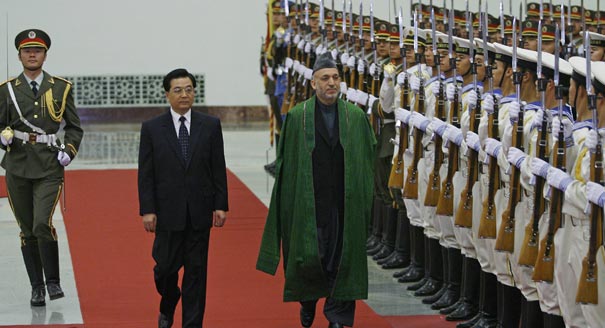
China's economic investment in Afghanistan provides an opportunity for Afghan development that could help stabilize the country—an outcome that would benefit not only Afghanistan and China, but also the United States.

Link Copied
By Tiffany Ng
Published on Sep 1, 2010

  • China has steadily increased its economic aid and investment in Afghanistan, most notably with a $3.5 billion deal to develop the Aynak copper mine. At the same time, it plays a very limited security role and has refused any direct military involvement.
  • Western commentators have eyed China’s approach to Afghanistan with suspicion and resentment, accusing China of “free-riding” and snapping up investment deals at the expense of the United States, which is paying dearly in blood and treasure.
  • While the United States and China share the goal of a stable and prosperous Afghanistan, fundamental differences in their basic strategies exist. China does not want to pressure Pakistan, nor does it want to align itself too closely with the United States, for fear of exacerbating the terrorist threat to itself or facilitating a long-term American presence in the region. By maintaining its distance and even-handed diplomacy, Beijing is positioning itself to work with whoever controls Kabul.
  • China has the potential to make important contributions to Afghan stability. State-owned Chinese corporations are uniquely risk-tolerant and can help pave the way for future investments. The Chinese also enjoy a more positive relationship with Afghans, making their investments less likely to be targeted for attack by insurgents. These investments can stimulate economic growth that aid money alone cannot.
  • U.S. policy makers should work with Afghanistan to ensure that such investment benefits the local people. Given China’s reluctance to openly cooperate with the United States in Afghanistan, Washington should help Kabul to effectively manage and maximize the positive impact of China’s involvement in Afghanistan through better aid coordination, transparency, and training.

About the Author

Tiffany Ng

Former Junior Fellow, Asia Program

Tiffany Ng
Former Junior Fellow, Asia Program
EconomySecuritySouth AsiaAfghanistanEast AsiaChina

Carnegie India does not take institutional positions on public policy issues; the views represented herein are those of the author(s) and do not necessarily reflect the views of Carnegie, its staff, or its trustees.

More Work from Carnegie India

  • Commentary
    The Impact of U.S. Sanctions and Tariffs on India’s Russian Oil Imports

    This piece examines India’s response to U.S. sanctions and tariffs, specifically assessing the immediate market consequences, such as alterations in import costs, and the broader strategic implications for India’s energy security and foreign policy orientation.

      Vrinda Sahai

  • Article
    Military Lessons from Operation Sindoor

    The India-Pakistan conflict that played out between May 6 and May 10, 2025, offers several military lessons. This article presents key takeaways from Operation Sindoor and breaks down how India’s preparations shaped the outcome and what more is needed to strengthen future readiness.

      Dinakar Peri

  • Book
    India and the Sovereignty Principle: The Disaggregation Imperative

    This book offers a comprehensive analysis of India's evolving relationship with sovereignty in a complex global order. Moving beyond conventional narratives, it examines how the sovereignty principle shapes India's behavior across four critical domains—from traditional military power to contemporary data governance.

      Rudra Chaudhuri, Nabarun Roy

  • Paper
    India-China Economic Ties: Determinants and Possibilities

    This paper examines the evolution of India-China economic ties from 2005 to 2025. It explores the impact of global events, bilateral political ties, and domestic policies on distinct spheres of the economic relationship.

      Santosh Pai

  • Article
    Hidden Tides: IUU Fishing and Regional Security Dynamics for India

    This article examines the scale and impact of Chinese IUU fishing operations globally and identifies the nature of the challenge posed by IUU fishing in the Indian Ocean Region (IOR). It also investigates why existing maritime law and international frameworks have struggled to address this growing threat.

      Ajay Kumar, Charukeshi Bhatt

Get more news and analysis from
Carnegie India
Carnegie India logo, white
Unit C-4, 5, 6, EdenparkShaheed Jeet Singh MargNew Delhi – 110016, IndiaPhone: 011-40078687
  • Research
  • About
  • Experts
  • Projects
  • Events
  • Contact
  • Careers
  • Privacy
  • For Media
Get more news and analysis from
Carnegie India
© 2026 Carnegie Endowment for International Peace. All rights reserved.





