• Research
  • About
  • Experts
Carnegie India logoCarnegie lettermark logo
{
  "authors": [],
  "type": "other",
  "centerAffiliationAll": "",
  "centers": [
    "Carnegie Endowment for International Peace"
  ],
  "collections": [],
  "englishNewsletterAll": "",
  "nonEnglishNewsletterAll": "",
  "primaryCenter": "Carnegie Endowment for International Peace",
  "programAffiliation": "",
  "programs": [],
  "projects": [],
  "regions": [
    "North Africa",
    "Egypt"
  ],
  "topics": []
}

Source: Getty

Other

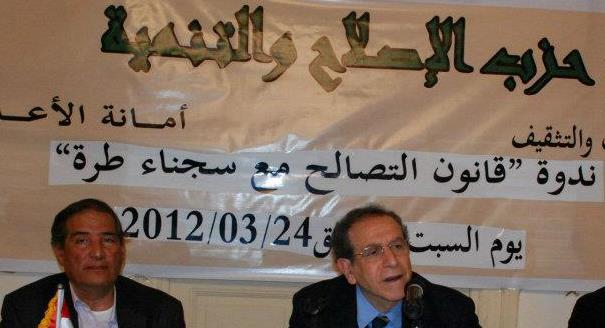
Reform and Development Party

A backgrounder on the Reform and Development Party.

Link Copied
Published on Sep 16, 2010

This resource was published on 09/16/2010 and is not updated to reflect changing circumstances.

The Reform and Development Party falls on the liberal side of the spectrum. Starting as a splinter from the Democratic Front in 2009, it was not allowed to register officially until May 2011, but remained active in the interim. The party remained aloof concerning alliances in the 2011 parliamentary elections, joining neither the Democratic Alliance nor the Egypt Bloc.

Major Party Figures

Ramy Lakkah: President
Anwar Tal’at Esma’t Sadat: Vice President

Background

The Reform and Development Party, a relative newcomer to Egypt’s political scene, was launched in January 2009 by Anwar Tal’at Esma’t Sadat, a nephew of former President Anwar Sadat, after he defected from the Democratic Front Party. The Political Parties Committee rejected his application for legal status in July 2010. Rather than appealing the decision, Sadat started lobbying for a complete overhaul of the committee’s structure to prevent it from functioning as an instrument of the National Democratic Party (NDP) and custodian of the regime’s interests. The party was legalized on May 21, 2011 after the 2011 uprising. In June 2011, the Reform and Development Party merged with the Our Egypt party led by Ramy Lakkah, and Lakkah became the party’s new president.

Party Platform

Political Issues

  • Fostering unity among Egyptians and encouraging the engagement of all citizens in the political process
  • Creating an independent supervisory committee to ensure free and fair elections
  • Establishing oversight mechanisms to monitor corruption in governing institutions
  • Establishing a clear separation between the religious and political realms

Socioeconomic Issues

  • Promoting economic development through free-market policies
  • Increasing the economic opportunities available to all citizens, while alleviating poverty and injustice
  • Supporting small-scale development projects and microfinance initiatives that benefit local communities

Foreign Policy Issues

  • Opposing the normalization of diplomatic and economic relations with Israel
North AfricaEgypt

Carnegie India does not take institutional positions on public policy issues; the views represented herein are those of the author(s) and do not necessarily reflect the views of Carnegie, its staff, or its trustees.

More Work from Carnegie India

  • Commentary
    Raja Mandala: India and Djibouti’s Geopolitical Scrum

    President Kovind’s visit to Djibouti and Ethiopia suggests India is finally waking up to the geopolitical significance of the Horn of Africa.

      C. Raja Mohan

  • Commentary
    Raja Mandala: Neweurasia

    Chancelleries across Eurasia are scrambling to come to terms with the entirely unexpected victory of Trump.

      C. Raja Mohan

  • Commentary
    A Reunion of Friends

    The relationship between India and Egypt has declined over the years. But, Indian Prime Minister Narendra Modi and Egyptian President Abdel Fattah al-Sisi should rebuild the friendship between Nehru and Nasser.

      C. Raja Mohan

  • Commentary
    Raja-Mandala: Between Talk and Action

    The India-Africa Summit can galvanize India’s security engagement with Africa.

      C. Raja Mohan

  • Commentary
    India and the Middle East: Finding a New Balance

    While some might find India’s new approach to the Middle East somewhat disconcerting, the government of Narendra Modi is bringing pragmatism and transparency to India’s Middle East policy.

      C. Raja Mohan

Get more news and analysis from
Carnegie India
Carnegie India logo, white
Unit C-4, 5, 6, EdenparkShaheed Jeet Singh MargNew Delhi – 110016, IndiaPhone: 011-40078687
  • Research
  • About
  • Experts
  • Projects
  • Events
  • Contact
  • Careers
  • Privacy
  • For Media
Get more news and analysis from
Carnegie India
© 2026 Carnegie Endowment for International Peace. All rights reserved.