

Paper
Adam Baczko, Gilles Dorronsoro, Arthur Quesnay
{
  "authors": [
    "Gilles Dorronsoro"
  ],
  "type": "legacyinthemedia",
  "centerAffiliationAll": "dc",
  "centers": [
    "Carnegie Endowment for International Peace"
  ],
  "collections": [],
  "englishNewsletterAll": "ctw",
  "nonEnglishNewsletterAll": "",
  "primaryCenter": "Carnegie Endowment for International Peace",
  "programAffiliation": "SAP",
  "programs": [
    "South Asia"
  ],
  "projects": [],
  "regions": [
    "South Asia",
    "Afghanistan"
  ],
  "topics": [
    "Security",
    "Military",
    "Foreign Policy"
  ]
}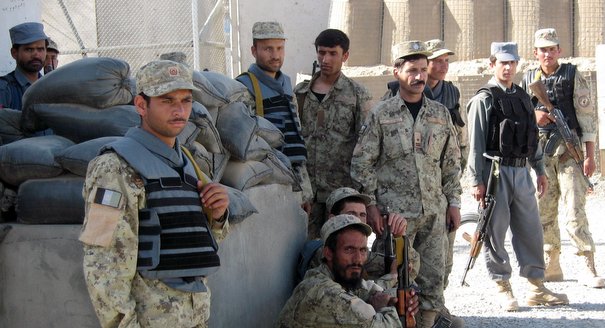
Source: Getty
The recent mass escape from the main prison in Kandahar demonstrates that the insurgency in Afghanistan is growing more sophisticated and more active.
Source: New York Times

First, Kandahar was supposed to be the success story of the coalition and the gains in this province were to compensate for the deterioration of the security in the rest of the country. But these developments paint another story about progress on the ground.
The complexity of the attack shows that the insurgents have a strong presence in the city and clearly indicates that the police have not been able to fundamentally improve security at the prison, despite an attack there two years ago.
The prison break will have a strong psychological impact, discouraging people who were ready to work with the coalition. This is especially true since Kandahar’s police chief, an important local figure, was recently killed.
It is yet another indication that the targeted eliminations conducted by the coalition have not seriously disrupted the insurgents — most likely because the leadership is more in Pakistan than in Afghanistan. The few dozen cadres who escaped from Kandahar prison will reinforce, even if only marginally, the local leadership.
Second, this attack is part of a national trend indicating a more sophisticated and aggressive insurgency this year. The coalition is peaking in terms of resources and soldiers on the ground. The last few weeks have demonstrated the insurgents’ ability to organize complex attacks. The number of attacks against the coalition is at record levels and everything indicates that their offensive will be especially aggressive this year. Since the coalition doesn’t have the resources to launch another large-scale operation, the insurgency will likely make significant progress in the coming months.
In this context, the transfer of security operations and responsibilities to the Afghan national army before 2014 seems like a fantasy. Military withdrawal without negotiating with the Taliban leadership is impossible.
Former Nonresident Scholar, South Asia Program
Dorronsoro’s research focuses on security and political development in Afghanistan. He was a professor of political science at the Sorbonne in Paris and the Institute of Political Studies of Rennes.
Recent Work
Adam Baczko, Gilles Dorronsoro, Arthur Quesnay
Gilles Dorronsoro
Carnegie India does not take institutional positions on public policy issues; the views represented herein are those of the author(s) and do not necessarily reflect the views of Carnegie, its staff, or its trustees.

In any defense establishment, change is an ongoing process. However, despite the best of intentions, existing bureaucracies, bound by habit and years of socialization, have their limits in implementing transformative change.

Anit Mukherjee

After the chill in ties between 2020 and 2024 that brought India–China relations to their lowest point in several decades, the two countries have engaged each other afresh. This paper argues that there are predominantly four imperatives guiding India’s approach to China, and they exist in an order of priority.

Saheb Singh Chadha

This piece argues that India’s central challenge is not managing a single flashpoint but resolving the underlying tension between expansion and institutional coherency of the BRICS grouping.

Vrinda Sahai

A partnership between India, a country of subcontinental size, and Africa, a continent of fifty-four countries, may seem asymmetric until one notes that both are home to nearly the same number of people—1.4 billion. This essay spells out the existing challenges to the partnership, its optimal potential, and the possible pathways to realize it over the next quarter-century.

Rajiv Bhatia

The India–EU Free Trade Agreement (FTA) is shaping up to be one of the most consequential trade negotiations, both economically and strategically. But, what’s in the agreement, what’s missing, and what will determine its success in the years ahead
Vrinda Sahai, Nicolas Köhler-Suzuki