• Research
  • About
  • Experts
Carnegie India logoCarnegie lettermark logo
AI
{
  "authors": [],
  "type": "other",
  "centerAffiliationAll": "",
  "centers": [
    "Carnegie Endowment for International Peace"
  ],
  "collections": [],
  "englishNewsletterAll": "",
  "nonEnglishNewsletterAll": "",
  "primaryCenter": "Carnegie Endowment for International Peace",
  "programAffiliation": "",
  "programs": [],
  "projects": [],
  "regions": [
    "North Africa",
    "Egypt"
  ],
  "topics": []
}

Source: Getty

Other

Nour Party

A backgrounder on the Nour Party.

Link Copied
Published on Sep 21, 2011

This resource was published on 09/21/2011 and is not updated to reflect changing circumstances.

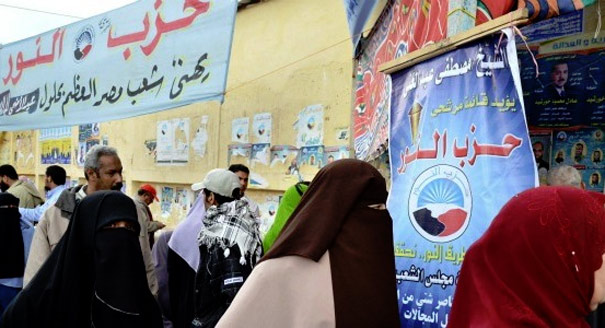
Al-Nour is a Salafi political party founded after the January 2011 uprising. It was originally a member of the Democratic Alliance, but left the alliance in September 2011, becoming the founding member and largest party in the Islamist Alliance.

Major Party Figures

Younes Makhioun: President

Background

Al-Nour was founded in 2011 following the January 2011 uprising. It was the first Salafi political organization to submit a request to be recognized as an official political party. The party’s former president, Emad ad-Din Abd al-Ghofour, made the request in May 2011 as the representative of the party’s founders, and al-Nour was granted official status on June 12, 2011. The party advocates gradual reform under the slogan: “The only reform we desire is the reform we can achieve.”  This slogan is based on a view of the principles of Islam as a comprehensive framework for religion and state.

Platform

Political Issues

  • Supporting Article 2 of the Egyptian Constitution which states that Islam is the religion of the state and the Islamic law is the main source of legislation
  • Preserving fundamental rights and public freedoms in the framework of Islamic law
  • Calling for Islamic law to serve as the guiding  principles for all political, social and economic issues
  • Supporting separation between the legislative, judicial and executive powers and independence of the judiciary

Socioeconomic Issues

  • Preserving the right to private property and free economic competition as long as it does not harm the interests of society
  • Reducing  unemployment through state provision of jobs
  • Recognizing health care as a basic human right
  • Calling for the complete independence of al-Azhar from the government and restoration of its prominent role throughout the Islamic world
  • Improving education and establishing training programs throughout Egypt
  • Advocating for a greater state role in the institutions of Zakat and Waqf
  • Supporting religious freedom for the Copts and separate personal status laws for non-Muslims

Foreign Policy Issues

  • Founding foreign relations on a basis of mutual respect and equality
  • Supporting a greater role for Egypt in the Arab and Islamic worlds as well as among the Nile Basin countries, particularly Sudan
North AfricaEgypt

Carnegie India does not take institutional positions on public policy issues; the views represented herein are those of the author(s) and do not necessarily reflect the views of Carnegie, its staff, or its trustees.

More Work from Carnegie India

  • Commentary
    Raja Mandala: India and Djibouti’s Geopolitical Scrum

    President Kovind’s visit to Djibouti and Ethiopia suggests India is finally waking up to the geopolitical significance of the Horn of Africa.

      C. Raja Mohan

  • Commentary
    Raja Mandala: Neweurasia

    Chancelleries across Eurasia are scrambling to come to terms with the entirely unexpected victory of Trump.

      C. Raja Mohan

  • Commentary
    A Reunion of Friends

    The relationship between India and Egypt has declined over the years. But, Indian Prime Minister Narendra Modi and Egyptian President Abdel Fattah al-Sisi should rebuild the friendship between Nehru and Nasser.

      C. Raja Mohan

  • Commentary
    Raja-Mandala: Between Talk and Action

    The India-Africa Summit can galvanize India’s security engagement with Africa.

      C. Raja Mohan

  • Commentary
    India and the Middle East: Finding a New Balance

    While some might find India’s new approach to the Middle East somewhat disconcerting, the government of Narendra Modi is bringing pragmatism and transparency to India’s Middle East policy.

      C. Raja Mohan

Get more news and analysis from
Carnegie India
Carnegie India logo, white
Unit C-4, 5, 6, EdenparkShaheed Jeet Singh MargNew Delhi – 110016, IndiaPhone: 011-40078687
  • Research
  • About
  • Experts
  • Projects
  • Events
  • Contact
  • Careers
  • Privacy
  • For Media
Get more news and analysis from
Carnegie India
© 2026 Carnegie Endowment for International Peace. All rights reserved.