

Paper
Matthew Rojansky
{
  "authors": [
    "Matthew Rojansky"
  ],
  "type": "legacyinthemedia",
  "centerAffiliationAll": "dc",
  "centers": [
    "Carnegie Endowment for International Peace"
  ],
  "collections": [],
  "englishNewsletterAll": "ctw",
  "nonEnglishNewsletterAll": "",
  "primaryCenter": "Carnegie Endowment for International Peace",
  "programAffiliation": "russia",
  "programs": [
    "Russia and Eurasia"
  ],
  "projects": [],
  "regions": [
    "Caucasus",
    "Russia"
  ],
  "topics": [
    "Political Reform",
    "Democracy",
    "Foreign Policy"
  ]
}
Source: Getty
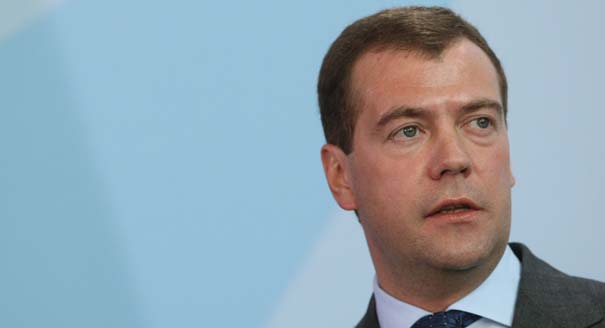
Dmitry Medvedev has the opportunity to follow in the footsteps of Mikhail Gorbachev and remain a strong advocate of Russian modernization and democratization as a liberal ex-president.
Source: National Interest

In March, Dmitry Medvedev, who has been president of Russia since 2008, will have a similar experience. He will surrender his office to his prime minister, predecessor and political patron Vladimir Putin, who after months of speculation has at last confirmed his intention to run for president on the ruling United Russia party's ticket. When Medvedev leaves office in March, he like Gorbachev will face the question of what role to play in his country's future. What becomes of a liberal ex-president in a decidedly illiberal state like Russia?
One thing is certain—Medvedev's welfare and personal security are assured as long as Putin remains in control. Medvedev has long been a close ally of Putin, and the latter is thought to have chosen him to become president in 2008 because of his unswerving loyalty. Thus, unlike former leaders in some other authoritarian states, Medvedev need not seek asylum abroad.
In fact, Medvedev has already telegraphed one likely possibility, namely that Putin's faith in him remains so great that he will continue to serve in the government, perhaps as prime minister. Putin may also define a new position for his protégé within the Russian government—for example, as chief justice of the constitutional court or in some high-profile international position, such as an ambassador at large for global security.
In any event, Medvedev's role in a future Putin-dominated government is likely to remain functionally similar to what it is today: evangelist in chief for Russia's modernization efforts, including the Skolkovo "city of innovation." Medvedev's voice could also continue to serve Putin's need for a popular lightning rod against corruption or in foreign policy as a spokesman and manager of the U.S.-Russia "reset."
If Medvedev is not given a formal appointment by his successor, he has another set of options altogether.
He can choose to follow the precedent set by Gorbachev, who also left office at a young age and well known for his liberal views—by participating selectively in political debates, possibly creating and leading a new political party or perhaps standing for office again in the next election, as Gorbachev did in 1996. Putin's predecessor and patron, Boris Yeltsin, was already in poor health when he left office in 1999, but even he spoke out occasionally on political and foreign-policy matters until his death in 2007.
Even without holding a formal office, Medvedev's voice will be influential. He could reach out to current and former political and business leaders and raise funds for favored causes. He could choose a signature initiative—most likely modernization—and create a nongovernmental organization to advance it, on the model of Gorbachev's Green Cross International or the Clinton Global Initiative. Other worthwhile causes might include combating corruption, environmental degradation, and drug and alcohol abuse, all of which cast a shadow over Russia's future.
Because he owes so much to Putin personally, Medvedev is unlikely to speak out as frankly or critically to Russian audiences about the Putin system as either Gorbachev or Yeltsin did. But he may have the opportunity to rise to a greater and more revered status internationally than he enjoyed as president if he chooses the path of ex-leaders like Vaclav Havel or Jimmy Carter, concerning himself with democratic development and human rights around the world. Even though he did not deliver perfect democracy and rule of law in his own country, the international community will surely welcome a prominent Russian voice to advocate these values.
Many outgoing presidents become obsessed with "legacy" to the point of wasting resources and political capital pursuing unrealistic or impossible goals during their last months in office. Thus far, Medvedev seems to have avoided chasing political rainbows. If anything he has refined his focus on concrete initiatives like Skolkovo and new campaigns against alcohol and tobacco use.
Perhaps Medvedev is keeping his head down, hoping that if he does not appear to threaten the system's stability, Putin will agree to keep him at the center of power, or perhaps even restore him to the presidency in 2018. Then again, maybe Medvedev has already defined his legacy and post-presidential role: offering Russians a bright vision of their country's future but accepting that the road to get there will be long and winding and that he may not himself be in the driver's seat.
Former Deputy Director, Russia and Eurasia Program
Rojansky, formerly executive director of the Partnership for a Secure America, is an expert on U.S. and Russian national security and nuclear-weapon policies.
Recent Work
Matthew Rojansky
Matthew Rojansky
Carnegie India does not take institutional positions on public policy issues; the views represented herein are those of the author(s) and do not necessarily reflect the views of Carnegie, its staff, or its trustees.

After the chill in ties between 2020 and 2024 that brought India–China relations to their lowest point in several decades, the two countries have engaged each other afresh. This paper argues that there are predominantly four imperatives guiding India’s approach to China, and they exist in an order of priority.

Saheb Singh Chadha

This piece argues that India’s central challenge is not managing a single flashpoint but resolving the underlying tension between expansion and institutional coherency of the BRICS grouping.

Vrinda Sahai

A partnership between India, a country of subcontinental size, and Africa, a continent of fifty-four countries, may seem asymmetric until one notes that both are home to nearly the same number of people—1.4 billion. This essay spells out the existing challenges to the partnership, its optimal potential, and the possible pathways to realize it over the next quarter-century.

Rajiv Bhatia

The India–EU Free Trade Agreement (FTA) is shaping up to be one of the most consequential trade negotiations, both economically and strategically. But, what’s in the agreement, what’s missing, and what will determine its success in the years ahead
Vrinda Sahai, Nicolas Köhler-Suzuki
Trump 2.0 has unsettled India’s external environment—but has not overturned its foreign policy strategy, which continues to rely on diversification, hedging, and calibrated partnerships across a fractured order.



Milan Vaishnav, ed., Sameer Lalwani, Tanvi Madan, …