• Research
  • About
  • Experts
Carnegie India logoCarnegie lettermark logo
{
  "authors": [
    "Michael Pettis"
  ],
  "type": "legacyinthemedia",
  "centerAffiliationAll": "dc",
  "centers": [
    "Carnegie Endowment for International Peace",
    "Carnegie China"
  ],
  "collections": [],
  "englishNewsletterAll": "asia",
  "nonEnglishNewsletterAll": "",
  "primaryCenter": "Carnegie China",
  "programAffiliation": "AP",
  "programs": [
    "Asia"
  ],
  "projects": [],
  "regions": [
    "East Asia",
    "China"
  ],
  "topics": [
    "Economy"
  ]
}
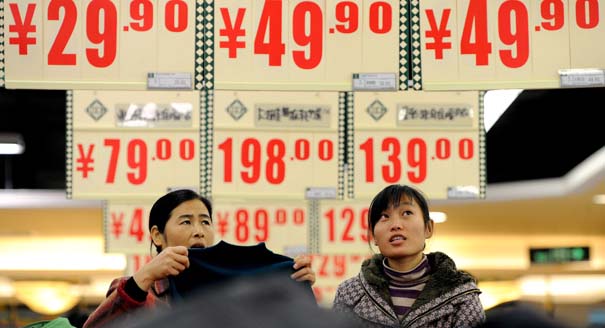
Source: Getty

In The Media
Carnegie China

Don't Panic, China's Economy is Not on the Rocks Yet

Falling growth rates in China may signal a much-needed transfer of wealth from the state to the household sector, a vital aspect of economic rebalancing.

Link Copied
By Michael Pettis
Published on Nov 7, 2011

Source: Financial Times

Don't Panic, China's Economy is Not on the Rocks YTwo years ago it was hard to find anyone who believed that annual GDP growth in China would ever fall below 8 per cent. Today, as the market fixates on various domestic bubbles, it is becoming almost as hard to find anyone who does not worry that China may be on the verge of collapse.

But while there should be little doubt that China has a very difficult economic adjustment ahead – with Beijing policymakers increasingly aware of the challenge – today’s panic may be no more justified than yesterday’s euphoria. If the adjustment is well managed the Chinese financial system will not collapse and the social cost will be minimal. It will, however, require Beijing to become serious about transferring wealth from the state to the household sector.

Why is wealth transfer necessary? Because for several years rapid growth in China has been driven by increasingly wasted investment and, with it, an unsustainable increase in debt, and this has come at the expense of households. Rapidly rising debt meant that only extremely low lending rates funded by hapless household depositors could keep debt servicing costs manageable.
 
Since households were effectively saddled with servicing the debt, their share of GDP dropped steadily. Other similar transfers also paid for by households and aimed at keeping high growth viable, such as direct subsidies and an undervalued currency, exacerbated this process.
 
As a consequence, the household share of GDP has dropped to perilously low levels and, with it, consumption has too. To rebalance its economy towards consumption China must eliminate the future burden on the household sector by sharply reducing investment and credit growth. This will come with a cost, however. GDP growth rates will drop, perhaps to below 3 per cent before the end of the decade.
 
But will China’s banks collapse? No. Beijing effectively guarantees the profitability and stability of the banking system by socialising credit risk and enforcing a high spread between the lending and deposit rates. As long as the government is credible, the banks will be solvent.
 
The real risk for China is that government debt levels rise enough to undermine this credibility. The case of Japan is relevant. During Japan’s 20-year adjustment period banking stability was largely maintained but government debt levels soared. It was through rising government debt that Japan effectively transferred wealth from the state and corporate sectors back to households and so gradually rebalanced its economy.
 
China too needs to transfer wealth back from the state to households if it wants household consumption to power future growth. There are two ways to do this. One way is the Japanese way – let government debt levels grow much faster than government assets as Beijing absorbs losses in the banking system. The other way is through direct transfers to the household sector, perhaps in the form of privatization or raising public ownership of state assets.
Either way, in the next decade the household share of China’s economy must grow as Beijing weans the economy from excessive investment. Much slower GDP growth need not be socially destabilising. As the household share of GDP grows, by definition household income will grow faster than GDP, and so even with GDP growth rates of 3 per cent or lower household income can still grow at a rate of 5 to 7 per cent.
 
In the next few years Beijing will decide how to accomplish this transfer, and the sooner the better. Policymakers can sell or transfer assets and use the proceeds directly or indirectly to boost household wealth, or, like Japan, Beijing can simply allow its debt burden to rise much faster than GDP. One or the other must happen. The former is politically difficult but will ultimately result in much healthier growth. The latter may saddle China, like Japan, with a long-term debt burden that will be difficult to shake.
 
As the market becomes increasingly worried about China’s surging debt, there is a tendency for the euphoria of earlier years to turn increasingly to panic. But Beijing still has time to manage its transition without social disruption. If it has the will to allow the household share of GDP to grow at the expense of local, provincial and central governments, it can manage the difficult transition.

About the Author

Michael Pettis

Nonresident Senior Fellow, Carnegie China

Michael Pettis is a nonresident senior fellow at the Carnegie Endowment for International Peace. An expert on China’s economy, Pettis is professor of finance at Peking University’s Guanghua School of Management, where he specializes in Chinese financial markets. 

    Recent Work

  • Commentary
    What’s New about Involution?

      Michael Pettis

  • Commentary
    Using China’s Central Government Balance Sheet to “Clean up” Local Government Debt Is a Bad Idea

      Michael Pettis

Michael Pettis
Nonresident Senior Fellow, Carnegie China
Michael Pettis
EconomyEast AsiaChina

Carnegie India does not take institutional positions on public policy issues; the views represented herein are those of the author(s) and do not necessarily reflect the views of Carnegie, its staff, or its trustees.

More Work from Carnegie India

  • Commentary
    The Impact of U.S. Sanctions and Tariffs on India’s Russian Oil Imports

    This piece examines India’s response to U.S. sanctions and tariffs, specifically assessing the immediate market consequences, such as alterations in import costs, and the broader strategic implications for India’s energy security and foreign policy orientation.

      Vrinda Sahai
  • Paper
    India-China Economic Ties: Determinants and Possibilities

    This paper examines the evolution of India-China economic ties from 2005 to 2025. It explores the impact of global events, bilateral political ties, and domestic policies on distinct spheres of the economic relationship.

      Santosh Pai

  • Article
    Hidden Tides: IUU Fishing and Regional Security Dynamics for India

    This article examines the scale and impact of Chinese IUU fishing operations globally and identifies the nature of the challenge posed by IUU fishing in the Indian Ocean Region (IOR). It also investigates why existing maritime law and international frameworks have struggled to address this growing threat.

      Ajay Kumar, Charukeshi Bhatt

  • Commentary
    TRUST and Tariffs

    The India-U.S. relationship currently appears buffeted between three “Ts”—TRUST, Tariffs, and Trump.

      Arun K. Singh

  • Research
    Views From Taipei: Essays by Young Indian Scholars on China

    This compendium brings together three essays by scholars who participated in Carnegie India's Security Studies Dialogue in 2024, each examining a different aspect of China’s policies. Drawing on their expertise and research, the authors offer fresh perspectives on key geopolitical challenges.

      • +1

      Vijay Gokhale, Suyash Desai, Amit Kumar, …

Get more news and analysis from
Carnegie India
Carnegie India logo, white
Unit C-4, 5, 6, EdenparkShaheed Jeet Singh MargNew Delhi – 110016, IndiaPhone: 011-40078687
  • Research
  • About
  • Experts
  • Projects
  • Events
  • Contact
  • Careers
  • Privacy
  • For Media
Get more news and analysis from
Carnegie India
© 2026 Carnegie Endowment for International Peace. All rights reserved.





