• Research
  • About
  • Experts
Carnegie India logoCarnegie lettermark logo
{
  "authors": [],
  "type": "other",
  "centerAffiliationAll": "",
  "centers": [
    "Carnegie Endowment for International Peace"
  ],
  "collections": [],
  "englishNewsletterAll": "",
  "nonEnglishNewsletterAll": "",
  "primaryCenter": "Carnegie Endowment for International Peace",
  "programAffiliation": "",
  "programs": [],
  "projects": [],
  "regions": [
    "North Africa",
    "Egypt"
  ],
  "topics": []
}

Source: Getty

Other

Egyptian Social Democratic Party

A backgrounder on the Egyptian Social Democratic Party

Link Copied
Published on Nov 4, 2011

This resource was published on 11/04/2011 and is not updated to reflect changing circumstances.

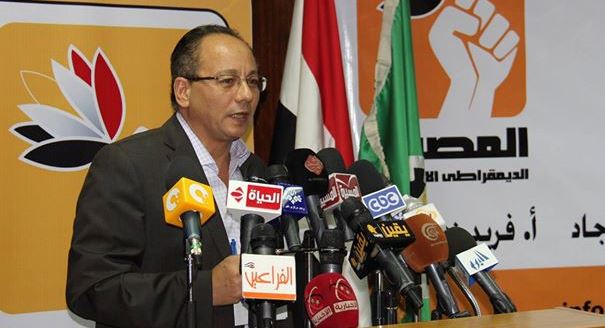
The Egyptian Social Democratic Party is a liberal party with an emphasis on social-democratic principles in its platform, straddling the fine line between free enterprise and social justice. It was a founding member of the Egypt Bloc and the second largest party in the Bloc in representation on electoral lists. During the administration of former president Mohamed Morsi, the Egyptian Social Democratic Party played a leading role in the opposition. After Morsi’s ouster by the military on July 3, 2013, a member of the party’s leadership, Dr. Hazem el-Beblawi, became prime minister in the interim government.

Major Party Figures

Mohamed Abou El-Ghar: Founding member and member of the party’s Board of Trustees
Emad Gad: Founding member and member of the party’s administrative committee
Farid Zahran: Founding member and member of the party’s administrative committee
Ziyad al-Elaimy: Founding member and member of the party’s administrative committee
Hany Naguib: Executive Director of the party’s administrative committee
Hazem el-Beblawi: Member of the party’s Board of Trustees

Background

The Egyptian Social Democratic Party was founded in March 2011 following the January 2011 uprising. After submitting the paperwork in June, the party was given official recognition on July 3, 2011.

Amr Hamzawy was a founding member of the Egyptian Social Democratic Party, but broke off from the party in April 2011 to form the Egypt Freedom Party after disagreements over a statement released by the Egyptian Social Democratic Party. The Egyptian Social Democratic Party was a member of the Egypt Bloc alliance. Disputes between the Bloc and Hamzawy’s Egypt Freedom Party over electoral lists led to the latter withdrawing from the Egypt Bloc.

Platform

Political Issues

  • Ensuring civil, political, economic, and social rights for all individuals which will allow them to reach their full pottential and achieve their productive energies
  • Supporting a modern, civil, democratic state where all citizens are equal in rights and duties regardless of sex, color, religion, race, wealth, or political affiliation
  • Advocating a democracy based upon rule of law

Socioeconomic Issues

  • Supporting a market economy with social justice
  • Advocating minimum guaranteed income
  • Ensuring adequate healthcare and housing
  • Supporting equal opportunity and a fair distribution of resources including to all governorates of Egypt
  • Ensuring economic development through public infrastructure spending which will stimulate the economy
  • Maintaining a clean environment by preserving natural resources in a sustainable way for future generations

Foreign Policy Issues

  • Advocating a just peace between Israel and the Palestinians based upon the internationally agreed upon resolutions leading to a Palestinian state
  • Supporting the right of self-determination for all peoples
  • Stopping the arms race between regimes in the Middle East including making the region one free of Weapons of Mass Destruction
North AfricaEgypt

Carnegie India does not take institutional positions on public policy issues; the views represented herein are those of the author(s) and do not necessarily reflect the views of Carnegie, its staff, or its trustees.

More Work from Carnegie India

  • Commentary
    Raja Mandala: India and Djibouti’s Geopolitical Scrum

    President Kovind’s visit to Djibouti and Ethiopia suggests India is finally waking up to the geopolitical significance of the Horn of Africa.

      C. Raja Mohan

  • Commentary
    Raja Mandala: Neweurasia

    Chancelleries across Eurasia are scrambling to come to terms with the entirely unexpected victory of Trump.

      C. Raja Mohan

  • Commentary
    A Reunion of Friends

    The relationship between India and Egypt has declined over the years. But, Indian Prime Minister Narendra Modi and Egyptian President Abdel Fattah al-Sisi should rebuild the friendship between Nehru and Nasser.

      C. Raja Mohan

  • Commentary
    Raja-Mandala: Between Talk and Action

    The India-Africa Summit can galvanize India’s security engagement with Africa.

      C. Raja Mohan

  • Commentary
    India and the Middle East: Finding a New Balance

    While some might find India’s new approach to the Middle East somewhat disconcerting, the government of Narendra Modi is bringing pragmatism and transparency to India’s Middle East policy.

      C. Raja Mohan

Get more news and analysis from
Carnegie India
Carnegie India logo, white
Unit C-4, 5, 6, EdenparkShaheed Jeet Singh MargNew Delhi – 110016, IndiaPhone: 011-40078687
  • Research
  • About
  • Experts
  • Projects
  • Events
  • Contact
  • Careers
  • Privacy
  • For Media
Get more news and analysis from
Carnegie India
© 2026 Carnegie Endowment for International Peace. All rights reserved.