

Paper
David Burwell
{
  "authors": [
    "David Burwell"
  ],
  "type": "legacyinthemedia",
  "centerAffiliationAll": "dc",
  "centers": [
    "Carnegie Endowment for International Peace"
  ],
  "collections": [],
  "englishNewsletterAll": "ctw",
  "nonEnglishNewsletterAll": "",
  "primaryCenter": "Carnegie Endowment for International Peace",
  "programAffiliation": "SCP",
  "programs": [
    "Sustainability, Climate, and Geopolitics"
  ],
  "projects": [
    "Carnegie Oil Initiative"
  ],
  "regions": [
    "North America",
    "United States"
  ],
  "topics": [
    "Climate Change"
  ]
}
Source: Getty
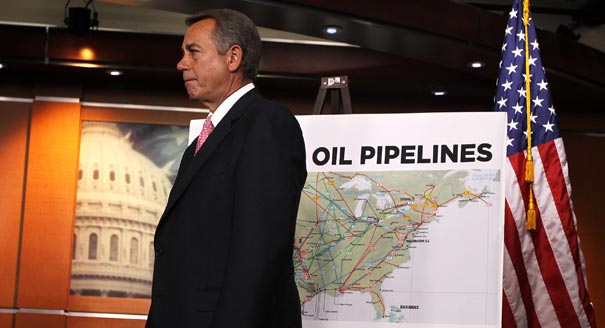
Congress should not fast-track the Keystone XL oil pipeline project, which could escalate environmental campaigns to stop oil sands development entirely.
Source: Huffington Post

Keystone XL is more than a political bargaining chip. It is more than a $7 billion capital energy project. It is the Rubicon that scientists, energy analysts, and environmentalists say we must not cross if we are to keep global warming at or below 2 degrees Celsius from pre-industrial times. Build Keystone XL and we lock ourselves into reliance on "dirty" energy sources that will put us over the 2 degrees tipping point. It is "game over."
This 2 degrees limit is not a random number. It is the limit beyond which settled science says we risk a 50-50 chance of severe planetary harm. Imagine a world with 35 percent of all species going extinct; a sea level rise flooding natural and urban infrastructure alike; forced exodus of more than 500 million people from coastal areas; and a deadly migration of tropical diseases toward populations that have not built up resistance. All this within the lifetime of those we care about most deeply -- our children and grandchildren.
Energy analysts are increasingly alarmed at the rate that the world is getting "locked-in" to fossil fuels as its primary energy source. The International Energy Agency, in its annual World Energy Outlook 2011, estimates that we have only until 2017 -- just five years from now -- to fundamentally turn capital investments in energy assets away from fossil fuels if we are to stay within this limit. If not, the best we may be able to achieve is a 3.5 degrees increase. If we delay this shift until 2035, we will be on track for a 6 degrees increase, the consequences of which approach planetary suicide. If we continue to mine tar sands -- the unconventional oils Keystone XL will transport at a rate of up to 800,000 barrels a day -- the lock-in occurs even earlier.
The 2 percent limit is also a legal limit. At the UN climate change summit in Cancun one year ago conferees signed an accord to keep global temperature rise to below the 2 degrees threshold. This commitment was reconfirmed and strengthened at Durban last week. Keystone XL requires a permit from the U.S. state department -- the same agency that negotiated the Cancun and Durban agreements. Given the warnings that scientists, energy analysts, and even insurance company executives are now urgently urging policymakers to heed, the state department has a duty to assess permit issuance against its commitments.
With global consensus now consolidating around the 2 degrees limit, you would think both public and private sector leaders would act -- fast. Yet, as noted recently by Lord Nicholas Stern, former chief economist of the World Bank, major oil, gas, and coal companies proceed to extract these fossil fuels on a business as usual basis. Shareholders seem oblivious to the fact that conversion of resources into proven reserves increasingly relies on risky or destructive exploration in the Arctic, deep oceans, and sensitive ecosystems. Sir Nicholas' conclusion: "either the market has not thought hard enough about the issue or thinks that governments will not do very much."
Environmentalists, understanding that neither private markets nor the political system is capable of responding to the challenge posed by climate change, are determined to stop this pipeline using whatever legal tools are available. If markets, international accords, and public policy won't respond by developing a plan to keep fossil fuel emissions within safe limits, then these resources must simply stay in the ground until an enforceable plan is adopted. Unconventional oils are at the frontline of the fight and Keystone XL is the point of the bayonet. Environmentalists are preparing themselves for trench warfare.
Fast-tracking the Keystone XL decision may escalate campaigns to stop oil sands development entirely. Politicians should ponder hard the wisdom of Will Roger's advice.
Former Nonresident Senior Fellow, Energy and Climate Program
Burwell focused on the intersection between energy, transportation, and climate issues, as well as policies and practice reforms to reduce global dependence on fossil fuels.
Recent Work
David Burwell
David Burwell
Carnegie India does not take institutional positions on public policy issues; the views represented herein are those of the author(s) and do not necessarily reflect the views of Carnegie, its staff, or its trustees.

How is AI reshaping space security, creating governance challenges, and where does international diplomacy stand today?


Tejas Bharadwaj, Almudena Azcárate Ortega

The U.S.–India semiconductor cooperation story is well-stocked with top-level strategic intent. What remains unresolved, however, are some underlying challenges that will determine whether the cooperation actually functions. Three such friction points stand out.

Shruti Mittal

India and the United States are close to concluding a Reciprocal Defense Procurement Agreement (RDPA) that will allow firms from the two countries to sell to each other’s defense establishments more easily. While this may not remedy the specific grievances both sides may have regarding larger bilateral issues, an RDPA could restore some momentum, following the trade deal announcement.

Konark Bhandari

On the last day of the India AI Impact Summit, India signed Pax Silica, a U.S.-led declaration seemingly focused on semiconductors. While India’s accession to the same was not entirely unforeseen, becoming a signatory nation this quickly was not on the cards either.
Konark Bhandari

This piece examines India’s response to U.S. sanctions and tariffs, specifically assessing the immediate market consequences, such as alterations in import costs, and the broader strategic implications for India’s energy security and foreign policy orientation.

Vrinda Sahai