

Commentary
Uri Dadush
{
  "authors": [
    "Uri Dadush"
  ],
  "type": "legacyinthemedia",
  "centerAffiliationAll": "",
  "centers": [
    "Carnegie Endowment for International Peace"
  ],
  "collections": [],
  "englishNewsletterAll": "",
  "nonEnglishNewsletterAll": "",
  "primaryCenter": "Carnegie Endowment for International Peace",
  "programAffiliation": "",
  "programs": [],
  "projects": [],
  "regions": [
    "South America",
    "South Asia",
    "East Asia",
    "North America"
  ],
  "topics": [
    "Economy"
  ]
}
Source: Getty
Over the past 20 years, emerging economies have not only grown faster than advanced countries, but outperformed market expectations--leading to significant returns on investment. Whether this will be the case in the future remains to be seen.
Source: Il Espresso

On the face of it, the reason for the extraordinary outperformance of emerging market equities is clear: growth. Over the last 20 years, emerging market GDP grew by 5.1 percent a year while advanced countries grew by only 2.2 percent a year, and this was broadly reflected in corporate earnings.
But wait, it is not so simple. After all, financial markets are supposed to be forward-looking, and the fact that emerging markets would grow faster was no secret even in 1992 (when, by the way, I first took on the task of forecasting emerging markets at the World Bank). Why didn’t markets reflect widely-held expectations that companies in emerging markets would grow faster in the price of their equities? A possible answer is that markets could not be sure that growth would be so rapid (in fact emerging economies and stock markets are more volatile than in advanced countries), so they priced the emerging equities at a discount. Moreover, in recent years they have kept getting surprised by the strong economic performance of emerging markets; in fact, at around 6.3 percent a year over the last five and ten years, emerging market growth outstripped most forecasts.So, will emerging markets outperform advanced countries again in coming years? They are certainly expected to continue to grow faster. The World Bank’s latest forecast, for example, projects 5.7 percent GDP growth through 2013 for emerging and developing economies, compared to 1.7 percent in advanced economies, an even wider difference than in the past.
But are markets already pricing in these expectations? In fact, markets continue to discount emerging markets, though less than they used to. They should be pricing a dollar of earnings in emerging markets higher than in advanced countries because the latter are expected to grow less rapidly, but they are doing the opposite, valuing advanced country stocks at 12.6 times earnings and emerging market stocks at 10.4 times earnings. This means that if the growth projections by the World Bank are realized, and this is reflected in profits, you will do much better investing in emerging markets than in advanced countries (about 6% a year higher return, in fact). But that also assumes that the relative valuation of emerging market and advanced country earnings will not change, which leads to the second question: will markets be surprised again by rapid growth in emerging markets in coming years?
If I knew the answer to that question, I would be very, very rich. There is little doubt that emerging markets, which have young and rapidly growing populations and are absorbing advanced technologies, will grow rapidly over the very long run. But here are four reasons the next five or ten years could bring some disappointment. First, growth expectations have never been higher, raising the bar. Moreover, many emerging markets (Russia, Indonesia, Argentina for example) have done well from commodity exports, and history teaches that record high prices of commodities will, sooner or later, lead to a big expansion in supply and new technologies that will reduce any shortage. Third, record low interest rates and lack of confidence in advanced countries, which have encouraged investment to emerging markets and caused their currencies to appreciate, will not persist forever. Finally, several emerging markets are already showing signs of macroeconomic imbalances and misallocated investment (Brazil, Turkey, China) or loss of reform momentum (India).
Still, the long-term growth prospects of emerging markets are so strong and current valuations are attractive enough that if you are 40 years old and investing for your old-age, you will still likely do very well by putting a good share of it in emerging markets rather than in slow-growing and fiscally-challenged advanced countries.

Former Senior Associate, International Economics Program
Dadush was a senior associate at the Carnegie Endowment for International Peace. He focuses on trends in the global economy and is currently tracking developments in the eurozone crisis.
Recent Work
Uri Dadush
Uri Dadush
Carnegie India does not take institutional positions on public policy issues; the views represented herein are those of the author(s) and do not necessarily reflect the views of Carnegie, its staff, or its trustees.

On March 10, 2026, India’s Union Cabinet approved amendments to Press Note 3, a regulation that mandated government approval on all foreign direct investment (FDI) from countries sharing a land border with India. This amendment raises questions primarily about whether its stated benefits will materialize and if the risks have been adequately weighed. This piece will address the same.

Konark Bhandari
Trump 2.0 has unsettled India’s external environment—but has not overturned its foreign policy strategy, which continues to rely on diversification, hedging, and calibrated partnerships across a fractured order.



Milan Vaishnav, ed., Sameer Lalwani, Tanvi Madan, …

This piece examines India’s response to U.S. sanctions and tariffs, specifically assessing the immediate market consequences, such as alterations in import costs, and the broader strategic implications for India’s energy security and foreign policy orientation.

Vrinda Sahai

This paper examines the evolution of India-China economic ties from 2005 to 2025. It explores the impact of global events, bilateral political ties, and domestic policies on distinct spheres of the economic relationship.

Santosh Pai
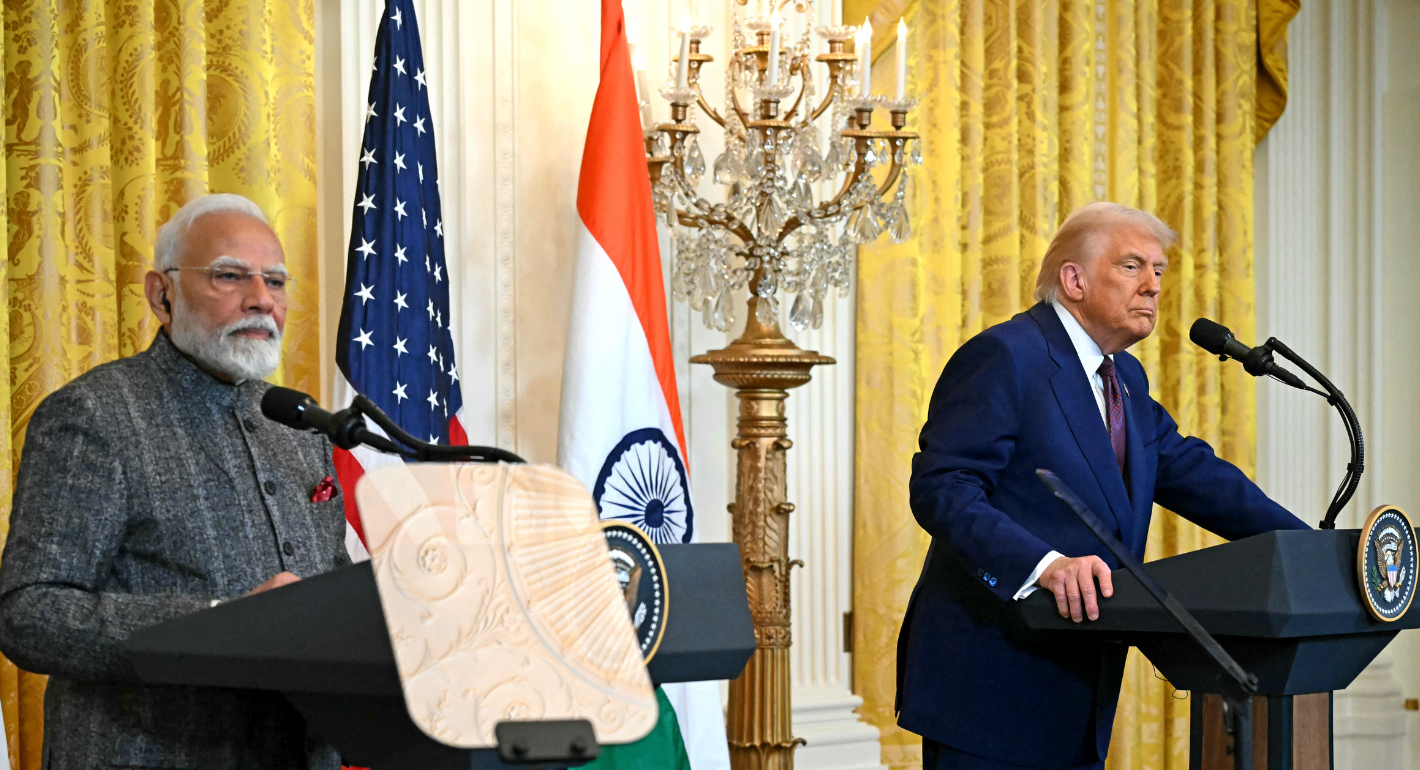
The India-U.S. relationship currently appears buffeted between three “Ts”—TRUST, Tariffs, and Trump.

Arun K. Singh