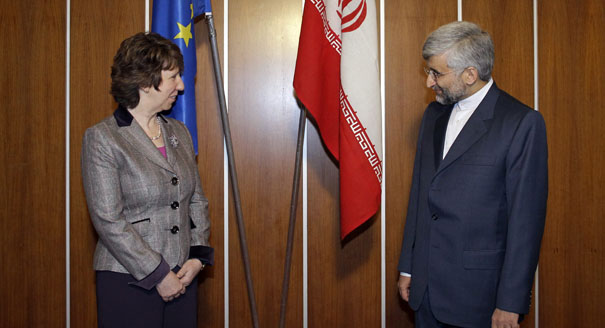
Though the participants in the negotiations about Iran's nuclear program foresee several rounds of discussions, all are acutely aware that time to reach agreement peacefully may be running out.
After a hiatus of more than a year, negotiations about Iran’s nuclear program are set to resume in Turkey on Friday between Iran and France, Germany, Britain, Russia, China and the United States. Though the participants foresee several rounds of discussions, all will be acutely aware that time to reach agreement peacefully may be running out.
So it is important to ask, at the start, how we will be able to tell whether the talks are moving forward.
Though talks that have taken place since 2004 have produced no real progress, recent developments suggest some grounds for cautious optimism. Sanctions are hurting Iran, and even tougher ones are expected to go into effect July 1. President Obama and other American officials have repeatedly warned Iran in recent weeks that the window for diplomacy is closing. Israel’s patience for a meaningful outcome from diplomacy is running thin. Iranian leaders presumably recognize that the likelihood of military action would be higher than ever if negotiations collapsed or began to stretch out aimlessly.
In addition, there are some indications that Iran’s attitude may have become more flexible. Iran still insists that its nuclear program is intended for peaceful use, and that it will not compromise on its right to enrich uranium. It continues to rebuff the International Atomic Energy Agency’s demands for greater cooperation, while threatening retaliation for sanctions imposed on it. But its leaders may be creating room for compromise. Iran sought the new negotiating round. It has done so in the past under severe pressure, only to step away from real compromise; but this time the supreme leader, Ayatollah Ali Khamenei, has twice reiterated his fatwa prohibiting acquisition of nuclear weapons. And some of his recent moves suggest that he is maneuvering to build a domestic political base of support for a possible deal over the nuclear program.
Still, tough and protracted negotiations undoubtedly lie ahead. Iran may never surrender some key elements of the hardware or material related to a bomb-making capacity, and its basic knowledge in this domain cannot be unlearned. At another level, any deal with the United States might ultimately run counter to preserving the clerical regime, for which opposition to America has long been a core political attitude. The United States, for its part, would be reluctant to let Iran leave the negotiations with a deal that left its nuclear option viable, bolstered the regime internally, and reinforced its regional influence and ambitions to the detriment of America’s allies.
In addition, the two sides distrust each other deeply, and their negotiating styles differ fundamentally. The Americans doubt that the Iranians ultimately can “deliver” on any deal, and Iran’s leadership has similar doubts about President Obama’s capacity to deliver in an election year.
Given these complexities, it won’t be easy to assess the progress of the coming talks. But we can suggest benchmarks:
Oil prices: The oil market is exceptionally sensitive to the possibility of a military escalation in the Persian gulf; the traders who set prices tend to be sophisticated, with sources of information among policy makers. Global oil prices, which have been above $100 a barrel all this year, are widely believed to reflect a risk premium of $20 to $25. Any significant decline in that premium following the new negotiation round would reflect optimism about the course of diplomacy. It would also further weaken Iran’s economy — putting even more pressure on Iran to negotiate seriously — while helping distressed Western economies and helping President Obama’s chances of re-election.
Access for verifiers: One urgent concession required of Iran is that it grant the International Atomic Energy Agency far greater access to its nuclear plans, facilities, records and personnel. In the absence of this, most other steps would ring hollow, making it unlikely that sanctions on Iran would be phased out — a goal high on Iran’s list of demands. Since time would be needed to test Iran’s sincerity about disclosures, and its cooperation with the atomic energy agency after years of delay and deceit, Iran’s willingness to undertake such steps early on would both be a prerequisite for, and a signal of, progress on the negotiations.
The bargaining issues: If the focus of talks remains stuck on an attempt to resurrect an earlier deal to trade a foreign supply of nuclear fuel for Iran’s agreement to ship its existing stockpile of enriched uranium out of the country, the diplomatic process will be headed in the wrong direction. Such a deal would fall short of what Iran and its counterparts across the table need in order to end the crisis. Anything less than early Iranian gestures on suspending higher levels of enrichment and conducting enrichment outside its commercial facility at Natanz would most likely doom the negotiations to failure. So would a refusal by the other side to suspend the implementation of new sanctions if Iran extended such gestures.
U.S.-Iran dialogue: In earlier rounds, Iran usually resisted conducting parallel direct discussions with the United States on the margins of the six-party talks. Yet such one-on-one dialogue is essential for success. Iranian willingness to relax its position, and American willingness to sustain bilateral dialogue in an election year, could indicate a prospect of resolving the nuclear crisis.
Frequency and duration of meetings: Previous unproductive negotiating rounds have been truncated and followed by long pauses. Such pacing would be inconsistent with the urgency of this round. Anything but frequent and prolonged negotiating rounds (though some might be unpublicized or employ back channels) would indicate that the negotiations were headed for failure.
A summer deadline: Sorting out all the issues associated with Iran’s nuclear program, let alone other issues that include Afghanistan, Iraq, support for terrorism and human rights, would take a long time. But in the absence of visible progress by the end of June, new sanctions will go into effect, making it even more painful for Iran to negotiate under pressure. Israel would be likely to conclude, in such a case, that the only option left was military. Diplomacy, in other words, has 11 weeks to yield results. Still, it is not unrealistic to think that most of the criteria described here could be met in the first round of renewed diplomacy — if Iran and its counterparts are determined to move from crisis to problem-solving.
Much more work would remain to be done, but the momentum toward war and economic hardship could at the very least be suspended.
Hibbs is a Germany-based nonresident senior fellow in Carnegie’s Nuclear Policy Program. His areas of expertise are nuclear verification and safeguards, multilateral nuclear trade policy, international nuclear cooperation, and nonproliferation arrangements.
Japan Chair for a World Without Nuclear Weapons, Senior Fellow
George Perkovich is the Japan Chair for a World Without Nuclear Weapons and a senior fellow in the Carnegie Endowment for International Peace’s Nuclear Policy Program. He works primarily on nuclear deterrence, nonproliferation, and disarmament issues.
Carnegie India does not take institutional positions on public policy issues; the views represented herein are those of the author(s) and do not necessarily reflect the views of Carnegie, its staff, or its trustees.
After the chill in ties between 2020 and 2024 that brought India–China relations to their lowest point in several decades, the two countries have engaged each other afresh. This paper argues that there are predominantly four imperatives guiding India’s approach to China, and they exist in an order of priority.
This piece argues that India’s central challenge is not managing a single flashpoint but resolving the underlying tension between expansion and institutional coherency of the BRICS grouping.
A partnership between India, a country of subcontinental size, and Africa, a continent of fifty-four countries, may seem asymmetric until one notes that both are home to nearly the same number of people—1.4 billion. This essay spells out the existing challenges to the partnership, its optimal potential, and the possible pathways to realize it over the next quarter-century.
The India–EU Free Trade Agreement (FTA) is shaping up to be one of the most consequential trade negotiations, both economically and strategically. But, what’s in the agreement, what’s missing, and what will determine its success in the years ahead
Trump 2.0 has unsettled India’sexternal environment—buthas notoverturned its foreign policystrategy,which continuesto relyon diversification, hedging,and calibrated partnerships across a fractured order.
+6
Milan Vaishnav, ed., Sameer Lalwani, Tanvi Madan, …