• Research
  • About
  • Experts
Carnegie India logoCarnegie lettermark logo
AI
{
  "authors": [
    "Michael D. Swaine"
  ],
  "type": "legacyinthemedia",
  "centerAffiliationAll": "dc",
  "centers": [
    "Carnegie Endowment for International Peace",
    "Carnegie China"
  ],
  "collections": [
    "China’s Foreign Relations",
    "U.S.-China Relations"
  ],
  "englishNewsletterAll": "asia",
  "nonEnglishNewsletterAll": "",
  "primaryCenter": "Carnegie Endowment for International Peace",
  "programAffiliation": "AP",
  "programs": [
    "Asia"
  ],
  "projects": [],
  "regions": [
    "North America",
    "United States",
    "East Asia",
    "China"
  ],
  "topics": [
    "Security",
    "Military",
    "Foreign Policy"
  ]
}
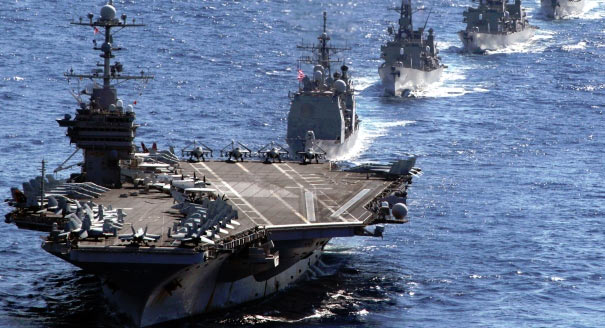
Source: Getty

In The Media

Chinese Leadership and Elite Responses to the U.S. Pacific Pivot

Fundamental differences in U.S. and Chinese views of regional security could increase the likelihood of crises in the Asia-Pacific.

Link Copied
By Michael D. Swaine
Published on Jul 17, 2012

Source: China Leadership Monitor

Over the past several years, the most significant overall U.S. foreign policy action of relevance to China has been the announcement and initial follow-through of the so-called “Pacific Pivot” or “Rebalancing” of U.S. attention and resources to the Asia-Pacific.  This policy move (hereafter termed the Pacific Pivot) , albeit in many ways expressing great continuity with past U.S. policy, is being viewed by many observers and officials in the U.S., China, Asia, and elsewhere, as an important response not only to the growing overall significance of the region to American interests, but in particular to the challenges and opportunities presented by an increasingly powerful and influential China.  The Pacific Pivot has thus drawn considerable attention and levels of controversy in many quarters, and nowhere more so than in Beijing.

This article takes a close look at the Chinese reactions to Washington’s increased stress on Asia, including Chinese assessments of the perceived implications of this policy shift for the region and China in particular.  Three categories of sources are examined :

  • Authoritative:  Several types of PRC sources are considered authoritative in the sense of explicitly “speaking for the regime.”   Of these, commentary on the Pacific Pivot has only occurred during Ministry of Foreign Affairs (MFA) or Ministry of Defense (MND) press conferences, and in the remarks of a few senior MFA officials.
     
  • Quasi-authoritative: Several types of usually homophonous, bylined articles appearing in the People’s Daily are considered quasi-authoritative in the sense that, although indirect and implicit, they are intended to convey the view of an important PRC organization.  Of these, commentary on the Pacific Pivot has only occurred in articles using the new byline Zhong Sheng (钟声),which is an apparent homophone for “the voice of the Central,” and appears to be written by the editorial staff of the People’s Daily International Department.
     
  • Non-authoritative: Many types of low-level commentary and signed articles appearing in a wide variety of PRC and Hong Kong media convey notable yet decidedly non-authoritative views.    Many of these types of articles include a broad spectrum of diverse reactions on the Pacific Pivot.
The content of statements and commentaries appearing in these sources is compared and contrasted to discern possible differences in the Chinese reaction to the Pacific Pivot.  In addition, their timing and content are compared to apparent changes over time in U.S. formulations, emphases, and military or diplomatic actions regarding the policy move, to see whether and how the Chinese response might be prompted and shaped by specific U.S. policy behaviors.  

The essay begins with a brief summary of the history and evolution of the Pacific Pivot (centering on key leadership speeches and writings as well as statements by U.S. government sources, such as State Department and Defense Department officials and spokespersons), followed by a quantitative and qualitative assessment of the Chinese response, divided into both authoritative and quasi-authoritative versus non-authoritative sources.  The quantitative analysis examines the frequency and timing of the appearance of statements regarding the pivot in selected key media.

The qualitative analysis examines the content and timing of Chinese statements and commentaries with regard to five issue areas where references to the Pacific Pivot are most evident: 

  • Broad regional strategy and U.S.-China relations 
  • U.S. defense doctrine and policies (especially the Air-Sea Battle Concept, or ASBC) 
  • The U.S. military presence in Asia (including basing, deployments, and exercises) 
  • U.S. policy toward the South China Sea territorial disputes  
  • The Trans-Pacific Partnership (TPP) initiative 

However, not all of the authoritative, quasi-authoritative, and non-authoritative sources examined cover every one of these six issue areas.

This article was originally published in the China Leadership Monitor. The full text is available here.

About the Author

Michael D. Swaine

Former Senior Fellow, Asia Program

Swaine was a senior fellow at the Carnegie Endowment for International Peace and one of the most prominent American analysts in Chinese security studies.

    Recent Work

  • Other
    What Kind of Global Order Should Washington and Beijing Strive For?

      Michael D. Swaine

  • Commentary
    A Smarter U.S. Strategy for China in Four Steps

      Michael D. Swaine

Michael D. Swaine
Former Senior Fellow, Asia Program
Michael D. Swaine
SecurityMilitaryForeign PolicyNorth AmericaUnited StatesEast AsiaChina

Carnegie India does not take institutional positions on public policy issues; the views represented herein are those of the author(s) and do not necessarily reflect the views of Carnegie, its staff, or its trustees.

More Work from Carnegie India

  • Commentary
    India Signs the Pax Silica—A Counter to Pax Sinica?

    On the last day of the India AI Impact Summit, India signed Pax Silica, a U.S.-led declaration seemingly focused on semiconductors. While India’s accession to the same was not entirely unforeseen, becoming a signatory nation this quickly was not on the cards either.

      Konark Bhandari

  • Commentary
    The Impact of U.S. Sanctions and Tariffs on India’s Russian Oil Imports

    This piece examines India’s response to U.S. sanctions and tariffs, specifically assessing the immediate market consequences, such as alterations in import costs, and the broader strategic implications for India’s energy security and foreign policy orientation.

      Vrinda Sahai

  • Article
    Military Lessons from Operation Sindoor

    The India-Pakistan conflict that played out between May 6 and May 10, 2025, offers several military lessons. This article presents key takeaways from Operation Sindoor and breaks down how India’s preparations shaped the outcome and what more is needed to strengthen future readiness.

      Dinakar Peri

  • Book
    India and the Sovereignty Principle: The Disaggregation Imperative

    This book offers a comprehensive analysis of India's evolving relationship with sovereignty in a complex global order. Moving beyond conventional narratives, it examines how the sovereignty principle shapes India's behavior across four critical domains—from traditional military power to contemporary data governance.

      Rudra Chaudhuri, Nabarun Roy

  • Paper
    India-China Economic Ties: Determinants and Possibilities

    This paper examines the evolution of India-China economic ties from 2005 to 2025. It explores the impact of global events, bilateral political ties, and domestic policies on distinct spheres of the economic relationship.

      Santosh Pai

Get more news and analysis from
Carnegie India
Carnegie India logo, white
Unit C-4, 5, 6, EdenparkShaheed Jeet Singh MargNew Delhi – 110016, IndiaPhone: 011-40078687
  • Research
  • About
  • Experts
  • Projects
  • Events
  • Contact
  • Careers
  • Privacy
  • For Media
Get more news and analysis from
Carnegie India
© 2026 Carnegie Endowment for International Peace. All rights reserved.






