

Article
Frederic Wehrey, Charles H. Johnson
{
  "authors": [
    "Frederic Wehrey"
  ],
  "type": "legacyinthemedia",
  "centerAffiliationAll": "dc",
  "centers": [
    "Carnegie Endowment for International Peace"
  ],
  "collections": [
    "Arab Awakening"
  ],
  "englishNewsletterAll": "menaTransitions",
  "nonEnglishNewsletterAll": "",
  "primaryCenter": "Carnegie Endowment for International Peace",
  "programAffiliation": "MEP",
  "programs": [
    "Middle East"
  ],
  "projects": [],
  "regions": [
    "North Africa",
    "Libya"
  ],
  "topics": [
    "Political Reform"
  ]
}
Source: Getty
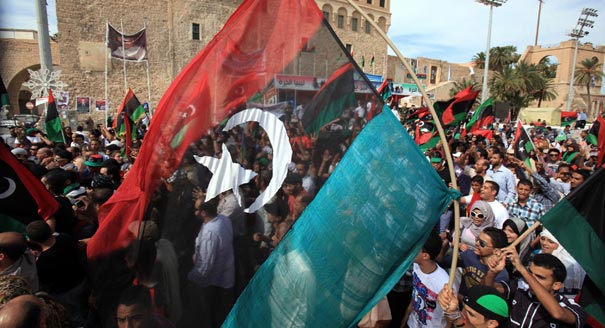
Despite continued turbulence, Libyans remain guardedly optimistic about the trajectory of their democratic transition, especially after parliamentary elections were held with few problems.
Source: NPR

This is WEEKEND EDITION from NPR News. I'm David Greene.
Yesterday, for the first time since the fall of Moammar Gadhafi, Libyans cast votes to elect their government. These were parliamentary elections. And while Libyans celebrated the landmark event in the street, it is clear the transition to democracy is running into trouble.
For more, we're joined by Fred Wehrey in the BBC Studios in London. He's a senior associate at the Carnegie Endowment for International Peace and he was in Libya during the run-up to the elections.
Welcome to the program.
FRED WEHREY: Thanks, good to be here.GREENE: So, tell us what the country seemed like as we approach the selection first. What were the conflicts that we were seeing in Libya?
WEHREY: You know, I would describe the mood as guardedly optimistic. The main issue really was the disagreement between the east and the west, and specifically this feeling in the east that they were not being represented by these elections, that the historic marginalization of the east - that Gadhafi had implemented - that this would continue. One activist told me that it was simply old wine in new bottles.
So, as a result of this, you had in the run-up to the election calls for boycott in the east, protests, violence, the closure of oil refineries and, as we saw on Election Day, some deadly acts of violence.
GREENE: Help us understand how this is possible. I think the image that many of us have from Libya was the ouster of Gadhafi being a victory for the east, for Benghazi, where the revolution was sort of born. Why do they feel they're not getting the power that they expected?
WEHREY: Well, that's just the crux of it. I mean they're disappointed that the transitional authority, the NCC, has really moved a lot of the political power to the west. Specifically, they point to the allocation of parliamentary seats, where the west has more parliamentary seats. And so, there's this move in the east of simply that these elections are illegitimate and people should not participate.
GREENE: And I guess, you know, we're still waiting for results from these elections. But I wonder, you know, is there a sense of who the front-runner parties are, and if we're seeing the same sort of secular Islamist divide that really emerged in Egypt?
WEHREY: You really don't see that divide. Libya is really a different political animal. The line between Islamist and secularist is really blurred. So what you're seeing is a very even, close race between the National Forces Alliance, a more nationalist secular party led by Mahmoud Jibril, the former executive chairman of the NTC, and a Muslim Brotherhood affiliate party, the Justice and Construction Party.
GREENE: And, as we go forward, I mean, a lot of the conflict we've been talking about - a helicopter shot down, boycotts, protests in the streets - does this all threaten to undermine this country as it goes forward? Or is this kind of the turbulence that we expect?
WEHREY: It's a bumpy, turbulence and road. But my sense here - and I really want to emphasize this - was the tremendous euphoria and can-do spirit of the Libyans. I mean, they realized that they do not want to jeopardize the enormous sacrifices that their martyrs made. You have to remember also that in the larger frame of things, this election was successful.
Polling went ahead and about 94 to 98 percent of the polling stations. There was high voter turnout. By and large this has been a historic, momentous occasion.
GREENE: We've been talking about the historic parliamentary election in Libya with Fred Wehrey. He's a senior associate at the Carnegie Endowment for International Peace and he joined us from the BBC Studios in London.
Thanks so much.
WEHREY: Thank you, appreciate it.
Senior Fellow, Middle East Program
Frederic Wehrey is a senior fellow in the Middle East Program at the Carnegie Endowment for International Peace, where his research focuses on governance, conflict, and security in Libya, North Africa, and the Persian Gulf.
Recent Work
Frederic Wehrey, Charles H. Johnson
Frederic Wehrey, Charles H. Johnson
Carnegie India does not take institutional positions on public policy issues; the views represented herein are those of the author(s) and do not necessarily reflect the views of Carnegie, its staff, or its trustees.

A partnership between India, a country of subcontinental size, and Africa, a continent of fifty-four countries, may seem asymmetric until one notes that both are home to nearly the same number of people—1.4 billion. This essay spells out the existing challenges to the partnership, its optimal potential, and the possible pathways to realize it over the next quarter-century.

Rajiv Bhatia
As India’s economy recovers from the coronavirus pandemic, Indian businesses need efficient financial structures to regain their ground. Key reforms to India’s Insolvency and Bankruptcy Code could fill these gaps.

Anirudh Burman
Access to cross-border data is an integral piece of the law enforcement puzzle. India is well placed to lead the discussions on international data agreements subject to undertaking necessary surveillance reforms.
Smriti Parsheera, Prateek Jha
After the coronavirus pandemic wanes, how will China’s reorientation of the Belt and Road Initiative to address global health concerns influence its relationships with South Asian countries?


Deep Pal, Rahul Bhatia
Early in the outbreak, government researchers forecast several high-risk scenarios that were downplayed or ignored in public messaging.
Gautam I. Menon