

Commentary
Judy Dempsey
{
  "authors": [
    "Judy Dempsey"
  ],
  "type": "legacyinthemedia",
  "centerAffiliationAll": "",
  "centers": [
    "Carnegie Endowment for International Peace",
    "Carnegie Europe",
    "Carnegie China"
  ],
  "collections": [
    "China’s Foreign Relations"
  ],
  "englishNewsletterAll": "",
  "nonEnglishNewsletterAll": "",
  "primaryCenter": "Carnegie Europe",
  "programAffiliation": "",
  "programs": [],
  "projects": [],
  "regions": [
    "Asia",
    "Europe"
  ],
  "topics": [
    "Foreign Policy",
    "Economy"
  ]
}
Source: Getty
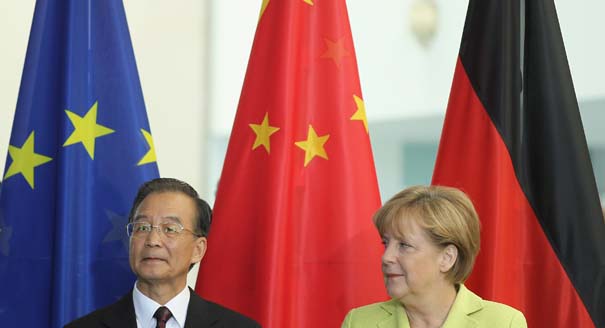
Germany and China are emphasizing bilateral ties, especially during the euro crisis. But their ever-expanding trade relationship could have a downside.
Source: New York Times

These top-of-the-range products take a lot of labor, which is why Berndes, one of the tens of thousands of small and medium-size companies, or Mittelstand, that fuel the German economy, moved a large part of its production several years ago to China. Last year, it brought everything back home. China, a company spokeswoman said, could not meet the delivery deadlines.
Other German companies are leaving China, too. They say they are frustrated with the corruption, poor quality control, theft of intellectual property, opaque investment regulations and hidden state subsidies. And with Chinese labor costs rising rapidly, the price advantage of producing in China might no longer be worth it for some Mittelstand companies.
These issues are not new to Chancellor Angela Merkel. She raised some of them last week during a two-day state visit to China, her second this year. Ms. Merkel’s focus, however, was on strengthening the economic and political ties between Berlin and Beijing. Her delegation included eight cabinet or deputy ministers and more than 20 company executives. It showed how seriously Berlin and Beijing are taking each other, especially during the euro crisis.As the crisis drags down most European economies, Germany’s export-driven economy has been an exception because of Chinese demand for its high-quality goods, be they luxury cars, chemicals, machinery or renewable technology. Bilateral trade amounted to $169 billion last year, 19 percent more than in 2010.
But this ever-expanding relationship could have a downside.
“As demand has slowed in Europe, German companies are increasingly dependent on emerging economies and above all on China for growth,” Hans Kundnani and Jonas Parello-Plesner of the European Council on Foreign Relations, an independent research group, said in a new report on the China-Germany relationship.
The Chinese economy is slowing, too. Its growth is expected to be 8 percent this year compared with 9.2 percent in 2011, according to the German Economy Ministry. The German economy could feel the pinch.
There is another, longer-term aspect to this dependence.
German companies are producing goods in China, like cars and high technology that the Chinese leadership regard as strategically important. Beijing is now investing heavily in these sectors. Analysts say that the potential for conflict is huge. “Chinese companies are moving up the value chain; China will increasingly provide competition,” said François Godement, a political science professor at the Institut d’Études Politiques in Paris, also known as Sciences Po, and director of strategy at its Asia Center.
Even before the euro crisis, foreign policy experts in Ms. Merkel’s Christian Democratic Union party had warned against Germany focusing too much on China while paying insufficient attention to other Asian countries. Now, says Sebastian Bersick, associate professor of international relations at Fudan University in Shanghai, “It would not be wise for Germany to extend bilateral ties with China to a point where the very success alienates other E.U. member states.”
Germany, he added, should diversify its relations in Asia “in order to balance its rather Sino-centric approach.”
Ms. Merkel recently visited India, Indonesia, Singapore and Vietnam to drum up business for German industry. The visits were fleeting. Bilateral trade is insignificant. Moreover, analysts say that Berlin has invested no effort in adopting any long-term political strategy toward a region that fears the rise of Chinese influence.
Berlin may also be making a mistake by giving precedence to bilateral ties with China over joining the European Commission’s attempts to establish a level playing field for European investments in China.
This could well suit the Chinese. Beijing is adept at playing off bilateral ties against the European Union’s attempts to develop a robust and united trade policy toward China.
Karel De Gucht, the E.U. trade commissioner, has been battling with the Chinese to open the public procurement regime, protect intellectual property rights, and end dumping practices and state subsidies for Chinese investors in Europe. Surely the member states should support his efforts. The euro crisis, however, has made Mr. De Gucht’s task even more difficult. Big and small member states are competing with one another for Chinese investments and contracts, regardless of the problems.
“With the euro crisis, European governments are increasingly acting on their own,” Mr. Godement said. Germany is no exception. Ms. Merkel said last week that she preferred to resolve a dispute over China’s dumping of solar panels in Germany rather than rely on the commission and E.U. trade rules.
That is a short-sighted policy, analysts said. By sidelining the commission, Germany is giving China free rein to set the trade agenda in the long term. The pullout of Berndes was a warning shot.

Nonresident Senior Fellow, Carnegie Europe
Judy Dempsey is a nonresident senior fellow at Carnegie Europe
Recent Work
Judy Dempsey
Judy Dempsey
Carnegie India does not take institutional positions on public policy issues; the views represented herein are those of the author(s) and do not necessarily reflect the views of Carnegie, its staff, or its trustees.

After the chill in ties between 2020 and 2024 that brought India–China relations to their lowest point in several decades, the two countries have engaged each other afresh. This paper argues that there are predominantly four imperatives guiding India’s approach to China, and they exist in an order of priority.

Saheb Singh Chadha

This piece argues that India’s central challenge is not managing a single flashpoint but resolving the underlying tension between expansion and institutional coherency of the BRICS grouping.

Vrinda Sahai
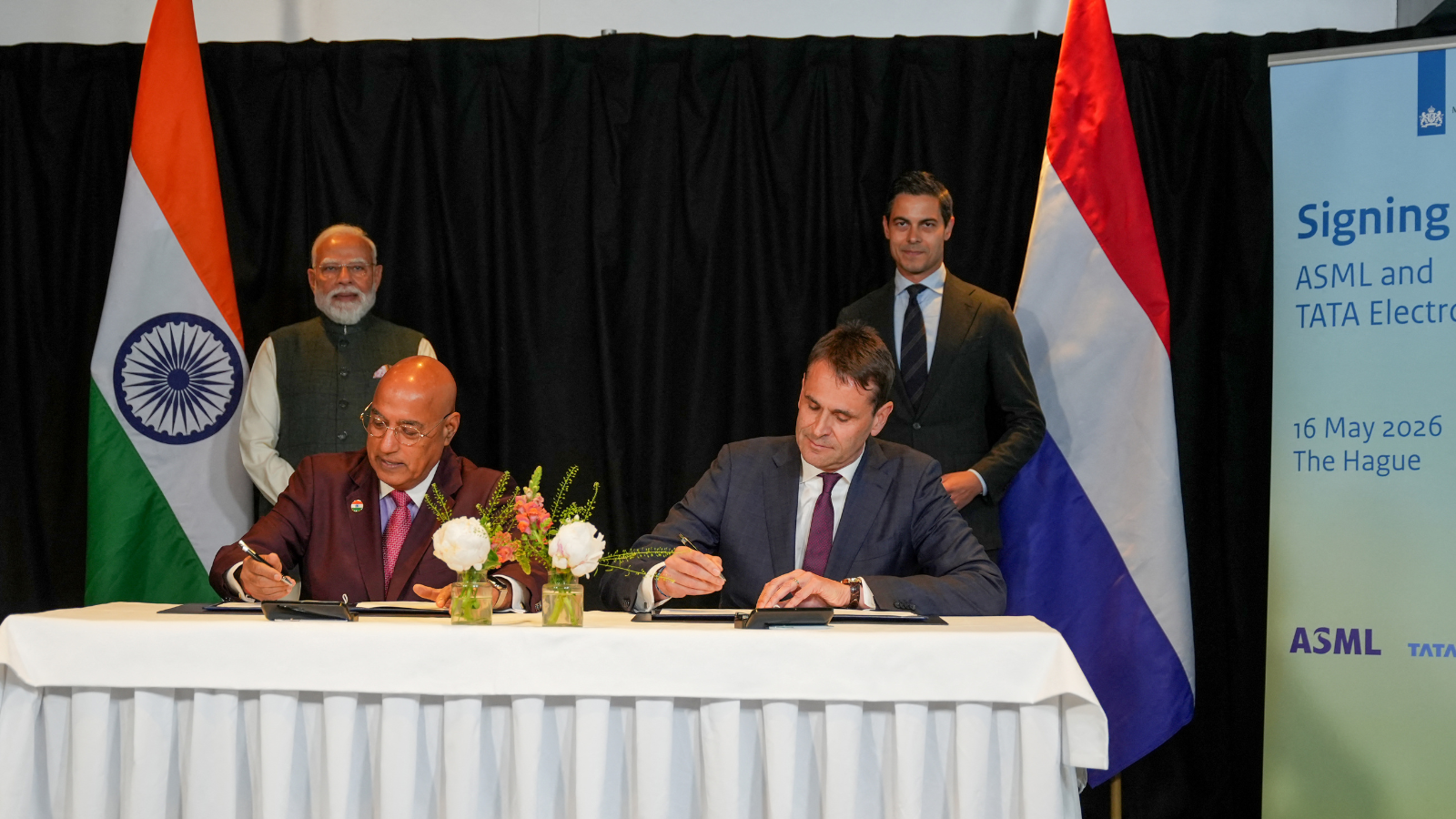
The ASML MoU with Tata Electronics is an indicator of how far the Indian semiconductor ecosystem has come. This ecosystem has been years in the making and represents real commercial logic.

Konark Bhandari

A partnership between India, a country of subcontinental size, and Africa, a continent of fifty-four countries, may seem asymmetric until one notes that both are home to nearly the same number of people—1.4 billion. This essay spells out the existing challenges to the partnership, its optimal potential, and the possible pathways to realize it over the next quarter-century.

Rajiv Bhatia

The India–EU Free Trade Agreement (FTA) is shaping up to be one of the most consequential trade negotiations, both economically and strategically. But, what’s in the agreement, what’s missing, and what will determine its success in the years ahead
Vrinda Sahai, Nicolas Köhler-Suzuki