While many Arab countries struggle to adapt to the economic implications of the Arab Spring, another crisis now looms on the horizon: the rising cost of food. Only a radical transformation in policy will spur a renaissance in agriculture and avoid the impending crisis.
While many Arab countries are struggling to adapt to the economic implications of the Arab Spring, another crisis now looms on the horizon: the rising cost of food. Taking the necessary steps to tackle this crisis is in the interest of not only the Arab Spring states, but the entire region—including the wealthy Gulf emirates. After all, nearly every country in the Arab world is facing a lack of food security.
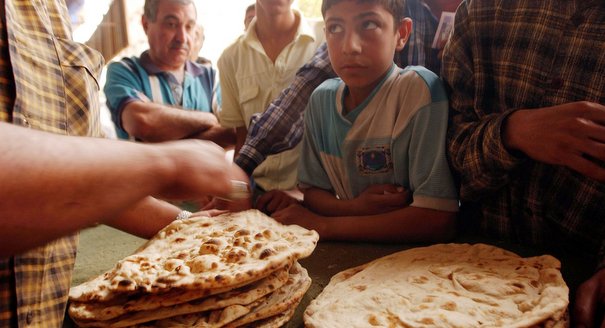
Most Arab countries currently import approximately 60–80 percent of their foodstuffs. Speculation on global food markets in 2008 resulted in a regional crisis. Commodity prices skyrocketed and drove inflation to unprecedented levels. Many Arab countries took targeted action intended to reduce inflation. But these measures failed to address the root causes of the food crisis. By taking a long-term approach that could have contained the impact of the crisis and protected Arab countries from being at the mercy of global markets whenever the there is a hike in food prices.
A glance at the data indicates just how serious the threat has become. The cost of the Arab world’s food imports is estimated to reach $115 billion by 2020. This estimate is based on a population growth rate of 3.5 percent over the next decade.
What makes the challenge even harder to overcome is the fact that the food crisis is likely to get worse before it gets better. There are several reasons for this, most importantly the global phenomenon of increasing desertification. In addition, conflicts over water resources are intensifying and the list of countries without food security continues to grow. And the expected rise in energy and production costs threatens the world with a tidal wave of price hikes.
These rising costs are likely to hit Arab states especially hard because of a number of underlying policy missteps. First, the agricultural sectors in most Arab countries have been severely neglected in recent decades, resulting in low levels of productivity. This spurred mass migration from agricultural regions to cities and suburbs, hence skilled workers have abandoned the sector and governments lost interest in allocating adequate financial resources to enhance the sector’s productivity, leading to a lack of agricultural resources and skilled labor.
Second, most Arab states have begun to subsidize foodstuffs, thus reducing the incentives to seek innovative solutions to the growing food security problem. But that cannot be sustained forever. The rise in global prices means higher budget deficits in most Arab countries. And, while the Gulf states are still running surpluses, the exorbitant cost of importing foodstuffs is nevertheless taking its toll.
Third, the Middle East and North Africa is generally considered to be among the poorest regions in the world as measured by its scarcity of freshwater resources. A distorted system of incentives has further contributed to the problem by failing to encourage the proper harvesting and exploitation of rainwater.
As a result of these misguided policies, Arab countries like Egypt and Morocco have exchanged surpluses of water resources for deficits. In addition, with the revolutionary changes that have swept across the Arab world taking center stage, regional projects aimed at promoting food security were neglected. These projects seek to use capital from Gulf states alongside major agricultural resources from countries with abundant crops, such as Sudan. Over the past few years, there have been numerous attempts to increase Arab investment in agriculture in countries like Sudan and Egypt. This is a step in the right direction, even if there is still a long way to go on the road to enhanced agricultural productivity and, ultimately, self-sufficiency.
In the future, every Arab state looking to restore growth and achieve a level of economic stability—both key to attracting investment—will come up against unexpected challenges. But this time the obstacles to development will not be blamed on protesters in the streets. Instead, numerous external factors will hinder growth in Arab countries. Populations are increasing in size across the world. Improved living standards in countries like China and India are increasing the global demand for food. According to a report issued by the World Bank, grain production must increase by 50 percent by the year 2030 in order to keep pace with mounting demand.
The Arab Spring has provided an opportunity to revisit not only the political organization of the region but also its economic policies. Those policies have marginalized the actual sectors of production—agriculture included. Given the expected rise in global prices and domestic demand, not to mention improved living standards in Arab countries and the rest of the world, there is an urgent need to radically transform these policies to spur a renaissance in the agricultural sector.
The Arab Spring can also pave the way to a reassessment of regional integration, based on the matching of financial capital from wealthier states to agricultural resources in poorer states. Without question, such an undertaking ideally requires a climate of political stability and security. But as long as Arab states wait for the clouds to part, they remain at the mercy of global price fluctuations—which seem unlikely to dip anytime soon.
Saif is an economist specializing in the political economy of the Middle East. His research focuses on international trade and structural adjustment programs in developing countries, with emphasis on Jordan and the Middle East.
Carnegie India does not take institutional positions on public policy issues; the views represented herein are those of the author(s) and do not necessarily reflect the views of Carnegie, its staff, or its trustees.
On March 10, 2026, India’s Union Cabinet approved amendments to Press Note 3, a regulation that mandated government approval on all foreign direct investment (FDI) from countries sharing a land border with India. This amendment raises questions primarily about whether its stated benefits will materialize and if the risks have been adequately weighed. This piece will address the same.
This piece examines India’s response to U.S. sanctions and tariffs, specifically assessing the immediate market consequences, such as alterations in import costs, and the broader strategic implications for India’s energy security and foreign policy orientation.
This paper examines the evolution of India-China economic ties from 2005 to 2025. It explores the impact of global events, bilateral political ties, and domestic policies on distinct spheres of the economic relationship.
This article argues that the geopolitical circumstances have never been more conducive, not merely for the early conclusion of the free trade agreement (FTA) between India and the EU, but also for crafting a substantive and comprehensive strategic partnership.