

In The Media
Lilia Shevtsova
{
  "authors": [
    "Lilia Shevtsova"
  ],
  "type": "legacyinthemedia",
  "centerAffiliationAll": "",
  "centers": [
    "Carnegie Endowment for International Peace",
    "Carnegie China",
    "Carnegie Russia Eurasia Center"
  ],
  "collections": [
    "China’s Foreign Relations"
  ],
  "englishNewsletterAll": "",
  "nonEnglishNewsletterAll": "",
  "primaryCenter": "Carnegie Russia Eurasia Center",
  "programAffiliation": "",
  "programs": [],
  "projects": [],
  "regions": [
    "East Asia",
    "China",
    "Russia"
  ],
  "topics": [
    "Economy"
  ]
}
Source: Getty
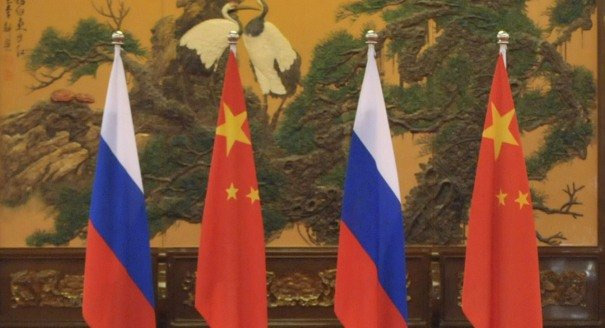
A comparison of China and Russia can reveal not only the dramas of undemocratic societies and the limitations of modernization efforts by top-down governments, but also the challenges that the West faces.
Source: American Interest
When Russia and China come up as subjects in the media and in political and academic discourse (as they frequently do), they are discussed in terms of bilateral relations, as a segue into a discussion of regional and global politics, as authoritarian threats to the West, or as examples of attempts at authoritarian modernization. Ever since Bobo Lo and I endeavored to compare Russia’s and China’s roads to modernization (see “A 21st Century Myth: Authoritarian Modernization in Russia and China”), I cannot help feeling that a comparison of these two civilizations and their centralized states, as they both look for an appropriate response to the Western democracies, would reveal not only the dramas of undemocratic societies and an understanding of the limitations of modernization efforts by top-down governments, but also the challenges that the West faces—challenges that it is, to date, incapable of assessing correctly.
Observing the authoritarian experiments of these two serious global actors (although one of them has been weakened), as well as their search for an appropriate international role, has made for interesting viewing, revealing several paradoxes: first, the paradox of stability covering up a deeper instability and impending upheavals; second, the paradox of economic growth that is most likely only a brief respite before a precipitous fall; third, the paradox of outward displays of force that conceal inner weakness and disorientation. These paradoxes illustrate that there is a conflict between perceptions and reality in these two authoritarian states. The only question is to what extent they are the results of conscious distortions of reality as opposed to naivety or unwillingness to accept inconvenient truths.Were Arnold Toynbee alive today, a comparison of Russia and China would provide him with ample material for his theories on the rise and fall of civilizations. Perhaps, Samuel Huntington would have revised some of his conclusions on reform from the top and the role of the middle class in modernization. I hope, too, that Francis Fukuyama will have a chance to compare the modern evolutions of Russia and China, and their systems’ struggles for survival, in the upcoming second volume of The Origins of Political Order.
The West should be particularly concerned about the future of these two models of the centralized state. The impact that Russia and China have on global security and the world economy is not the only cause for concern. More importantly, both authoritarian systems have found a way to exploit liberal democracy, and both have been quite successful at doing this. Since the fall of Communism, Russia’s personalized regime has been able to use the West as an important guarantor of its stability. It has also been sponging off liberal democracies, in the form of its elite’s personal integration into Western society. This integration has led to the creation of powerful pro-Kremlin lobbying structures that are undermining the normative foundation of liberal democracy (in fact, the Western politicians often don’t even recognize that this is what is happening). It is unclear how the Putin regime will survive, now that it has embarked on the path of consolidating itself by rejecting the West and treating it as an enemy.
Through the force of economic might, China earned the West’s admiration and is now treated as a future global superpower, forcing the United States to struggle with the question of how to adapt its policy to this perception. Moreover, it has made the United States, still the world’s only superpower, its debtor.
Regional and global stability, as well our assessments on the prospects for liberal democracy to formulate foreign policy equal to these challenges, are contingent on Russia’s and China’s successful exit from the centralized state model, in which the state survives by limiting society’s freedom. ...

Former Senior Associate, Russian Domestic Politics and Political Institutions Program, Moscow Center
Shevtsova chaired the Russian Domestic Politics and Political Institutions Program at the Carnegie Moscow Center, dividing her time between Carnegie’s offices in Washington, DC, and Moscow. She had been with Carnegie since 1995.
Recent Work
Lilia Shevtsova
Lilia Shevtsova

After the chill in ties between 2020 and 2024 that brought India–China relations to their lowest point in several decades, the two countries have engaged each other afresh. This paper argues that there are predominantly four imperatives guiding India’s approach to China, and they exist in an order of priority.

Saheb Singh Chadha

This piece argues that India’s central challenge is not managing a single flashpoint but resolving the underlying tension between expansion and institutional coherency of the BRICS grouping.

Vrinda Sahai

On March 10, 2026, India’s Union Cabinet approved amendments to Press Note 3, a regulation that mandated government approval on all foreign direct investment (FDI) from countries sharing a land border with India. This amendment raises questions primarily about whether its stated benefits will materialize and if the risks have been adequately weighed. This piece will address the same.

Konark Bhandari

This piece examines India’s response to U.S. sanctions and tariffs, specifically assessing the immediate market consequences, such as alterations in import costs, and the broader strategic implications for India’s energy security and foreign policy orientation.
Vrinda Sahai

This paper examines the evolution of India-China economic ties from 2005 to 2025. It explores the impact of global events, bilateral political ties, and domestic policies on distinct spheres of the economic relationship.

Santosh Pai