

In The Media
John Judis
{
  "authors": [
    "John Judis"
  ],
  "type": "legacyinthemedia",
  "centerAffiliationAll": "",
  "centers": [
    "Carnegie Endowment for International Peace",
    "Malcolm H. Kerr Carnegie Middle East Center"
  ],
  "collections": [],
  "englishNewsletterAll": "",
  "nonEnglishNewsletterAll": "",
  "primaryCenter": "Carnegie Endowment for International Peace",
  "programAffiliation": "",
  "programs": [],
  "projects": [],
  "regions": [
    "North America",
    "United States",
    "Middle East",
    "Iraq",
    "Gulf"
  ],
  "topics": [
    "Political Reform",
    "Security",
    "Military",
    "Foreign Policy"
  ]
}
Source: Getty
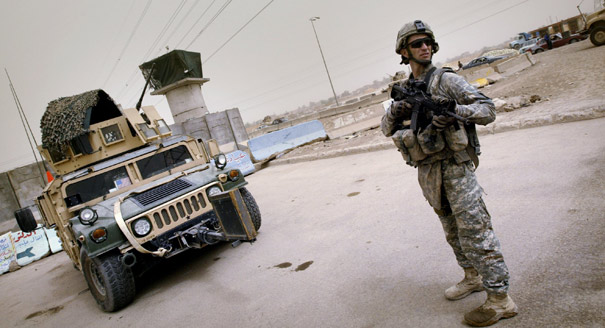
The months before the Iraq war testify to the importance of letting the public have full access to information before making decisions about war and peace.
Source: New Republic
In the six months before the American invasion of Iraq in March 2003 and the six weeks after the invasion (culminating in George W. Bush’s “Mission Accomplished” speech), I often compared my situation in Washington to that of Jeannette Rankin, the Montana congresswoman and pacifist who voted against entry into both World War I and II. Not that I would have voted against declaring war in 1941; the comparison was to her isolation, not with her isolationism.
There were, of course, people who opposed invading Iraq—Illinois State Senator Barack Obama among them—but within political Washington, it was difficult to find like-minded foes. When The New Republic’s editor-in-chief and editor proclaimed the need for a “muscular” foreign policy, I was usually the only vocal dissenter, and the only people who agreed with me were the women on staff: Michelle Cottle, Laura Obolensky and Sarah Wildman. Both of the major national dailies—The Washington Post and The New York Times (featuring Judith Miller’s reporting)—were beating the drums for war. Except for Jessica Mathews at the Carnegie Endowment for International Peace, Washington’s thinktank honchos were also lined up behind the war.
In December of 2002, I was invited by the Ethics and Public Policy Center to a ritzy conference at an ocean front resort in Key West. The subject was to be Political Islam, and many of the best-known political journalists from Washington and New York were there. The conversation invariably got around to Iraq, and I found myself one of the few attendees who outright opposed an invasion. Two of the speakers at the event—Christopher Hitchens, who was then writing for Slate, and Jeffrey Goldberg, who was then writing for The New Yorker—generously offered to school me on the errors of my way.
I found fellow dissenters to the war in two curious places: the CIA and the military intelligentsia. That fall, I got an invitation to participate in a seminar at the Central Intelligence Agency on what the world would be like in fifteen or twenty years. I went out of curiosity—I don’t like this kind of speculation—but as it turned out, much of the discussion was about the pending invasion of Iraq. Except for me and the chairman, who was a thinktank person, the participants were professors of international relations. And almost all of them were opposed to invading Iraq.
In early 2003, I was invited to another CIA event: the annual conference on foreign policy in Wilmington. At that conference, one of the agency officials pulled me aside and explained that the purpose of the seminar was actually to try to convince the White House not to invade Iraq. They didn’t think they could do that directly, but hoped to convey their reservations by issuing a study based on our seminar. He said I had been invited because of my columns in The American Prospect, which was where, at the time, I made known my views opposing an invasion. When Spencer Ackerman and I later did an article on the CIA’s role in justifying the invasion, we discovered that there was a kind of pro-invasion “B Team” that CIA Director George Tenet encouraged, but what I discovered from my brief experience at the CIA was that most of the analysts were opposed to an invasion. (After Spencer’s and my article appeared, I received no more invitations for seminars or conferences.)
I had a similar experience when I talked to Jon Sumida, a historian at the University of Maryland, who specializes in naval history and frequently lectures at the military’s colleges. Sumida told me that most of the military people he talked to—and he had wide contacts—were opposed to an invasion. I confirmed what Sumida told me a year or so later when I was invited to give a talk on the Iraq war at a conference on U.S. foreign policy at Maryland. A professor from the Naval War College was to comment on my presentation. I feared a stinging rebuttal to my argument that the United States had erred in invading Iraq, but to my astonishment, the professor rebuked me for not being tough enough on the Bush administration.
These dissenters were entirely right about the war, and nothing that has happened since then has weakened their case. The United States got several hundred thousand people killed to install a regime that may eventually prove to be as oppressive as Saddam Hussein’s, is closely allied to the Iranian government, and has proven as likely to give oil contracts to Chinese firms as to American firms. And oh yes, Iraq didn’t have “WMDs” after all—a ridiculous acronym that the administration and its supporters used to equate the possession of chemical or biological weapons with the possession of nuclear weapons.
The people who had the most familiarity with the Middle East and with the perils of war were dead set against the invasion. That includes not only the CIA analysts and the military professors, but also the State Department’s Bureau of Intelligence and Research, which rejected the administration’s claims that Iraq was about to acquire nuclear weapons. But they were not in a position to make their voices heard. The CIA analysts were reduced to creating this half-cocked scheme for getting a report on the far-flung future to the White House, which they hoped someone would read. The military dissenters, as we know, were silenced by Secretary of Defense Donald Rumsfeld and his deputy Paul Wolfowitz. And the State Department was ignored by the White House.
Some people in Washington still haven’t recanted (unless I missed an editorial on Fred Hiatt’s Washington Post op-ed page apologizing for the newspaper’s leading role in stoking the flames of war), but most of the people I worked with began to doubt the war within about four months. I remember a talk I had with Lawrence Kaplan, who was writing about foreign policy for the magazine and who had written a book with William Kristol making the case for war. Lawrence had excellent contacts within neo-conservative circles, and told me that, to his astonishment, some people he talked to had already trained their sights on regime change in Iran and Syria. I think that was Lawrence’s first inkling that he had gotten on a train to Baghdad with a lot of nutty people. (Lawrence subsequently did a brilliant report on the failure of the liberal dream in Iraq that infuriated the neo-cons.)
I opposed the war, and didn’t listen to those who claimed to have “inside information” probably because I had come of age politically during the Vietnam War and had learned then not to trust government justifications for war. I had backed the first Bush administration’s Gulf War, but precisely because of its limited aims. Ditto the Clinton administration intervention in Kosovo. George W. Bush’s aims in Iraq were similar to American aims in South Vietnam. During those months leading up to the war, I kept having déjà vu experiences, which failed to interest my colleagues. Still, I wavered after Colin Powell’s thoroughly deceptive speech at the United Nations in February 2003, where he unveiled what he claimed was evidence of Iraqi nuclear preparations. I had to have an old friend from the anti-war days remind me again of the arguments against an invasion.
My own experience after Powell’s speech bears out the tremendous power that an administration, bent on deception, can have over public opinion, especially when it comes to foreign policy. And when the dissenters in the CIA, military, and State Department are silenced, the public—not to mention, journalists—has little recourse in deciding whether to support what the administration wants to do. Those months before the Iraq war testify to the importance of letting the public have full access to information before making decisions about war and peace. And that lesson should be heeded before we rush into still another war in the Middle East.

Former Visiting Scholar
As a visiting scholar at Carnegie, Judis wrote The Folly of Empire: What George W. Bush Could Learn from Theodore Roosevelt and Woodrow Wilson.
Recent Work
John Judis
John Judis
Carnegie India does not take institutional positions on public policy issues; the views represented herein are those of the author(s) and do not necessarily reflect the views of Carnegie, its staff, or its trustees.

In any defense establishment, change is an ongoing process. However, despite the best of intentions, existing bureaucracies, bound by habit and years of socialization, have their limits in implementing transformative change.

Anit Mukherjee

How is AI reshaping space security, creating governance challenges, and where does international diplomacy stand today?


Tejas Bharadwaj, Almudena Azcárate Ortega

After the chill in ties between 2020 and 2024 that brought India–China relations to their lowest point in several decades, the two countries have engaged each other afresh. This paper argues that there are predominantly four imperatives guiding India’s approach to China, and they exist in an order of priority.

Saheb Singh Chadha

This piece argues that India’s central challenge is not managing a single flashpoint but resolving the underlying tension between expansion and institutional coherency of the BRICS grouping.

Vrinda Sahai

A partnership between India, a country of subcontinental size, and Africa, a continent of fifty-four countries, may seem asymmetric until one notes that both are home to nearly the same number of people—1.4 billion. This essay spells out the existing challenges to the partnership, its optimal potential, and the possible pathways to realize it over the next quarter-century.

Rajiv Bhatia