

In The Media
David Rothkopf
{
  "authors": [
    "David Rothkopf"
  ],
  "type": "legacyinthemedia",
  "centerAffiliationAll": "",
  "centers": [
    "Carnegie Endowment for International Peace"
  ],
  "collections": [],
  "englishNewsletterAll": "",
  "nonEnglishNewsletterAll": "",
  "primaryCenter": "Carnegie Endowment for International Peace",
  "programAffiliation": "",
  "programs": [],
  "projects": [],
  "regions": [
    "North America",
    "United States",
    "Middle East",
    "Israel",
    "Palestine"
  ],
  "topics": [
    "Political Reform",
    "Security",
    "Foreign Policy"
  ]
}
Source: Getty
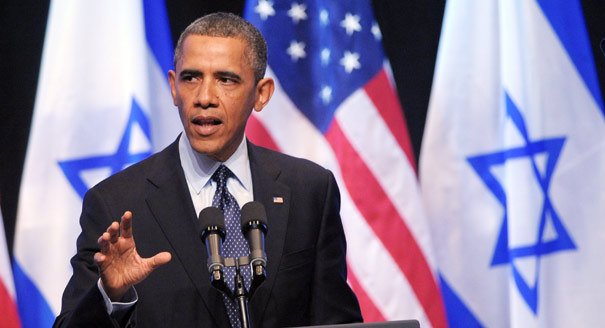
In the wake of Obama's energizing address on the peace process, he must now face greatly raised hopes that he will follow up on his words more successfully than he has the Cairo or Prague remarks.
Source: CNN
Any great speech about the Israeli-Palestinian peace process should leave everyone feeling a bit uncomfortable. Given that all involved have contributed to the troubled situation on the ground, all must challenge themselves to create the changes that are necessary.
By this measure and virtually any other fair metric, President Barack Obama's address to Israeli students Thursday was a great speech. Boldly, pointedly and deftly, he provided a virtuoso display of political leadership and international statesmanship.
It stands as a companion piece to his great speech in Egypt early in his first term about America and the Arab world. And his great speech in the Czech Republic about nuclear disarmament. And his great Nobel Prize acceptance speech. And his many other great addresses. And like each of those resonant, masterful moments, the measure of the remarks will be in the follow-up, in the change they actually produce.
It is, after all, easier to be a speechmaker than a peacemaker. And in the wake of Obama's energizing address, he must now face greatly raised hopes that he will follow up on his words more successfully than he has the Cairo or Prague remarks. As Brookings Institution analyst and longtime U.S. diplomat Martin Indyk noted on CNN afterward, the president has now "raised expectations sky-high that he himself is going to work to make peace possible."
It remains to be seen whether that happens, but for a moment it is worth considering why the speech was so effective and important. Let's start by counting the people the president made uncomfortable.
We must begin with Obama's host for this visit to Israel, Prime Minister Benjamin Netanyahu. Surely, Netanyahu must have been pleased with the repeated and persuasive statements from Obama since his arrival in Israel that he and the United States remain committed to a special relationship with Israel and to helping ensure Israeli survival. This was precisely the kind of affirmation that the Israelis hoped for from this trip, salve to the wounds -- many Netanyahu brought on himself -- acquired in the run-up to last fall's presidential elections.
But of all the slights and bumps of the past months, the president's remarks -- in a sly but unmistakable way -- delivered the toughest blow to date to Netanyahu despite their powerful pro-Israeli rhetoric and images. Because Obama sent a message to Netanyahu that if need be he would go over his head to the Israeli people.We must begin with Obama's host for this visit to Israel, Prime Minister Benjamin Netanyahu. Surely, Netanyahu must have been pleased with the repeated and persuasive statements from Obama since his arrival in Israel that he and the United States remain committed to a special relationship with Israel and to helping ensure Israeli survival. This was precisely the kind of affirmation that the Israelis hoped for from this trip, salve to the wounds -- many Netanyahu brought on himself -- acquired in the run-up to last fall's presidential elections.
But of all the slights and bumps of the past months, the president's remarks -- in a sly but unmistakable way -- delivered the toughest blow to date to Netanyahu despite their powerful pro-Israeli rhetoric and images. Because Obama sent a message to Netanyahu that if need be he would go over his head to the Israeli people.
To receive this message, Obama picked a young audience that he knew represented a different portion of Israel's vibrant polity, and he had them cheering and applauding, not just at the expressions of friendship, but at tough remarks about how unconstructive Netanyahu's settlement policies have been and how vital it is to establish a safe, prospering state for the Palestinians.
By the end, despite efforts to put an enthusiastic face on the event, Netanyahu must have been grateful there have been no Israeli politicians offering an alternative vision as clear as Obama's. Had there been, Netanyahu might have been working Thursday's speech as a commentator on Fox News.
Indeed, Obama's remarks about how all must share the aspirations of Palestinian children must have resonated particularly well with Palestinian Authority President Mahmoud Abbas. But because this was a good and thus fair speech on the issue of peace, the president likely also made Abbas a bit uneasy with the forcefulness of his commitment to Israel's existence as a Jewish state, a commitment that cuts directly to an issue on which even the most constructive members of the Palestinian leadership have been reluctant to show flexibility.
Abbas, however, was certainly nowhere nearly as directly affronted as the Hamas leaders in Gaza, whom the president unceremoniously slammed for their rocket attacks and for their inattentiveness to the needs of the Palestinian people entrusted into their care. Further, of course, in calling out the terrorist nature of Hezbollah, the president sent yet another message concerning his willingness to confront that organization's sponsors in Tehran.
In fact, it has seemed frequently throughout this trip that it has been more about standing together with Israel on Iran, toughening the approach to Bashar al-Assad's regime in Syria and working to support Jordan than it has been about the Israelis and the Palestinians.
But even on this last point, the speech again succeeded in making another group uncomfortable. Because in the end, it was the most potent speech an American president has ever given in Israel about the peace process, the most personal statement of commitment to it. And therefore it must have made very uncomfortable the small group of American diplomats and national security specialists who are going to have to follow through and try to live up to its promise with their actions.
In the end, Obama must make himself central to this process, actively and continuously, or the hopes it has raised will once again be cruelly deflated.
On the other hand, were he to follow through on this and help advance peace through the establishment of an independent Palestinian state that agreed to the secure existence of Israel, he would also be doing much to live up to the promise of his other earlier addresses. Like those calling for better relations with the Islamic world in Cairo and advancing the cause of peace in Prague and in Oslo.
Former Visiting Scholar
David Rothkopf was a visiting scholar at the Carnegie Endowment as well as the former CEO and editor in chief of the FP Group.
Recent Work
David Rothkopf
David Rothkopf
Carnegie India does not take institutional positions on public policy issues; the views represented herein are those of the author(s) and do not necessarily reflect the views of Carnegie, its staff, or its trustees.

How is AI reshaping space security, creating governance challenges, and where does international diplomacy stand today?


Tejas Bharadwaj, Almudena Azcárate Ortega

After the chill in ties between 2020 and 2024 that brought India–China relations to their lowest point in several decades, the two countries have engaged each other afresh. This paper argues that there are predominantly four imperatives guiding India’s approach to China, and they exist in an order of priority.

Saheb Singh Chadha

This piece argues that India’s central challenge is not managing a single flashpoint but resolving the underlying tension between expansion and institutional coherency of the BRICS grouping.

Vrinda Sahai

A partnership between India, a country of subcontinental size, and Africa, a continent of fifty-four countries, may seem asymmetric until one notes that both are home to nearly the same number of people—1.4 billion. This essay spells out the existing challenges to the partnership, its optimal potential, and the possible pathways to realize it over the next quarter-century.

Rajiv Bhatia

The U.S.–India semiconductor cooperation story is well-stocked with top-level strategic intent. What remains unresolved, however, are some underlying challenges that will determine whether the cooperation actually functions. Three such friction points stand out.

Shruti Mittal