

Paper
James M. Acton, Ankit Panda
{
  "authors": [
    "James M. Acton"
  ],
  "type": "legacyinthemedia",
  "centerAffiliationAll": "dc",
  "centers": [
    "Carnegie Endowment for International Peace"
  ],
  "collections": [
    "U.S. Nuclear Policy",
    "Korean Peninsula"
  ],
  "englishNewsletterAll": "ctw",
  "nonEnglishNewsletterAll": "",
  "primaryCenter": "Carnegie Endowment for International Peace",
  "programAffiliation": "NPP",
  "programs": [
    "Nuclear Policy"
  ],
  "projects": [],
  "regions": [
    "North America",
    "United States",
    "East Asia",
    "South Korea",
    "North Korea"
  ],
  "topics": [
    "Security",
    "Nuclear Policy"
  ]
}
Source: Getty
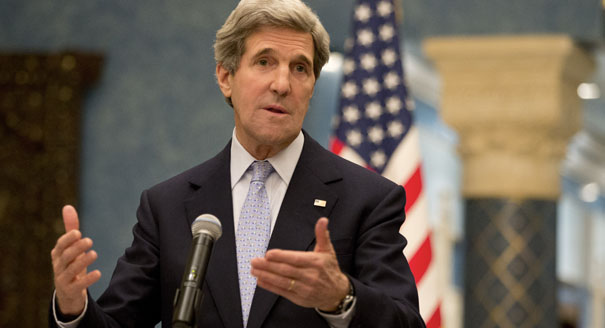
U.S. Secretary of State John Kerry has used strong words against North Korea after the country threatened to attack the United States.
Source: Al Jazeera
U.S. Secretary of State John Kerry has used strong words against North Korea after the country threatened to attack the United States. Carnegie's James Acton talks to Al Jazeera about the latest tensions between North Korea and the United States.
"We've heard yet another provocative announcement from North Korea. The irony is that this is not even the most provocative announcement to have come out of North Korea in the past few days," said Acton, adding, "threatening to build more nuclear weapons is actually not as provocative as threatening to use them against the United States, South Korea, or anyone else."
"But make no mistake," said Acton, "this is a dangerous and volatile situation on the Korean Peninsula; the South Korean government is worried, the United States government is worried, and they have good reasons to be." Acton said that he does not think that North Korea will use a nuclear weapon out of the blue, but rather that Pyongyang will commit another provocation.
"I don't think that North Korea wants a war," said Acton, "the question is whether it miscalculates, the question is whether it thinks it can get away with provoking South Korea via military force and assume that it will not be hit back.

Jessica T. Mathews Chair, Co-director, Nuclear Policy Program
Acton holds the Jessica T. Mathews Chair and is co-director of the Nuclear Policy Program at the Carnegie Endowment for International Peace.
Recent Work

James M. Acton, Ankit Panda
James M. Acton
Carnegie India does not take institutional positions on public policy issues; the views represented herein are those of the author(s) and do not necessarily reflect the views of Carnegie, its staff, or its trustees.

In any defense establishment, change is an ongoing process. However, despite the best of intentions, existing bureaucracies, bound by habit and years of socialization, have their limits in implementing transformative change.

Anit Mukherjee

How is AI reshaping space security, creating governance challenges, and where does international diplomacy stand today?


Tejas Bharadwaj, Almudena Azcárate Ortega

After the chill in ties between 2020 and 2024 that brought India–China relations to their lowest point in several decades, the two countries have engaged each other afresh. This paper argues that there are predominantly four imperatives guiding India’s approach to China, and they exist in an order of priority.

Saheb Singh Chadha

The U.S.–India semiconductor cooperation story is well-stocked with top-level strategic intent. What remains unresolved, however, are some underlying challenges that will determine whether the cooperation actually functions. Three such friction points stand out.

Shruti Mittal

This piece argues that the present Indian strategy, based on opportunistic diversification and utilization of limited strategic reserves, remains inadequate when confronting supply disruptions. It evaluates India’s options in the short, medium, and long terms.

Vrinda Sahai