

Q&A
Suzanne Maloney, Aaron David Miller, Karim Sadjadpour
{
  "authors": [
    "Karim Sadjadpour"
  ],
  "type": "legacyinthemedia",
  "centerAffiliationAll": "dc",
  "centers": [
    "Carnegie Endowment for International Peace"
  ],
  "collections": [
    "Arab Awakening"
  ],
  "englishNewsletterAll": "menaTransitions",
  "nonEnglishNewsletterAll": "",
  "primaryCenter": "Carnegie Endowment for International Peace",
  "programAffiliation": "MEP",
  "programs": [
    "Middle East"
  ],
  "projects": [],
  "regions": [
    "North Africa",
    "Egypt"
  ],
  "topics": [
    "Political Reform",
    "Democracy"
  ]
}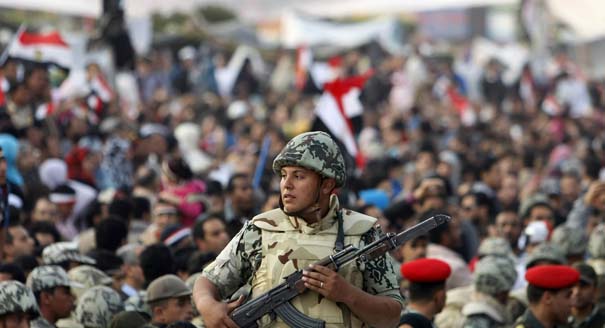
Source: Getty
The most immediate concern for Egypt’s liberals and the U.S. government is the possibility of the Muslim Brotherhood abandoning politics and resorting to street violence if they are not reassured that their voices will be heard.
Source: CNBC
Karim Sadjadpour discussed the recent events in Egypt and the challanges its new leader will face on CNBC Squabox.
HOST: Supporters of Egypt's ousted president protesting today calling it Friday of rejection. For more on the situation in Egypt, we're joined by Karim Sadjadpour he is a senior associate from the Carnegie Endowment Institute for International Peace. Good morning to you.
KARIM SADJADPOUR: Good morning.
HOST: Help me with this. The U.S. government spends about $1.5 billion a year in aid to Egypt. What should the role of the government in the U.S. government now be, given what's happening there?
KARIM SADJADPOUR: The Obama administration is faced with quite a conundrum in Egypt. The U.S. government wants to show it is committed to democratic principles and committed to the rule of law, and the rule of law and democratic principles were abrogated in Egypt. The country's military waged a coup against an elected president Mohamed Morsi. On the other hand, the U.S. government also doesn't want to be seen as going against the will of the Egyptian people. What we saw over the course of the last week or two in Egypt was tens of millions of people going out into the streets against Mohamed Morsi. That’s going to be very difficult for -- it's been very difficult for the U.S. government to reconcile these two objects of standing for rule of law and standing for democratic principles but at the same time not going against the will of the Egyptian people.HOST: What ultimately is the answer? Is there a carrot or stick involved in terms of how to work with either the military or whatever you think is supposed to be the next election process and how that goes?
KARIM SADJADPOUR: I do think if you saw the statement from president Obama, they did again articulate this commitment to rule of law and principles and that is the route which they are going to continue to talk about and I think they will want the transition, the process towards another presidential election, to happen as swift as possible. They certainly don't want the military to continue to rule over Egypt and frankly I’m not sure if the Egyptian military is interested in overtly ruling over Egypt.
HOST: Real quick, go through some of what you think may then happen next over the next couple weeks, because there is a lot of volatility in the region. The economy and markets are all looking at this trying to understand what may happen.
KARIM SAJDAPOUR: I think the immediate concern that Egyptian liberals and U.S. government has is that the Muslim brotherhood, president Morsi, the ousted party in Egypt is going to say that they -- the legitimate power they held was taken away illegitimately and they will go outside politics and take to the streets and use violence. It’s critical in this transitional process at that takes place Muslim brotherhood are reassured that their rights are going to be counted. I think an announcement has to be made very quickly as to when presidential elections are going to take place.

Senior Fellow, Middle East Program
Karim Sadjadpour is a senior fellow at the Carnegie Endowment for International Peace, where he focuses on Iran and U.S. foreign policy toward the Middle East.
Recent Work

Suzanne Maloney, Aaron David Miller, Karim Sadjadpour

Aaron David Miller, Karim Sadjadpour, Robin Wright
Carnegie India does not take institutional positions on public policy issues; the views represented herein are those of the author(s) and do not necessarily reflect the views of Carnegie, its staff, or its trustees.

A partnership between India, a country of subcontinental size, and Africa, a continent of fifty-four countries, may seem asymmetric until one notes that both are home to nearly the same number of people—1.4 billion. This essay spells out the existing challenges to the partnership, its optimal potential, and the possible pathways to realize it over the next quarter-century.

Rajiv Bhatia

Experts weigh in on whether the United States is too hostile toward China.

Stephen Wertheim, Evan S. Medeiros, Vijay Gokhale
As India’s economy recovers from the coronavirus pandemic, Indian businesses need efficient financial structures to regain their ground. Key reforms to India’s Insolvency and Bankruptcy Code could fill these gaps.

Anirudh Burman

Access to cross-border data is an integral piece of the law enforcement puzzle. India is well placed to lead the discussions on international data agreements subject to undertaking necessary surveillance reforms.
Smriti Parsheera, Prateek Jha
After the coronavirus pandemic wanes, how will China’s reorientation of the Belt and Road Initiative to address global health concerns influence its relationships with South Asian countries?
Deep Pal, Rahul Bhatia