

Commentary
Dmitri Trenin
{
  "authors": [
    "Dmitri Trenin"
  ],
  "type": "legacyinthemedia",
  "centerAffiliationAll": "",
  "centers": [
    "Carnegie Endowment for International Peace",
    "Carnegie Russia Eurasia Center"
  ],
  "collections": [],
  "englishNewsletterAll": "",
  "nonEnglishNewsletterAll": "",
  "primaryCenter": "Carnegie Russia Eurasia Center",
  "programAffiliation": "",
  "programs": [],
  "projects": [
    "Eurasia in Transition"
  ],
  "regions": [
    "Russia"
  ],
  "topics": [
    "Foreign Policy"
  ]
}
Source: Getty
Russia has the potential to play a critical role as a global mediator, moderating international tension and fostering global understanding. Unfortunately, as things stand today, this potential remains unrealized.
Source: Global Times
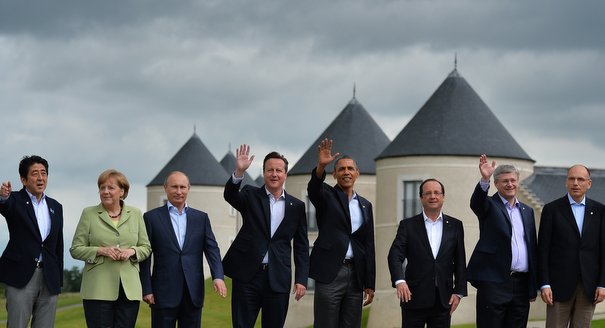
The G8 summit last month in Northern Ireland will probably be remembered as the formal start of the negotiations leading to a transatlantic free trade area.
On the most salient political issue, the civil war in Syria, the summit has achieved more clarity, but no progress.
With neither Russia on the one hand, and the US, France and Britain on the other, likely to fundamentally change their approach in the foreseeable future, the Syrian war will continue, and the Geneva conference, proposed by the US and Russia in May, will recede into the future.When US Secretary of State John Kerry came to Moscow in May and agreed on a plan for such a conference with his Russian counterpart Sergei Lavrov, each side had its own assumptions about what would happen as a result of their joint initiative.
The US side hoped that the proposed conference would lead to a swift transfer of power from Bashar al-Assad's government to opposition leaders and technocrats. The Russians, on the contrary, saw the conference as a platform for forging a compromise between Damascus and the moderate part of the Syrian opposition.
The US strategy could have worked if Russian President Vladimir Putin had decided to cut off Assad and become an accessory to the US-Saudi-Qatari quest for a regime change in Damascus. It is not clear why Putin should have followed that course.
The Western argument that the Syrian conflict, the longer it lasts, is breeding more and more extremists who would present a threat to Russia cuts both ways. Putin uses exactly this argument to warn the Europeans about the danger of arming Syrian rebels.
The Russian strategy would have succeeded if Washington had decided to split the difference with Moscow on Syria.
For the Kerry-Lavrov initiative to succeed, the US and Russia would have needed to agree on the end goal, as well as strategy and tactics of reaching it.
In implementation, they would have had to act as very close and trusting allies, as in a military operation against a common enemy. They would have needed to lean hard on their respective clients or give them offers they would not dare to refuse.
A US-Russian Dayton-in-Syria would have looked like a civilian version of World War II. The miracle, however, has failed to happen.
In Northern Ireland, Putin denied he was isolated. The Russian Ministry of Foreign Affairs severely criticized the statement by Prime Minister Stephen Harper of Canada, who had said that the G8 was, in reality, the G7 plus 1.
Indeed, the G8 stands as a monument to unfulfilled promises and expectations of Russia's integration into the West and its transformation along Western standards.
By now, all this is history which cannot be undone. A Russia which rejects US leadership and sees the US more as a competitor and even an adversary cuts against the very nature of the group of "like-minded industrial democracies."
Expelling Russia and reverting to the "neat" G7 format, however, is hardly practical: It will create more problems than it would try to solve. Instead, even within the G8, Western nations are strengthening their own cooperation in the face of growing challenges to residual Western domination of the world.
The formal launch of the dialogue on the transatlantic and transpacific free-trade areas is a sign that US and other Western leaders realize this.
There are many other useful things that the G7 can do within the framework of the G8 and which Russia will not and cannot block.
As for Russia's presence in the group, it is often useful to have a contrarian who questions others' basic assumptions and offers a wholly different worldview.
By putting Western ideas and proposals to a harsh test, Russia is serving a useful function - if its partners are interested in having a second opinion before taking up major responsibility.
Ideally, Russia would be even more valuable if it managed to function as a global mediator - a "corresponding member" belonging to all main groups, but to none exclusively, and seeing its goal in moderating international tension and fostering global understanding.
Unfortunately, as things stand today, this is a mission impossible.
Former Director, Carnegie Moscow Center
Trenin was director of the Carnegie Moscow Center from 2008 to early 2022.
Recent Work
Dmitri Trenin
Dmitri Trenin
Carnegie India does not take institutional positions on public policy issues; the views represented herein are those of the author(s) and do not necessarily reflect the views of Carnegie, its staff, or its trustees.

After the chill in ties between 2020 and 2024 that brought India–China relations to their lowest point in several decades, the two countries have engaged each other afresh. This paper argues that there are predominantly four imperatives guiding India’s approach to China, and they exist in an order of priority.

Saheb Singh Chadha

This piece argues that India’s central challenge is not managing a single flashpoint but resolving the underlying tension between expansion and institutional coherency of the BRICS grouping.

Vrinda Sahai

A partnership between India, a country of subcontinental size, and Africa, a continent of fifty-four countries, may seem asymmetric until one notes that both are home to nearly the same number of people—1.4 billion. This essay spells out the existing challenges to the partnership, its optimal potential, and the possible pathways to realize it over the next quarter-century.

Rajiv Bhatia

The India–EU Free Trade Agreement (FTA) is shaping up to be one of the most consequential trade negotiations, both economically and strategically. But, what’s in the agreement, what’s missing, and what will determine its success in the years ahead
Vrinda Sahai, Nicolas Köhler-Suzuki

Trump 2.0 has unsettled India’s external environment—but has not overturned its foreign policy strategy, which continues to rely on diversification, hedging, and calibrated partnerships across a fractured order.



Milan Vaishnav, ed., Sameer Lalwani, Tanvi Madan, …