

Research
- +10
Rosa Balfour, Frances Z. Brown, Yasmine Farouk, …
{
  "authors": [
    "Moisés Naím"
  ],
  "type": "legacyinthemedia",
  "centerAffiliationAll": "",
  "centers": [
    "Carnegie Endowment for International Peace"
  ],
  "collections": [],
  "englishNewsletterAll": "",
  "nonEnglishNewsletterAll": "",
  "primaryCenter": "Carnegie Endowment for International Peace",
  "programAffiliation": "",
  "programs": [],
  "projects": [],
  "regions": [
    "North America",
    "United States"
  ],
  "topics": [
    "Political Reform",
    "Democracy"
  ]
}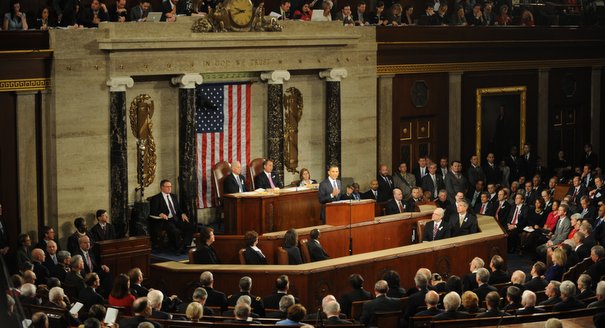
Source: Getty
Democracies everywhere—from the oldest and most mature, to the youngest and least institutionalized—are showing a surprising common feature.
Source: Atlantic
Today, polarized electorates are the norm, and their votes offer no clear mandate to any party or candidate. That political conflict can result in full out governmental paralysis comes as no surprise… in Italy. Less so in the United States. But it does happen here too; and it is safe to assume that America's most recent "governance accident" won't be the last.
Nor was it the first. Between 1976 and 1996, the U.S. government shutdown 17 times, always a result of partisan gridlock. And while none of these shutdowns lasted more than three weeks, none occurred in a political environment as bitterly divided as the one we’re living in today.
We now know how it works: a minority group wins just enough votes to have sufficient Congressional representation to twist, postpone, water-down or even stop governmental action. These minority groups may not have the power to impose their views but have just enough power to veto the agenda of the majority.These disrupters have no interest in helping govern the nation; their goal is to undermine or altogether block the initiatives of their political rivals and ensure their failure. And they justify the “collateral damage” of their belligerence in terms of noble-sounding national causes—from curbing intrusive government to stopping its wasteful ways, and from protecting the middle class to battling corruption. Raising the flag of the common good, divisive leaders deftly obscure the fact that they and their close allies are the primary beneficiaries of their obstructionism. This is happening not just in Italy or the United States. "Governance accidents" that paralyze national governments have become a global trend. Democracies around the world are becoming more and more "Italian.”
Democracies everywhere—from the oldest and most mature, to the youngest and least institutionalized—are showing a surprising common feature: It is increasingly rare that a presidential candidate trounces his opponent. Elections won by a landslide are endangered species. They still happen occasionally, but the prevalent trend is that wherever free and fair elections take place, the margins of victory are shrinking. Increasingly, elections are won by a hair.
Today, polarized and fragmented electorates are the norm, and their votes offer no clear mandate or dominant position to any party or candidate. This is why so many countries are governed by complex, cumbersome, and unstable coalitions formed by political groups whose members often have little in common and in some extreme cases are even bitter rivals.
As I have noted elsewhere, in 2012, among the 34 members of the “rich nations club,” the Organization for Economic Co-operation and Development, only four featured a government that also had an absolute majority in parliament. In India, 35 parties shared seats in the 2009 election; no party has won an absolute majority since 1984. In fact, absolute majorities are globally on the wane. In electoral democracies, minority parties have won on average more than 50 percent of the seats in parliament throughout the postwar period; in 2008, minority parties controlled 55 percent of seats on average. But even in countries that are not deemed democracies, minority parties are increasing their clout. In those countries, minority parties held fewer than 10 percent of seats three decades ago; now their average share has risen to nearly 30 percent.
Politics in the United States have been polarizing for decades. But as Nate Silver has shown, the current level of polarization is unprecedented. He attributes it to the fact that the Republicans have radicalized their political positions more intensely and at a faster clip while the Democrats have been shifting to the left far more gradually. But perhaps most important is the fragmentation within the two American parties and the fact that their leaders no longer have the power to enforce a common posture or partisan discipline among their more militant factions. Recorded for posterity are the television scenes of John McCain and other exasperated Republican leaders imploring Ted Cruz and his radical Tea Party colleagues to abandon the obstinacy of a stance that clearly damaged the party and—had it succeeded—would have dealt a severe blow to the U.S. economy and would have surely sent destabilizing shock waves overseas.
Frank Fukuyama has named this tendency a vetocracy, which is to say a political system plagued by groups, or even individuals, with the ability to veto the actions of their political rivals. Too many can stop the game, but very few can win. Who has the power to make decisions or pass initiatives?
The forces behind the vetocracies are many and varied—from economic crises that erode standards of living and raise voter frustration to the frequent political and governmental corruption scandals; from the communication and information revolutions to changing demographics. Political dysfunction feeds on all of these forces, which now define the political landscape of most of the world's democracies. As Americans have been discovering, the dysfunction engendered by the proliferation of political players with the capacity to shutdown the government is very damaging, affects everyone and, in some cases, may even spill over and affect other countries. The surprise is that this havoc can be caused by very small groups. Power is changing in surprising and little-understood ways.

Distinguished Fellow
Moisés Naím is a distinguished fellow at the Carnegie Endowment for International Peace, a best-selling author, and an internationally syndicated columnist.
Recent Work



Rosa Balfour, Frances Z. Brown, Yasmine Farouk, …
Moisés Naím
Carnegie India does not take institutional positions on public policy issues; the views represented herein are those of the author(s) and do not necessarily reflect the views of Carnegie, its staff, or its trustees.

On the last day of the India AI Impact Summit, India signed Pax Silica, a U.S.-led declaration seemingly focused on semiconductors. While India’s accession to the same was not entirely unforeseen, becoming a signatory nation this quickly was not on the cards either.

Konark Bhandari

This piece examines India’s response to U.S. sanctions and tariffs, specifically assessing the immediate market consequences, such as alterations in import costs, and the broader strategic implications for India’s energy security and foreign policy orientation.

Vrinda Sahai

On July 30, 2025, the United States announced 25 percent tariffs on Indian goods. While diplomatic tensions simmered on the trade front, a cosmic calm prevailed at the Sriharikota launch range. Officials from NASA and ISRO were preparing to launch an engineering marvel into space—the NASA-ISRO Synthetic Aperture Radar (NISAR), marking a significant milestone in the India-U.S. bilateral partnership.

Tejas Bharadwaj
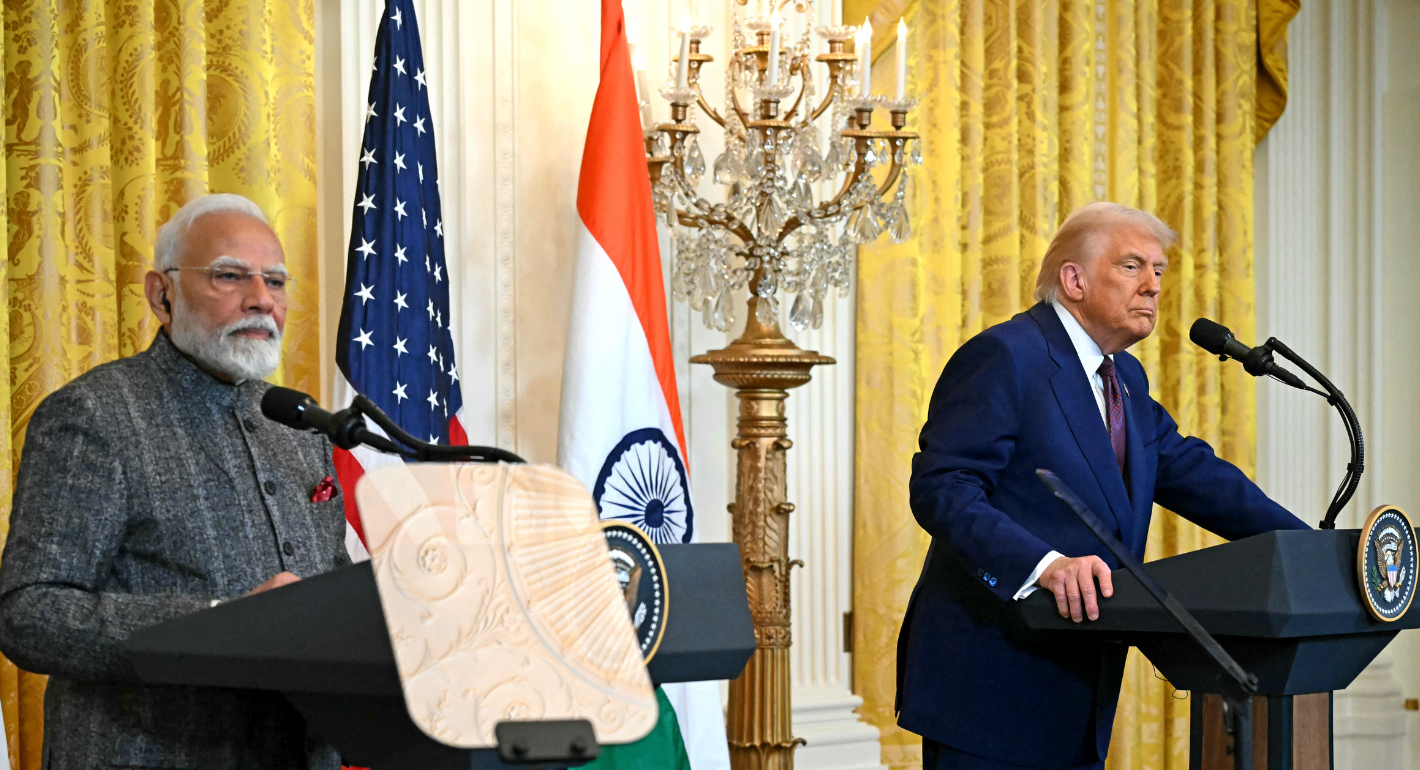
The India-U.S. relationship currently appears buffeted between three “Ts”—TRUST, Tariffs, and Trump.
Arun K. Singh

As part of the TRUST initiative, leaders of the two countries committed to building trusted and resilient supply chains, including for semiconductors and critical minerals. India and the United States have made steady progress in this area over the years. This essay explores the takeaways from discussions on semiconductor supply chains that took place at Carnegie India’s 9th Global Technology Summit.
Konark Bhandari