

In The Media
Lilia Shevtsova
{
  "authors": [
    "Lilia Shevtsova"
  ],
  "type": "commentary",
  "centerAffiliationAll": "",
  "centers": [
    "Carnegie Endowment for International Peace",
    "Carnegie Russia Eurasia Center"
  ],
  "collections": [],
  "englishNewsletterAll": "",
  "nonEnglishNewsletterAll": "",
  "primaryCenter": "Carnegie Russia Eurasia Center",
  "programAffiliation": "",
  "programs": [],
  "projects": [],
  "regions": [
    "Russia",
    "Eastern Europe",
    "Ukraine"
  ],
  "topics": [
    "Foreign Policy"
  ]
}
Source: Getty
The Vilnius summit may be successful only if Europe analyzes the Ukrainian lesson and the EU’s own strategic faults, and if it decides to reinvent its current Eastern Partnership model.
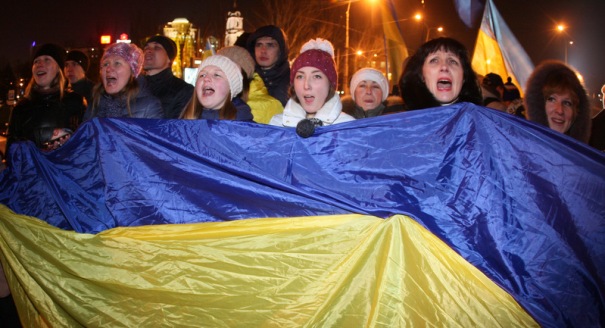
Indeed, the Association Agreement (AA) that the EU planned to sign with Ukraine this week in Vilnius did not guarantee Ukraine integrating with Europe any time soon. However, this step could have been an important benchmark that would have signified that Ukrainians have finally chosen their strategic vector—the movement toward liberal democracy. The official Kiev has decided in favor of a pact with Vladimir Putin’s Kremlin instead.
The political and analytic community together with media are unanimous in explaining what went wrong: Viktor Yanukovych has surrendered to Putin’s pressure. Besides, the Ukrainian leader stands to gain personally from his surrender— the European norms would have hardly allowed him to reproduce his power indefinitely. Yet this is not the whole truth. There is a third party that has played its role in the Ukrainian drama. I mean the European Union. I would argue that not only the EU efforts to embrace Ukraine were not sufficient, its integration agenda is hardly convincing and the implementation mechanism of this agenda is dubious. Moreover, today the EU itself lacks a well-defined trajectory and a clear understanding of where it is going, resembling a retirement home, and is thus not an attractive role model.
Anyway, there is no doubt about Putin’s role in Ukraine’s “about-turn” and Yanukovych’s game. But what about the EU integration strategy and the effectiveness of the Eastern Partnership model?
The Polish and Swedish initiative to create the Eastern Partnership (EaP) was no doubt a positive step, proving that at least these two countries care about what is happening in the eastern part of Europe. But the structure that emerged after going through the Brussels “pipeline” appears to be based on incompatible goals, which led to its inevitable paralysis. First, the EaP became hostage to the EU’s reluctance to irritate Russia. Second, Brussels focused on cooperation with authoritarian or semi-authoritarian governments hoping that they would embrace the integration and normative agenda (!). Third, the bureaucratic and technocratic approaches prevailed. Fourth, the EU has failed to persuade the Ukrainian society that there are long-term dividends that could help Ukraine to successfully cross the “valley of tears” of its transformation.
The main goal of the EaP is “to create the necessary conditions to accelerate political association and further economic integration between the European Union and interested partner countries.” In the process of their cooperation, Association Agreements that focus on the three areas of cooperation have to be signed: political association and economic integration, mobility of people, and stronger sector cooperation. But just as was the case with the EU-Russia partnership, while the mechanisms to develop the EaP were being created the bureaucratic machine that serves the interests of the European bureaucracy and the state apparatus of non-democratic states has emerged. Instead of encouraging the new rules of the game in the sphere of administration and government, the EaP effectively became a support factor for the initiatives spearheaded by predominantly undemocratic and illiberal regimes. Moreover, as the Ukrainian case has reconfirmed, the leaders of the EaP member states have other expectations of the EU promise—economic integration as the first step toward political transformation and acceptance of the European norms.
The situation borders on absurd. For instance, authoritarian governments receive rule of law funding from the EU, while they have no intention to respect the rule of law. What successful reforms entitle Baku to receive “soft” loans from Europe? Why is the Belarusian delegation going to the Vilnius summit when Belarus is turning into a totalitarian state? Did the EU really expect that Yanukovych would reject the “selective justice” and would have Tymoshenko as his rival during the forthcoming presidential elections? Finally, to what extent will the free trade agreements and visa facilitation help the EaP members move toward the European standards of liberal democracy?
Some forces inside the EU and the EaP member countries hoped that the model would become a bridge between Europe and Russia, but this did not happen. While some still continue to say that the EaP membership is not incompatible with being a member of Russia’s Eurasian Union, the Kremlin made it abundantly clear that the neighboring countries will have to choose between Russia and Europe. And the Kremlin is right, since the EaP and Eurasian Union are predicated on different principles. Hence, no matter how much Brussels is trying to avoid zero-sum politics with regard to Russia, it is inevitable given the fact that Moscow adheres to a different set of values and demands that its neighbors put an end to their past ambivalence. They can no longer try to be partners with both Moscow and Europe at the same time.
If Europe proceeds in this bureaucratic mode, rejecting moral dimensions and trying to play geopolitical games, it is bound to lose to Moscow in the struggle for influence over the new independent states. Thus, Europe has to choose a new strategy.
What will it be? Here are a few approaches to formulating the new EaP model:
The Vilnius summit may be successful only if it analyzes the Ukrainian lesson and the EU’s own strategic faults, and if it decides to reinvent its current Eastern Partnership model that in reality has become the game “Let’s Pretend!”
The Ukrainian saga continues to unfold. Yanukovych will pathetically fail in his attempts to pursue previous tactics of “riding two horses in opposite directions,” that is vacillating between Europe and Moscow. Putin’s Kremlin will demand to make a choice, and leaning toward Russia will mean for the Ukrainian leader accepting the role of a Russia’s lap dog. Meanwhile, the Kremlin is taking responsibility for future Ukrainian problems and it could help those in Ukraine who still hesitate about where to move get rid of their doubts. True, they will have to pay a price for overcoming their illusions.
Luckily, the Kremlin and Putin are doing and will continue to do everything to force Brussels to come out of its political lethargy and start moving.
Former Senior Associate, Russian Domestic Politics and Political Institutions Program, Moscow Center
Shevtsova chaired the Russian Domestic Politics and Political Institutions Program at the Carnegie Moscow Center, dividing her time between Carnegie’s offices in Washington, DC, and Moscow. She had been with Carnegie since 1995.
Recent Work
Lilia Shevtsova
Lilia Shevtsova
Carnegie India does not take institutional positions on public policy issues; the views represented herein are those of the author(s) and do not necessarily reflect the views of Carnegie, its staff, or its trustees.

After the chill in ties between 2020 and 2024 that brought India–China relations to their lowest point in several decades, the two countries have engaged each other afresh. This paper argues that there are predominantly four imperatives guiding India’s approach to China, and they exist in an order of priority.

Saheb Singh Chadha

This piece argues that India’s central challenge is not managing a single flashpoint but resolving the underlying tension between expansion and institutional coherency of the BRICS grouping.

Vrinda Sahai

A partnership between India, a country of subcontinental size, and Africa, a continent of fifty-four countries, may seem asymmetric until one notes that both are home to nearly the same number of people—1.4 billion. This essay spells out the existing challenges to the partnership, its optimal potential, and the possible pathways to realize it over the next quarter-century.

Rajiv Bhatia

The India–EU Free Trade Agreement (FTA) is shaping up to be one of the most consequential trade negotiations, both economically and strategically. But, what’s in the agreement, what’s missing, and what will determine its success in the years ahead
Vrinda Sahai, Nicolas Köhler-Suzuki

Trump 2.0 has unsettled India’s external environment—but has not overturned its foreign policy strategy, which continues to rely on diversification, hedging, and calibrated partnerships across a fractured order.



Milan Vaishnav, ed., Sameer Lalwani, Tanvi Madan, …