

Article
C. Raja Mohan, Darshana M. Baruah
{
  "authors": [
    "C. Raja Mohan"
  ],
  "type": "legacyinthemedia",
  "centerAffiliationAll": "dc",
  "centers": [
    "Carnegie Endowment for International Peace",
    "Carnegie India"
  ],
  "collections": [],
  "englishNewsletterAll": "ctw",
  "nonEnglishNewsletterAll": "",
  "primaryCenter": "Carnegie India",
  "programAffiliation": "SAP",
  "programs": [
    "South Asia"
  ],
  "projects": [],
  "regions": [
    "South Asia"
  ],
  "topics": [
    "Political Reform",
    "Democracy",
    "Security"
  ]
}
Source: Getty
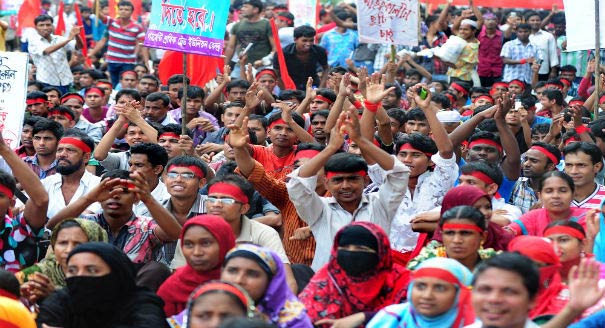
The continuing violence in Bangladesh and the political cloud over the general elections scheduled for January are of great consequence for the entire subcontinent.
Source: Indian Express
The continuing violence in Bangladesh, following the execution of Islamist leader Abdul Quader Mollah, and the political cloud over the general elections scheduled for January 5 are of great consequence for the entire subcontinent.
That Bangladesh is deeply divided on these issues is not in doubt. If many in Bangladesh have welcomed the execution of Mollah, a leader of the Jamaat-e-Islami, as long overdue, radical groups have gone on the rampage. Mollah was convicted by a war crimes tribunal of murdering a family of 11 and aiding the Pakistan army in killing 369 people. The divide in Dhaka has fed into the bitter rivalry between the Awami League, led by Sheikh Hasina, and the Bangladesh Nationalist Party, led by Khaleda Zia, that has long undermined political stability in the nation and limited the realisation of its vast economic potential.The current violence is also about two very different conceptions of Bangladesh — Hasina swears by secularism and ethnic nationalism; Zia is now in the thrall of the Jamaat-e-Islami, which collaborated with the Pakistan army in the genocide against Bengalis in 1971, and other extremist groups that seek to bring the nation under the sway of political Islam. Those who joined the Pakistan army in mass murder should have been brought to justice long ago. The political twists and turns in Bangladesh over the last four decades gave much impunity to those who participated in the genocide. After her massive victory in 2010, Hasina formed a war crimes tribunal to bring the collaborators to justice.
The unfolding developments in Bangladesh are not just internal to the country. They are about a troubled history that binds the subcontinent — the liberation of Bangladesh from the clutches of the Pakistan army by Indian forces in 1971. It is also about the political future of the subcontinent. As extremists took to the streets in Bangladesh, their ideological kin in Pakistan were quick to react. Hafiz Mohammad Saeed, chief of the Lashkar-e-Taiba, now going by the name of Jamaat-ud-Dawa, led the funeral prayers in Multan for Mollah and accused India of being a part of the conspiracy to eliminate "Pakistan lovers" in Bangladesh.
The Pakistan National Assembly passed a resolution condemning the execution of Mollah. Pakistan's interior minister, Chaudhry Nisar Ali Khan called it the "judicial murder" of a man who had stood for the unity of Pakistan. The struggle for justice in Dhaka has become intertwined with the general elections. Hasina has formed an all-party government in the run up to the elections. Her opponents are demanding her resignation and the establishment of a neutral government before the elections are held. The Awami League had amended the constitutional provision calling for a neutral caretaker government for three months before elections.
Because the BNP has boycotted the elections, many candidates of the Awami League and its allies are likely to win unopposed. Hasina might well get a two-thirds majority if the election proceeds as planned. Meanwhile, the Jamaat and the BNP are determined to disrupt the process, rob the elections of their legitimacy and make it impossible for the next government to function. Some in the West and in Bangladesh have criticised the work of the war crimes tribunal on technical grounds. The United States and European countries have said that the non-participation of major parties like the BNP is bound to diminish the political credibility of the elections. International efforts, including by the UN, to resolve the differences between the Awami League and the BNP have failed.
There is, indeed, another way of looking at the current dynamic in Bangladesh — as part of a larger struggle in the subcontinent between the forces of moderation and modernisation on one hand, and those who want to push the region towards religious extremism on the other. At one end of the subcontinent, in Afghanistan, the Taliban, with the support of the Pakistan army, is poised to strike at the Afghan people after the international community withdraws troops in 2014. In Islamabad, the Nawaz Sharif government appears to have no political stomach to confront the militant Tehreek-e-Taliban Pakistan, which seeks to overthrow the state and establish an Islamic order.
For its part, India would have liked to have stayed away from the current controversy in Bangladesh. In the recent elections in the Maldives and Nepal, India has consciously avoided becoming an issue. Delhi has signalled its determination to do business with whoever is in power while supporting democratic processes. In Bangladesh, it has encouraged the BNP to participate in the elections without much effect. Despite its muted tone, many see Delhi as a partisan supporter of the Awami League. Neutrality will not help India escape the political fallout from the current turmoil in Bangladesh. India's eastern frontier has seen much calm in recent years, thanks to Dhaka's determined fight against extremism on its own soil and its unstinting support to India in combating cross-border terrorism. This could well be reversed if the Islamist groups backed by Pakistan's ISI gain ground in Bangladesh.
Some have argued that a more accommodative posture on Hasina's part could have moderated the Jamaat and the BNP. Others would cite the recent experience in Egypt, where political power did not change the nature of the Muslim Brotherhood. The academic argument can go on, but the die has been cast in Dhaka for a definitive contest between the forces of progress and regression. The outcomes from the struggle for justice in Bangladesh, the battle to rescue its history and the war for preserving its secular ethos, are likely to have a lasting impact on the subcontinent's political future and India's regional security environment. It is time Delhi's political classes paid some serious attention to the developments in Bangladesh.
This article was originally published in the Indian Express.
Former Nonresident Senior Fellow, Carnegie India
A leading analyst of India’s foreign policy, Mohan is also an expert on South Asian security, great-power relations in Asia, and arms control.
Recent Work

C. Raja Mohan, Darshana M. Baruah


Alexander Gabuev, Paul Haenle, C. Raja Mohan, …
Carnegie India does not take institutional positions on public policy issues; the views represented herein are those of the author(s) and do not necessarily reflect the views of Carnegie, its staff, or its trustees.

In any defense establishment, change is an ongoing process. However, despite the best of intentions, existing bureaucracies, bound by habit and years of socialization, have their limits in implementing transformative change.

Anit Mukherjee

After the chill in ties between 2020 and 2024 that brought India–China relations to their lowest point in several decades, the two countries have engaged each other afresh. This paper argues that there are predominantly four imperatives guiding India’s approach to China, and they exist in an order of priority.

Saheb Singh Chadha

This piece argues that the present Indian strategy, based on opportunistic diversification and utilization of limited strategic reserves, remains inadequate when confronting supply disruptions. It evaluates India’s options in the short, medium, and long terms.

Vrinda Sahai

Trump 2.0 has unsettled India’s external environment—but has not overturned its foreign policy strategy, which continues to rely on diversification, hedging, and calibrated partnerships across a fractured order.



Milan Vaishnav, ed., Sameer Lalwani, Tanvi Madan, …

This piece examines India’s response to U.S. sanctions and tariffs, specifically assessing the immediate market consequences, such as alterations in import costs, and the broader strategic implications for India’s energy security and foreign policy orientation.
Vrinda Sahai