

Commentary
Dmitri Trenin
{
  "authors": [
    "Dmitri Trenin"
  ],
  "type": "commentary",
  "centerAffiliationAll": "",
  "centers": [
    "Carnegie Endowment for International Peace",
    "Carnegie Russia Eurasia Center"
  ],
  "collections": [],
  "englishNewsletterAll": "",
  "nonEnglishNewsletterAll": "",
  "primaryCenter": "Carnegie Russia Eurasia Center",
  "programAffiliation": "",
  "programs": [],
  "projects": [],
  "regions": [
    "Russia"
  ],
  "topics": [
    "Political Reform",
    "Security"
  ]
}
Source: Getty
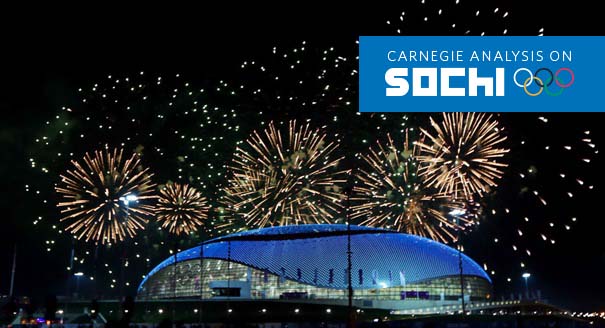
Although Russia has failed to get at the Winter Olympics the one prize it particularly coveted, the ice hockey title, it managed to win a far more important victory—in ensuring that the Games, the athletes, and spectators were safe. However, making Russia safer remains a challenge.
Although Russia has failed to get at the Winter Olympics the one prize it particularly coveted, the ice hockey title, it managed to win a far more important victory—not in the overall medals count, although it counts—but in ensuring that the Games, the athletes and spectators were safe.
With so many worries just before the Olympics, all made credible by the terrible double suicide attacks in Volgograd on New Year's Eve, this was a feat that particularly deserves recognition. We may never know how realistic the threat of terrorist attack actually was, but the Russian security services did their very best.
They were certainly motivated by President Vladimir Putin's constant, intense and very personal attention to the issue, but it must also be that the services have learned a lot in the last decade and a half. Their level of professionalism has definitely improved, as far as counter-terrorism is concerned, even if counter-insurgency— for example, in Dagestan—still underperforms.
Keeping Sochi safe for the Olympics has been highly important, but, with the Games over, making Russia safer remains a challenge. Rising to that challenge requires embedding counter-insurgency within a broader political and economic strategy for the North Caucasus, and preventing terrorist attacks demands a much higher degree of mutual confidence between the law enforcers and ordinary citizens.
Former Director, Carnegie Moscow Center
Trenin was director of the Carnegie Moscow Center from 2008 to early 2022.
Recent Work
Dmitri Trenin
Dmitri Trenin
Carnegie India does not take institutional positions on public policy issues; the views represented herein are those of the author(s) and do not necessarily reflect the views of Carnegie, its staff, or its trustees.

In any defense establishment, change is an ongoing process. However, despite the best of intentions, existing bureaucracies, bound by habit and years of socialization, have their limits in implementing transformative change.

Anit Mukherjee

After the chill in ties between 2020 and 2024 that brought India–China relations to their lowest point in several decades, the two countries have engaged each other afresh. This paper argues that there are predominantly four imperatives guiding India’s approach to China, and they exist in an order of priority.

Saheb Singh Chadha

This piece argues that India’s central challenge is not managing a single flashpoint but resolving the underlying tension between expansion and institutional coherency of the BRICS grouping.

Vrinda Sahai

This piece argues that the present Indian strategy, based on opportunistic diversification and utilization of limited strategic reserves, remains inadequate when confronting supply disruptions. It evaluates India’s options in the short, medium, and long terms.
Vrinda Sahai

This piece examines India’s response to U.S. sanctions and tariffs, specifically assessing the immediate market consequences, such as alterations in import costs, and the broader strategic implications for India’s energy security and foreign policy orientation.
Vrinda Sahai