

In The Media
Lilia Shevtsova
{
  "authors": [
    "Lilia Shevtsova"
  ],
  "type": "commentary",
  "centerAffiliationAll": "",
  "centers": [
    "Carnegie Endowment for International Peace",
    "Carnegie Russia Eurasia Center"
  ],
  "collections": [],
  "englishNewsletterAll": "",
  "nonEnglishNewsletterAll": "",
  "primaryCenter": "Carnegie Russia Eurasia Center",
  "programAffiliation": "",
  "programs": [],
  "projects": [],
  "regions": [
    "Russia"
  ],
  "topics": [
    "Political Reform"
  ]
}
Source: Getty
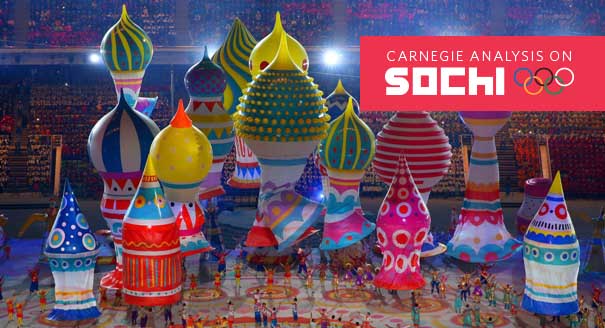
The Sochi Olympics are the Kremlin’s attempt to create the fairy tale myth of Russia that does not exist.
I think that despite the mocking depictions of unfinished Sochi hotels that lack running water and sport cracks in the walls, the Kremlin will succeed in creating the image of the Fairy Tale Russia. And millions of TV viewers will actually believe in this fairy tale. Its creators will use sporting events and glittering shows to amaze millions of people—both in Russia and overseas—and get them hooked on Russia’s great-power mystique. But people will be amazed by Putin’s Russia—the country that belongs to the Kremlin and its main resident.
After watching the Olympics’ opening ceremony—a 3-hour long spectacle that featured 5,000 participants—many of my friends told me in unison: “This is the most brilliant performance I have ever seen!” They are not President Vladimir Putin’s admirers at all; nevertheless, they were amazed. Actually, this is exactly what the Kremlin political strategists want. They did not need a performance that glorified Putin. The show that they created sought to engender patriotic sentiments, which can always be exploited to the regime’s and state’s advantage.
But the opening ceremony was indeed a fairy tale—an artists’ myth of Russia that does not exist. The popular Russian joke that proclaims Russia to be the elephants’ birthplace which means that Russia is an embodiment of absurdities is actually about the Olympic Russia. It is the place you cannot really find in reality. It is the Potemkin village that the Russian elite have become so experienced in building through the centuries.
The real Russia is quite another animal. It is the first in the world when it comes to:
At the same time, Russia is also first when it comes to generals, billionaires, direct individual investment in foreign countries, as well as whiskey imports.
Welcome to the Sochi Olympics!
Former Senior Associate, Russian Domestic Politics and Political Institutions Program, Moscow Center
Shevtsova chaired the Russian Domestic Politics and Political Institutions Program at the Carnegie Moscow Center, dividing her time between Carnegie’s offices in Washington, DC, and Moscow. She had been with Carnegie since 1995.
Recent Work
Lilia Shevtsova
Lilia Shevtsova
Carnegie India does not take institutional positions on public policy issues; the views represented herein are those of the author(s) and do not necessarily reflect the views of Carnegie, its staff, or its trustees.

This piece argues that India’s central challenge is not managing a single flashpoint but resolving the underlying tension between expansion and institutional coherency of the BRICS grouping.

Vrinda Sahai
As India’s economy recovers from the coronavirus pandemic, Indian businesses need efficient financial structures to regain their ground. Key reforms to India’s Insolvency and Bankruptcy Code could fill these gaps.

Anirudh Burman
Access to cross-border data is an integral piece of the law enforcement puzzle. India is well placed to lead the discussions on international data agreements subject to undertaking necessary surveillance reforms.

Smriti Parsheera, Prateek Jha
After the coronavirus pandemic wanes, how will China’s reorientation of the Belt and Road Initiative to address global health concerns influence its relationships with South Asian countries?
Deep Pal, Rahul Bhatia
Early in the outbreak, government researchers forecast several high-risk scenarios that were downplayed or ignored in public messaging.
Gautam I. Menon